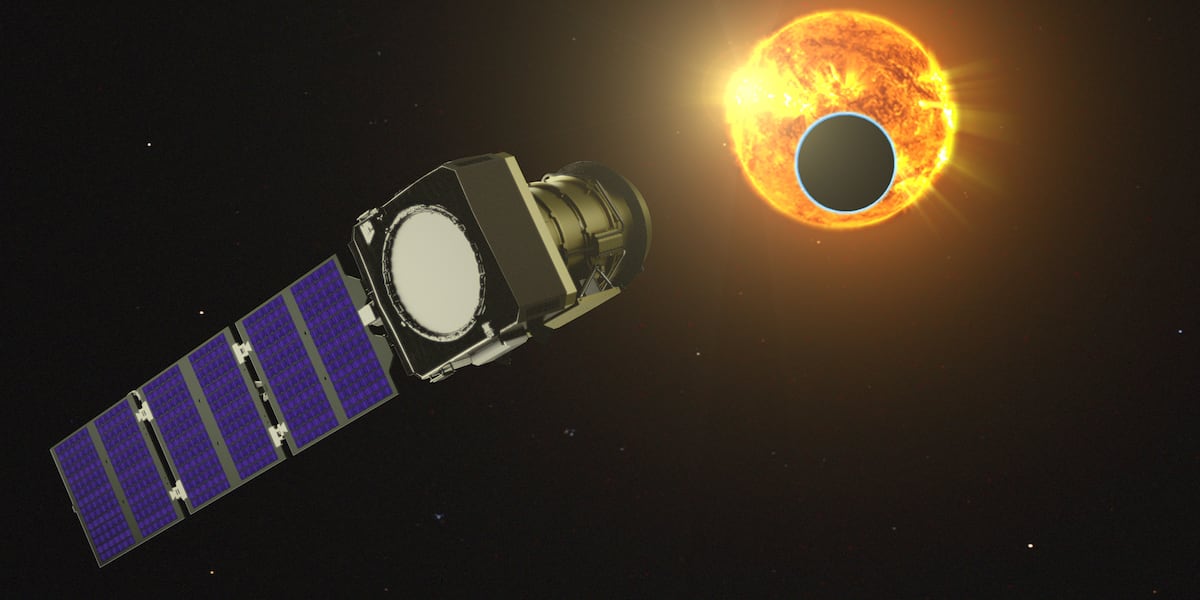
TUCSON, AZ (AZFamily) — After years of planning, the University of Arizona’s latest satellite is ready to blast off and study planets outside of our solar system.
Scientists said Pandora was mounted this week inside the launch rocket, which is a SpaceX Falcon 9. The satellite, the size of a refrigerator, now waits for clear weather at the Vandenberg Space Force Base in California when the launch window opens at 6:19 a.m. on Sunday. You can watch a livestream of the launch by clicking/tapping here.
UofA said Pandora will study the atmospheres of at least 20 planets orbiting distant stars, including to see if they have hazes, clouds and water. It’ll stare at each of the planets and host stars for 24 hours at a time before moving on to the next and repeating the process for 10 observations for each system.
The satellite has a powerful telescope with an 18-inch mirror and specialized sensors that can “split” light into its colors and measure how bright something is with great precision. That’s how it’ll analyze the chemical makeup of a star and the planets’ atmospheres.
Pandora will help interpret data from previous missions like NASA’s Kepler Space Telescope, the agency’s first planet-hunting mission, and ongoing missions such as the James Webb Space Telescope, which is the largest telescope in space.
“Pandora opens a new chapter in exoplanet science, and it will guide future projects in their search for habitable worlds,” Daniel Apai, the UofA lead of the mission and its exoplanet science team, said in a news release.
Once the satellite passes all its tests and reaches its orbit, UofA’s Multi-Mission Operation Center will run the mission.
“This is the first time an orbiting astrophysics mission is operating from our new Mission Operations Center at the university,” said Erika Hamden, director of the Arizona Space Institute. “The PHOENIX Mars Lander and the OSIRIS-REx asteroid sample return mission were operated very successfully from the U of A, and now we’re excited to continue that legacy with Pandora. We hope this represents just the first of many transformational NASA missions that ASI will operate out of the Advanced Research Building.”
See a spelling or grammatical error in our story? Please click here to report it.
Do you have a photo or video of a breaking news story? Send it to us here with a brief description.
Copyright 2026 KTVK/KPHO. All rights reserved.