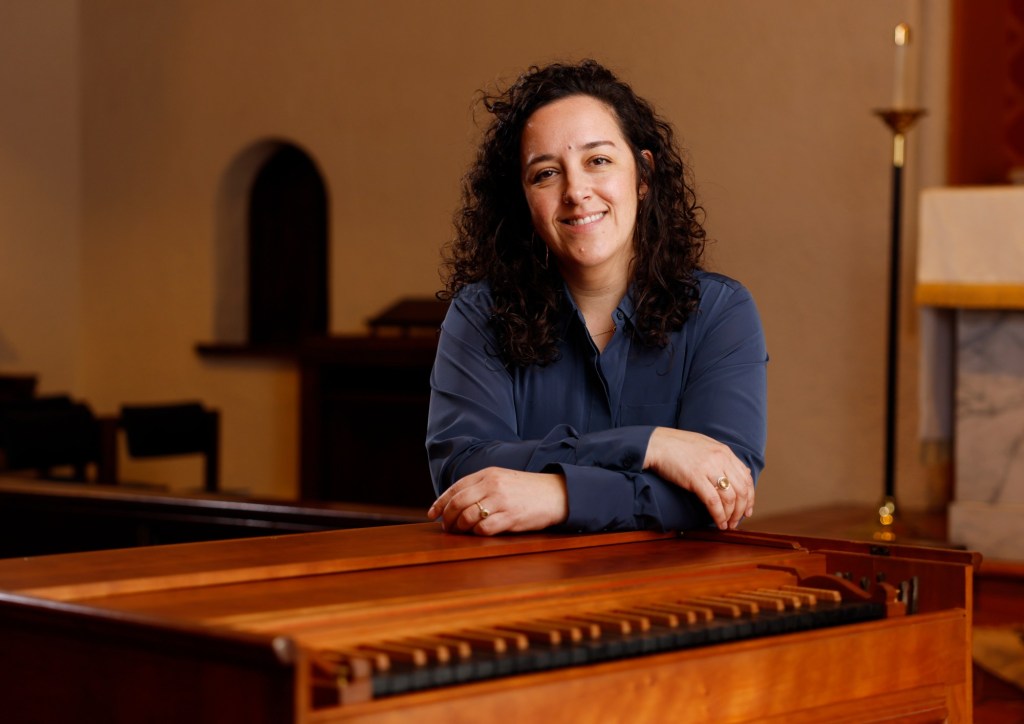
Early music — the kind defined as being from the medieval, Renaissance and Baroque time periods — reminded Pamela Narbona Jerez of home. As a girl growing up in Santiago, Chile, she sang in the choir at her all-girls Catholic school, continuing to sing and perform in this style of music after graduating.
“Then, I moved to the U.S. in my 20s, and the first thing I did was to try to find ensembles that did this music. The collaboration with the other singers was very moving to me. The soundscape sounds like home. I have other musical tastes outside of it, but I always return to it,” she says.
That return has included joining the San Diego Early Music Society, first as a volunteer board member, and currently as the organization’s executive director. The nonprofit, which was started in the 1980s, presents early music concerts that feature about half a dozen main performances each year, along with a solo series featuring another three to four concerts (their solo series for the 2025-26 season begins with Corina Marti and Michal Gondko on Jan. 18 at St. Paul’s Episcopal Cathedral). Their outreach program features primarily local musicians, workshops and community events that are free to the public by way of a grant from the city of San Diego. Most of the concerts take place at St. James by-the-Sea Episcopal Church in La Jolla, All Souls’ Episcopal Church in Point Loma and St. Paul’s Episcopal Cathedral.
Narbona Jerez, 45, earned degrees in vocal performance and musicology from San Diego State University and lives in Bonita. She works in instructional design when she’s not managing the music nonprofit, and took some time to talk about the creativity, collaboration, and improvisation that she enjoys about early music.
Q: Tell us about the San Diego Early Music Society.
A: Our purpose is to present early music. Early music is a little different from what you get to hear at the opera or with the symphony, even though they will feature “early music,” we specialize in that era and feature musicians who use historical performance practices and, at times, historical instruments or replicas of historical instruments. We’ve had people come and perform with instruments that were built in the 1700s, so it’s sort of like a working museum and a little bit of archeology. We want to promote that music, specifically, and to do that we bring top artists from North America and Europe, primarily, to come to San Diego and perform. These are folks that are winning awards and they’re just at the top of their game. The idea is just to present this music and to engage in conversation with our audience or with the people who attend our outreach programs, as well.
What I love about Bonita…
Bonita is great, it really is. I lived in Central San Diego for 20 years, so I was always in Clairemont or Linda Vista or Bay Park, and I thought I never wanted to leave because it’s so central. Then, I moved to Bonita three years ago, and this sounded like the end of the world to me because all of my concerts were up north, but it is so beautiful here. There are a lot of green spaces, so you can hike all day, it’s very walkable, there are golf courses. Now that I live here I would really love to bring some of our outreach here because Southwestern College is nearby, the Bonita library is small, but it’s great. This has been a whole discovery. I really love it here.
Q: What is it about this style of music that appeals to you? What do you enjoy about it?
A: It’s very creative. When you’re a performer — I’m a singer and performer — when you have to perform a piece, they give you sheet music and there are indications for how you have to perform it. You have some wiggle room, some room for creativity, but for the most part there’s a way of performing or a way of doing. Early music is different. It allows for a lot of creativity on the part of the performer, a lot of exploration. It’s a very curiosity-driven genre because a lot of the music that these folks perform is being sort of reconstructed from pieces that were lost or that were found recently, or the score was missing, or part of it was missing. Also, the score doesn’t have all of the indications on the page; it’s sort of like a jazz chart in the way jazz musicians use notation, so it allows for a lot of improvisation. That part really appealed to me.
There’s a piece that everybody plays; it’s been hundreds of years that people have been performing this piece and it’s called “La Follia.” Everybody does it differently, so you can recognize it and you know what it is, what it sounds like, but it’s always different. That’s the biggest appeal of early music, to me, that it’s very flexible and it’s very interdisciplinary. For example, if you’re playing music from the Middle Ages, medieval music is very connected to medieval cosmology, so there’s all of this context that you can have that makes it very rich. It’s the same for Renaissance music. You will have to sort of understand what humanism was. Or, with Baroque, it’s ethics. So, there is this side of it that sounds very academic and very scholarly, and that can be very satisfying for somebody like me.
Q: How did you get your start in music and when did you know it was something you wanted to study and pursue professionally?
A: I think I always wanted to be a musician, but when I graduated high school in Chile that wasn’t really an option, so I went into journalism first. I wanted to be a writer like Gabriel Garcia Márquez. I really enjoyed that first year in journalism, but then the opportunity presented itself to move to the U.S. in 2001. I didn’t speak English at all, so when I moved here, journalism was not an option I could continue. I thought, maybe I’ll do music, so I think I enrolled at Palomar College, after it took me a bit to learn to speak well enough to go to college, I started majoring in music. I did vocal performance at San Diego State and, while I was there, I felt pretty confident about my English level at that time. I missed writing, I missed reading, and that side of me that was the little girl that wanted to be a journalist, so I switched to musicology, which is the perfect marriage of the two, music and writing. From there, I continued to do music on the side and develop a more editorial, professional side that would be my full-time job for a long time; and it continues to be while music is on the side.
Q: What is the best advice you’ve ever received?
A: To find a cause and serve it. Since I was little, my mandate was always to leave the world better than you found it. I was a Girl Scout and that’s kind of where it started, so serving a cause has been a very important thing in my life. I’ve done a lot of work for nonprofits in different areas, and it’s always been very rewarding, very challenging, because, of course, it’s volunteer work. You have to sort of fit it in between your paid work. So, it’s always challenging, but it’s always rewarding, and I’ve never regretted any of the things I’ve ever done for. Nonprofits, especially in the arts, for social causes, social justice causes, so finding a cause and serving it, that is the best advice.
Q: What is one thing people would be surprised to find out about you?
A: If they know me, they will be very surprised to know that I know how to code, how to do math because I never, ever thought I would be in a place where I could build a website, for example. It sounds very little, but it’s so far removed from what I thought I would be. I thought I was going to be a writer and a musician, and all of a sudden I’m sitting in front of a computer reading code and I love it because it’s sort of a syntax very close to a language, and so it’s very fun.
Q: Please describe your ideal San Diego weekend.
A: Anything outdoors. Some kind of a hike or a visit to the beach. I like (Mount) Woodson, myself; sometimes I would do Cowles. I like those long, very strange hikes. Because I live in Bonita, we have a lot of really, really good taco shops, so I would grab a taco. If you ever have a chance to go to Taco Machin, I highly recommend. They’re excellent. So, I’d grab a taco for lunch, and then we have so much good music and good art in San Diego, so I would go to a concert by one of my friends. I have a few favorites, like Project Link, they do a lot of amazing stuff. Or, Art of Elan, Master Chorale, any of those. If we (San Diego Early Music Society) had a concert, I would go to one of my concerts, obviously. Then, maybe close the evening with dinner in South Park or North Park or Convoy. That would be, for me, my ideal weekend: to start outdoors, finish with dinner, have music in the middle.