On one level, experts see the arrival of 372 beds at three new or expanding hospitals in Irvine as a welcome addition to Orange County’s effective but strained health care system.
Simply put, more beds – even when clustered in a slice of the county that, hospital-wise, is already well served – could lessen the load at the 30-plus big hospitals that pepper all of Orange County. That alone, experts say, could mean slightly faster and slightly better health care for everybody, not just for people living near the new beds.
“While the hospitals opening are in higher-income areas of Irvine, they could improve accessibility (throughout the county) in the long term if all hospitals in the area continue to operate at full capacity,” said Dylan Roby, a health equity expert who chairs the Department of Health, Science and Behavior at the UC Irvine Joe. C. Wen School of Population & Public Health.
But, on another level, the new beds are about more than medical Whack-a-Mole.
For one thing, they offer optimism in what is an otherwise bleak time for hospitals.
The beds in question – 144 at UCI Health, on Irvine’s west end, near Jamboree Boulevard and Campus Drive; 73 at City of Hope Orange County’s expansion on Irvine’s east side, on Sand Canyon Avenue; and 155 that will be available when Hoag Hospital expands its Irvine operations (also on Sand Canyon) later this year – are coming at a time when hospitals are far more likely to close than they are to open.
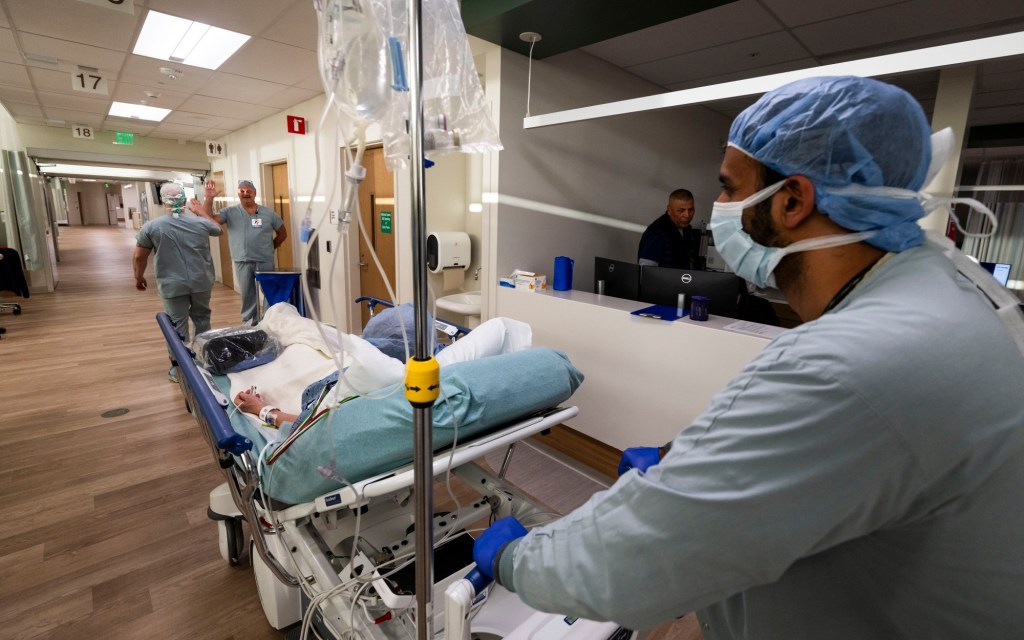
 City of Hope hospital opened for its first patients in Irvine, CA on Monday, December 1, 2025. (Photo by Paul Bersebach, Orange County Register/SCNG)
Two years ago, the California Hospital Association issued a report saying 1 in 5 hospitals statewide were at risk of closing down. Last year, a study by the General Accounting Office found that in urban parts of the country more hospitals closed than opened from 2019 through 2023, and that shuttered hospitals often led to worse health for people living in those areas. And from 2010 through 2020, the number of surgical hospitals in the United States fell by about 38%, a net loss of 298 facilities, according to the health data organization KFF. And, over a similar 10-year period, at least 100 hospitals closed in rural communities, according to a study by the Boston University School of Public Health.
Those trends are widely expected to accelerate, starting this year, as federal funding for health insurance is reduced.
Against that backdrop, any expansion of hospital services – even in a community with lots of high-income, well-insured households – runs counter to broader economic and political forces that are pushing health facilities to insolvency and transforming some communities into health care deserts.
Another factor is specialization.
All of the beds at City of Hope will be devoted to different types of cancer. Likewise, many of the new beds coming in Hoag’s Irvine expansion will be devoted to fighting cancers, while others will specialize in women’s health or digestive health.
Such specialization used to be rare, but health experts say that’s no longer true. As the overall population ages up, and as medical training becomes more intricate, specialized medicine has become more common than so-called “acute care,” or non-specialized, hospital services.
For all of those reasons, and more, health care experts say the new beds – and the hospitals they’ll be in – represent much of what’s good, bad and problematic for health care in Orange County.
“It’s great that we’re having that kind of investment – or any investment – in new hospitals, and not just for Orange County,” said Paul Young, senior vice president of public policy and reimbursement for the Hospital Association of Southern California.
“We’re approaching some very challenging times in the industry,” Young added. “So what you’re seeing in Orange County right now is unusual and welcome.”
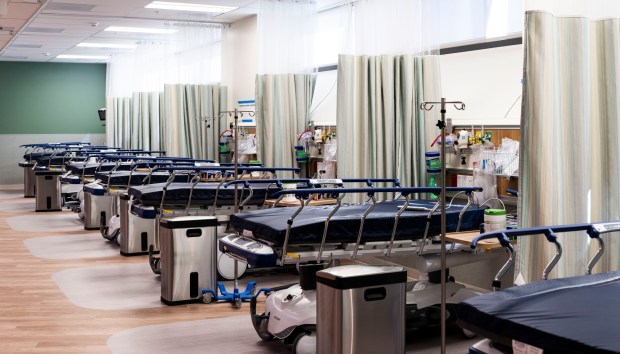 Beds in post-anesthesia care at the new UCI Health hospital in Irvine, CA on Thursday, November 6, 2025. (Photo by Paul Bersebach, Orange County Register/SCNG)
More is more
To understand the importance of 372 hospital beds in a county of nearly 3.2 million people, you need to consider a few other numbers related to the local health care system.
One is 6,600. That’s roughly how many licensed hospital beds there were in the county in mid-2025, before any of the new beds came online. People staying in those beds receive all manner of health services, from general surgical and illness recovery to specialty pediatric care or psychiatric care or long-term physical rehabilitation. The new openings will boost the county’s overall bed count by about 5.6%, to nearly 7,000.
“One of the reasons we like living here is that we can get to a hospital when we need to,” said Maryanne Albright, a 91-year-old Laguna Woods resident who recently was being treated for breathing problems at the Kaiser Hospital in Irvine.
“That’s probably true for a lot of my neighbors, too,” she added.
Yet even with the new beds, the county might be running something of a hospital deficit.
By late 2026, Orange County will have about 2.18 hospital beds for every 1,000 residents, well under the national average of 2.32 per 1,000 for similar urban communities.
Health experts and independent groups such as the National Institutes of Health note that there is no optimal number for hospital beds in a community. They add that bed counts shouldn’t be used as a proxy to measure the overall quality of health care.
Still, many experts also say having more hospital beds is better than having fewer.
“Every community needs to try to preserve hospital access,” said Young of the Hospital Association.
“Hospitals aren’t top of mind until you need one,” he added. “But at that point, they become a pretty big deal.”
In some ways, that’s already playing out in Orange County.
Last year, the county hosted 16,000 “in-patient stays,” or nights spent in a local hospital by somebody who lives in a different county, according to George W. Greene, chief executive of the Hospital Association of Southern California.
That number is likely to grow when the new beds come online.
Los Angeles and San Diego counties both have more hospital beds, per capita, than Orange County, so it’s not clear if many people from those counties travel when they need hospital care. But the bed-per-person rates in Riverside and San Bernardino counties are much lower than in Orange County, roughly 1.63 per 1,000 residents, and it’s likely that many inland residents use hospitals in Orange County.
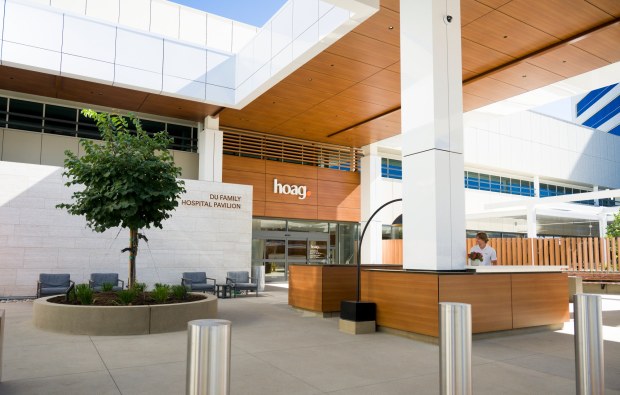 The newly redesigned front entrance at Hoag Hospital Irvine is part of the Sun Family Campus Expansion in Irvine on Wednesday, October 1, 2025. (Photo by Leonard Ortiz, Orange County Register/SCNG)
But access isn’t the only driver of that trend. The variety and quality of the medical care offered in Orange County often is, or at least is perceived to be, better than average.
“When you look at the issue of in-migration, of the county getting more (hospital patients) coming in than going out, you have to look at what’s available locally and compare it with what’s offered in the nearby communities,” Young said.
“In the Inland Empire communities, they don’t yet have a lot of the same services – the pediatric beds, the high-level procedures, the transplants – that you can get in Orange County.”
What’s more, Young and others say that as the federal government cuts back on health spending, getting access for even basic health services – such as having a child in a hospital – might force patients to travel.
“Hoag is already one of the busiest obstetric units in the state,” Young said.
“And that’s not all local.”
What the beds can’t fix
As strong as medical care is in Orange County, experts say it’s also stratified. Hospitals in the county’s lower-income, lower-insured communities don’t always offer the same level of care and service – everything from cleanliness to physician training – found at hospitals that serve the county’s wealthier communities.
But that’s not just an Orange County thing. Throughout the country, wealth translates into better health
Consider: In 2023, the average life expectancy in Virginia was 76.8 years, according to federal data. In West Virginia – the state literally next door – it was 71 years.
In Virginia, the 2023 median household income was about $90,000; in West Virginia, it was about $60,400.
So, does nearly $30,000 a year really equal about six extra years above ground? Health experts say yes, if only because people earning less are put at higher risk in everything from the jobs they perform to the air they breathe to how frequently they seek (or don’t seek) routine checkups.
The wealth-equals-health dynamic played out glaringly in Orange County during the pandemic.
According to county data, by the last days of the pandemic, in 2023, the running COVID-19 case rate was twice as high in Santa Ana as it was in Newport Beach, and the death rate was nearly three times as high. Similar discrepancies played out throughout the county, where people living in lower-income communities – even neighborhoods – were far more likely to catch, and sometimes die from, COVID-19 than their higher-income neighbors.
But, again, that’s not an Orange County-only story. Public health experts consistently have found differences in long-range outcomes among different demographic groups and communities around the country.
For example, in the pre-pandemic year of 2019, federal data showed that non-Hispanic Black men in Mississippi lived, on average, 66.9 years, the shortest life expectancy of any specific demographic group in any state. Meanwhile, Asian women in California lived the longest: 87.1 years.
That 20-plus-year gap reflects a lot of different things: Hypertension and cardiac maladies go untreated for many men in Mississippi but are often caught earlier for Asian women in California. Gun homicides are about seven times more common in Mississippi than they are in California. About 1 in 5 Black men in Mississippi smoke, while that’s true of only about 1 in 20 Asian women in California.
Those demographic groups also live in different economic worlds.
The median per-capita income for an Asian woman in California is about $51,700 a year, according to state and federal data. While federal data doesn’t track that specifically for Black men in Mississippi, the median household income for Black families in that state is around $27,000.
More money often means more or better insurance. About 13.5 % of Black men in Mississippi don’t have health insurance, nearly twice the 7% uninsured rate for Asian women in California, according to state and federal data. And insurance translates into regular checkups, preventative medicine and, generally, a greater ability to seek treatment for an ailment or injury before it morphs into a health emergency.
Health demographics aren’t tracked in such detail on a city-by-city basis. But some city-by-city data – about income and insurance – suggest that the same inequities shaping lifespans around the country also exist in Orange County.
People living in the communities closest to the new hospital beds – Irvine, Newport Beach, Laguna Beach and Lake Forest – also are among the most likely to be insured. The uninsured rates in those cities for people too young to qualify for Medicare are, respectively, 4.6%, 3.1%, 3.6% and 5.1%, according to 2023 Census data. By comparison, the uninsured rates are three to four times higher in lower-income cities that are further from the new beds, such as Santa Ana (13.7%), Anaheim (11.9%) and Costa Mesa (11.9%), according to Data USA.
When lots of people in a community are uninsured, everyone in that community – insured and uninsured alike – can suffer.
“More uninsured people are more likely to wind up in the local hospital (emergency room) as their primary place for care. And that essentially impacts everyone else,” said Young of the Hospital Association.
“Everybody would prefer to not see people having to use the emergency department for primary care,” Young added. “We need to preserve that capacity for someone needing emergency health services.”
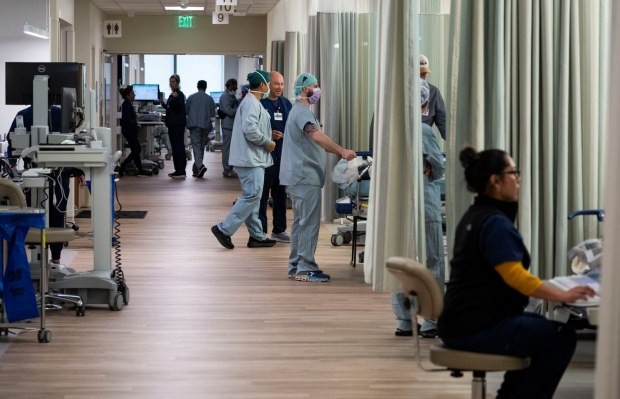 Patients are prepared for surgery on the opening day of UCI Health – Irvine in Irvine, CA on Wednesday, December 10, 2025. (Photo by Paul Bersebach, Orange County Register/SCNG)
Probably not enough
If 372 new hospital beds sounds underwhelming, consider this:
They cost, collectively, a little more than $1.3 billion.
In 2025, hospital construction costs run about $3.5 million per bed, a figure that includes everything from the price of land and drywall to all the fancy gizmos that go into a modern hospital room.
This matters because the demographics of Orange County are poised to create a huge spike in demand for hospital beds. In fact, at 7,000 rooms, the county might be grossly unprepared to meet the county’s hospital demand of, say, 2030.
That’s because we’re getting old.
The median age in Orange County currently is about 39.1 years. That’s slightly older than the median ages in Los Angeles (37.9), San Diego (37.6) and Riverside (36.1) counties, and considerably older than the median age (34.4) in San Bernardino County.
But that’s just the median. Orange County’s older population also is older, on average, than the rest of the state. The average Medicare recipient in Orange County is 75; statewide, it’s 73.
That two-year gap among the aged soon could be huge. When you strip away every other factor that determines public health – everything from obesity to the murder rate to pollution – the most profound link to hospitalization is age.
“We didn’t think of hospitals when we were younger,” said Kaiser patient Albright. “But when you retire, you think about it a lot. It becomes part of your life.”
Young said his organization recently looked at hospital use in Southern California for people in five-year age ranges. From age 65 through 69, he said, 156 out of every 1,000 people spend at least one night a year in a hospital room. That jumps to 209 per 1,000 for people ages 70 to 74, and it nearly doubles, to 301 per 1,000, by the time people reach the 80- to 84-year window.
At the end of 2024, Orange County was home to 550,224 people age 65 or older, according to Census data. By 2040, that slice of the population is expected to hit about 725,000.
There’s no hospital room building boom on the horizon that will meet that need.
“This is why hospital capacity is critical,” said Young. “Granted, the technology will improve. The rate of people needing to use a hospital bed is probably going to go down.
“But technology isn’t going to advance quick enough to offset the demographics,” he added. “That’s what’s coming.”