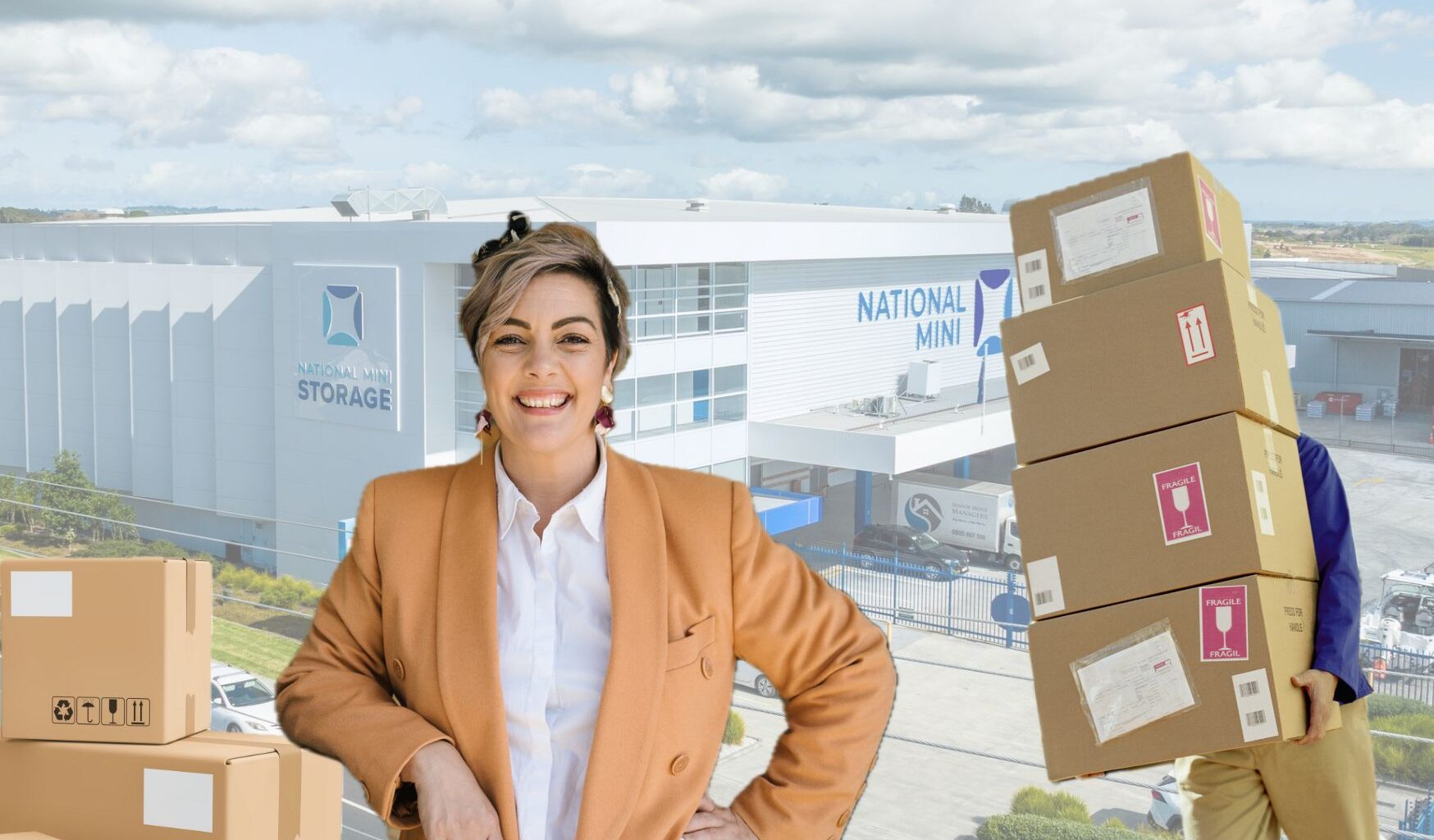
On a weekday afternoon in the second week of summer, a woman clad in gym gear walks out of the elevator at National Mini Storage in central Auckland and into the carpark, grasping a large plastic box with a handwritten label reading ‘December/Xmas’.
There’s a steady trickle of vehicles coming and going from outside the large white and blue building: some load trolleys with bags and boxes to wheel into the lift and up to their storage unit, others go empty-handed to retrieve a little, or a load, of their belongings.
Inside, the multi-storey building is made up of corridors lined with security cameras, which monitor garage-type spaces with manual roller doors. It’s a bit like renting an apartment for your stuff: a $217 monthly fee will get you 2×1 metres of space while at the larger end, $532 will pay for the monthly lease of a ‘single car garage’ sized unit.
A growth in the storage industry comes amid the largest-ever transfer of generational family wealth, which in New Zealand is expected to see $1.6 trillion change hands in the next 25 years. Alongside cash and property, baby boomers and the silent generation will pass down the mounds of belongings they’ve collected over their lifetimes.
The problem of where to put these heirlooms is being squeezed by housing intensification, particularly in Auckland where work is underway to enable higher-density development along transport routes and around town centres.
Sam Scott, who specialises in the self-storage industry at real estate company CBRE, says homes are getting smaller but “we still have lots of stuff”.
The supply rate of self-storage units in New Zealand is 2.39 per 100 people; relatively small when compared to America where around one-third of people have rented a unit before and 10 percent are current renters.
Demand is expected to balloon with an aging population and a growth in medium- and high-density housing, as well as e-commerce businesses which are often run from a home or small office with product stored elsewhere.
“As part of my job I go out and meet these storage managers who are the people on site, and I hear about people’s stories,” Scott says.
“Historically, a majority of people would have had one car in a garage and then maybe use the other half as storage … but we’ve obviously had more apartments and townhouses built and they don’t have that flexibility. They don’t have space to store stuff.
“There are also people moving, people between moves and cases where a family member has passed away and relatives have had to clean the house out, and they will just store possessions somewhere until they can figure out what they want to do with everything – that’s pretty common,” Scott says.
“Storage for business is another common one, with e-commerce stuff that offers a really flexible option for businesses who can upscale and downscale pretty quickly and they’re not being subject to what might have historically been a two-year leave on a small workshop or industrial building.”
Big money
Scott is seeing a corporatisation of the industry, with fewer single operators and more cases of “the big guys” buying up smaller facilities.
He points to a deal over the ditch involving Australia’s National Storage REIT, which at the beginning of December agreed to a AUD $4 billion (NZD $4.5 billion) takeover offer by a consortium backed by Brookfield Asset Management.
The deal drove National Storage’s shares to an all-time high of AUD $2.810.
National Mini Storage and its 13 Auckland sites has this year been acquired by Kennards, a private Australian-owned business with a market value of more than $4 billion. Kennards is another of the key players in the New Zealand market alongside National Storage and Storage King.
Open spaces at National Mini Storage are available for storage of a car, boat or RV for $445 a month. Down the road at the umbrella company’s Mt Eden site, climate-controlled wine cellars are available for rent at a rate of around $100 for a 24-case unit.
As with any property, you’ll pay a premium for location. Comparatively, at Total Storage on Tyne Street in Invercargill, car storage will set you back just $140 per month.
Makala Ffrench Castelli, chief executive of the Self Storage Association of Australasia, says Auckland’s square meterage of self-storage space per capita has grown by around 50 percent since 2013.
Nationwide, there are around 129,000 storage units spread across 780 facilities, with 1.29 million square metres of net storage area. Looking ahead, a further 12 facilities are in the supply pipelines.
“Homes are getting smaller, more people are moving more often and businesses need extra space too. These lifestyle, demographic and economic shifts are driving steady demand and self storage has become a practical, flexible solution for thousands of households and businesses,” Ffrench Castelli says.
“Australia’s self storage market is expanding more rapidly due to its size, population dynamics and depth of new development activity. New Zealand remains a healthy, demand-led market with a more moderate growth profile.
“Both markets are underpinned by strong long-term fundamentals, with New Zealand continuing to mature steadily.”
Small business
Smaller operators are also contributing to this market growth, such as East Side Storage in Rotorua.
The owner, who preferred not to be named, describes himself as a “small businessman in a big market”. He purchased the business four years ago, decreased the average unit size, increased the number of units from 46 to 120 and boosted its profitability.
“Industrial Property tends to be less cyclical, and this is just a version of an industrial building.
“It’s a pretty simple business, really. You’ve got security, you’ve got cameras, you’ve got roller doors, and you get people to pay by direct debit. It’s a great cashflow business with lower risk because you’ve got multiple tenancies.
“One downside is the banks traditionally haven’t liked them because the leases are only short term.”
Rotorua is a different market from Auckland, the owner says, with around half of the market comprising boat and car storage for “all the holiday people”.
Clear the decks
While CBRE and East Side Storage are facilitating places to store this “stuff”, another industry has sprung up made up of professional organisers and ‘declutterers’, offering to help customers purge anything that’s not in use or, in the words of Marie Kondo, sparking joy.
Beks Holmes, of The Decluttering & Organising Co., started the business under a different name close to eight years ago. It’s now grown to a team of four, which caters predominantly to women aged between 40 and 60.
Customers can opt for in-person organising sessions or online coaching for those needing motivation and accountability. At the end of an in-house session, Homes or her co-workers will take away anything needing to be thrown out or donated – though they do not sell on behalf of a client.
Holmes says decluttering is hard work for her team and often emotional work for their clients. After a couple of instances early on in the business’ lifetime where she was engaged by hoarders, she now conducts a screening call and will turn them away if they fit into that category.
“I’m very keen that we do more good than harm … and I don’t have specialist training for that type of work.”
Inheriting a parents’ possessions upon their death can be a catalyst for someone seeking help, as can kids leaving home and failing to clear out their old clothes, toys and school books. For many, the trigger is both of these things happening at once.
 Before (L) and after (R) Holmes helped a customer sort out their ‘cupboard of doom’. Photo composite: Supplied
Letting go of things can be difficult and the mentality of older generations who in the past may have had less access to things they needed is often that it’s best to hold on to things ‘just in case’.
“For anyone that’s 40-plus that’s holding on to things for other people, I tell them ‘don’t’. Ask them now – get a family chat going and say: ‘I’ve got this thing I’m holding on to for you, do you want it?’
“So often the answer is no. ‘We don’t want the family crystal’, ‘We don’t want the silver’; they don’t want that stuff.”
Many of Holmes’ clients tell her they’ve had moments where they’ve looked around and thought: “None of this is my stuff”.
“The kind of people that we have as clients, probably many of them have a tough time saying no in all areas of their life. So they become what we call the family storage unit. We ask them: ‘Are you the family storage unit at the moment? Are you holding on to things for multiple different people, like a sibling moving overseas for a few years?’
“That space is yours, and you should fill it with your own things, and the things that make your life easier or make you happy to kind of look at.”