As foreign minister of Venezuela, Nicolás Maduro travelled to Damascus in 2007 for a highly publicised meeting with then-president of Syria, Bashar al-Assad, en route to Tehran.
Maduro was ostensibly in the region to strengthen his country’s ties with others similarly hostile to Washington. But behind closed doors, his visit had another purpose: a secret meeting with a senior Hizbollah commander, integral to its overseas operations.
The previously unreported encounter took place at a hotel in central Damascus, said three people with knowledge of the meeting, and would mark the first known instance of Maduro meeting directly with a member of the Lebanese militant group.
Washington, particularly recent Republican administrations, has long accused Venezuelan officials of colluding with Hizbollah in drug trafficking operations and illicit finance, with several Maduro allies subject to criminal investigations by US authorities that cite such links.
Those relationships face renewed scrutiny following Maduro’s capture by US forces last week in a brazen pre-dawn raid on Caracas.
Maduro faces sweeping drug trafficking charges. In court in New York on Monday, he pleaded not guilty to four charges of narco-terrorism, conspiracy to import cocaine and possession of weapons.
The indictment does not mention Hizbollah or Iran, but in an interview the day after Maduro’s capture, US secretary of state Marco Rubio said Venezuela has “cosied up to Hizbollah” and its patron Tehran.
“It’s very simple,” Rubio said. “In the 21st century, under the Trump administration, we are not going to have a country like Venezuela in our own hemisphere, in the sphere of control and at the crossroads for Hizbollah, for Iran and for every other malign influence in the world. That’s just not going to exist.”
Hizbollah’s Venezuelan connection sprang from a burgeoning relationship between Tehran and Caracas shaped by anti-US ideology and the impact of Washington’s sanctions on both countries.
Hizbollah, Iran’s biggest proxy, developed relationships with government officials in Caracas under the late leader Hugo Chávez, which grew closer under Maduro, said an intelligence official and another person familiar with the situation.
One of the people said: “You all of a sudden start seeing Hizbollah activities proliferate. We’re talking drug trafficking, money laundering, schemes to obtain passports, arms, intelligence — all orchestrated with diplomatic cover.”
Hizbollah and Venezuelan authorities have always denied the claims.
But multiple investigations and overt clues illustrate the depth of the relationships, which developed as Hizbollah took an entrepreneurial approach to activities such as money laundering and arms trafficking across the world.
 Kidnapped Venezuelan President Nicolás Maduro is taken to a New York court on January 5 for his first appearance on US federal charges © Eduardo Munoz/Reuters
Jack Kelly, a retired agent for the US Drug Enforcement Administration who helped lead its investigation into Hizbollah and organised crime — dubbed “Project Cassandra” — said the agency found evidence that Hizbollah operatives were provided with Venezuelan passports, while Conviasa, Venezuela’s state-owned airline, provided the group with logistical support.
Project Cassandra was initiated in 2008 to investigate activities including drug trafficking, weapons smuggling and money laundering. Kelly said that around 2010, the DEA learned of cocaine loads being sent on Conviasa flights to Damascus, as well as large bulk shipments of hard currency.
This, Kelly said, was to send on to Hizbollah-linked money exchanges in Lebanon. “That couldn’t have happened without the Chavistas being aware of it,” he said.
Roger Noriega, a former US assistant secretary of state for western hemisphere affairs, in 2012 testified that Conviasa operated regular flights from Caracas to Damascus and Tehran “providing Iran, Hizbollah, and associated narco-traffickers a surreptitious means to move personnel, weapons, contraband and other materiel”.
Much of the evidence of links between Hizbollah and Venezuela dates from Project Cassandra, one of the most comprehensive criminal investigations into the Lebanese group’s international ties.
But Hizbollah’s relationships in Venezuela appear to have continued since that probe, which ended in 2016.
A complaint filed in a US federal court against the cryptocurrency exchange Binance in December alleged that Venezuela-based, Hizbollah-linked gold smugglers and money launderers had moved tens of millions of dollars in crypto through the exchange.
Binance said in response to the case that it fully complied with “internationally recognised sanctions laws”.
In one of its most significant findings, Project Cassandra uncovered links between a high-ranking Hizbollah official and a Medellín-based Lebanese drug kingpin with ties to the militant group, Ayman Jomaa.
Jomaa was accused of running one of the largest and most sophisticated international drug smuggling and money laundering networks, involving Colombia and Venezuela, that the DEA had ever seen.
In his testimony, Noriega stated that “Venezuela has provided thousands of phone IDs, passports and visas to persons of Middle Eastern origin” — claims echoed to the FT by ex-US officials and the intelligence official.
 Tareck El Aissami, centre, is a former vice-president of Venezuela who has been indicted on corruption and sanctions-dodging charges in the US © AFP via Getty Images
Tareck El Aissami, a former Maduro confidant and vice-president sanctioned by the US, Canada and the EU, was key to the passports scheme, said the person familiar with the situation. El Aissami has been indicted on corruption and sanctions-dodging charges in the US.
At the same time, investigators saw striking images of Hizbollah fighters in Venezuela. Kelly said that the DEA around 2010 saw credible evidence that operatives from the militant group were present.
“We saw pictures of Hizbollah fighters on rooftops in Margarita Island with long guns training in urban warfare,” he said. Margarita Island, a duty-free zone off the coast, is a hub of Hizbollah financial activity, said the intelligence official, and is home to a large Lebanese diaspora community.
Another former US official also said they had seen evidence of Hizbollah fighters wearing fatigues in Venezuela around the same time.
Some members of the Trump administration have described these as training camps, but Matthew Levitt, a former counterterrorism official with the FBI and US Treasury, now an expert on Hizbollah’s global reach, said that was an exaggeration. “Hizbollah has a very deep history in Venezuela . . . It doesn’t need to run training camps to maintain a presence there.”
 As foreign minister of Venezuela, Nicolás Maduro travelled to Damascus in 2007 for a highly publicised meeting with then-president of Syria, Bashar al-Assad © Sana/Reuters
At times Hizbollah, which was founded in the early 1980s, turned to the sizeable Lebanese diaspora community in Latin America for support, relying on clan-based networks for funding and help concealing illicit business activities, either voluntarily or through coercion.
“Some of [Maduro’s] confidants and most trusted fixers were from those clans,” said the intelligence official.
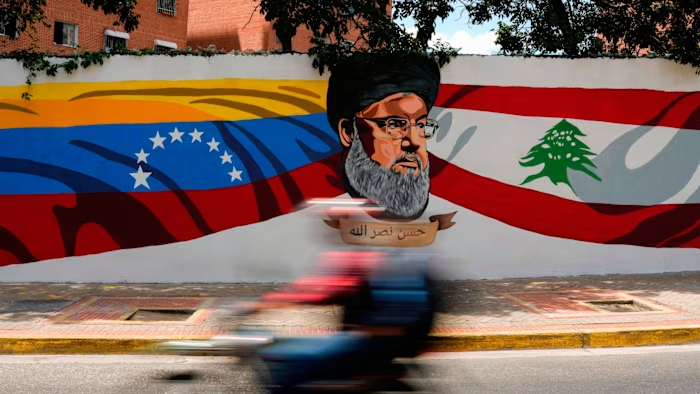
As early as 2008, the US Treasury sanctioned Ghazi Nasr Al Din, a Venezuelan diplomat who worked at the embassies in Damascus and Beirut and “utilised his position […] to provide financial support to Hizbollah”.
A 2020 Atlantic Council report written by an analyst who has since joined Trump’s Department of Defense identified the Nasr Al Din clan as one of three “embedded into the Maduro regime bureaucracy […] who provided protection and resources to Hizbollah”.
Adel El Zabayar, a close Maduro ally, was indicted by the US DoJ in 2020 on narco-terrorism charges and was accused of links to Hizbollah, including appearing in propaganda videos for the group.
Trump administration officials have also made claims with little evidence that Hizbollah planned to use Venezuela as a basis for what would be unprecedented direct attacks on the US.
The Republican chair of the House foreign affairs committee, Brian Mast, on Monday night claimed Maduro had allowed Hizbollah to use Venezuela “as a base for espionage and kinetic operations against the US”.
Legal cases have also alleged Venezuelan links with the Palestinian militant group Hamas, with little supporting evidence.
At the same time there are signs that Hizbollah’s Venezuela connections have endured.
 People celebrate while holding Palestinian and Hizbollah flags at an outdoor event in Caracas © Ariana Cubillos/AP
The FT in December found that Venezuela-based crypto accounts had transacted with crypto wallets later linked to Tawfiq Al-Law — a US sanctioned Syrian accused of moving illicit money for Hizbollah, the Iran-backed Houthis in Yemen and a company tied to the Assad regime in Syria.
Binance said it denied the allegations and fully complied with “internationally recognised sanctions laws, consistent with other financial institutions”.
Rubio’s message was being read by Hizbollah, already weakened and under continuous attack by Israel, as a clear threat to their continued operations, according to the person familiar with the group’s thinking.
“But [Maduro’s] regime is still in place. The system is still in place — the same one that seemingly collaborated with Hizbollah,” said Levitt, the former US counterterrorism official.
“Perhaps the secretary knows something that I don’t — but looking in from the outside, it’s completely unclear to me how what the US did is going to translate into a setback for Hizbollah and Iran in Venezuela.”
Additional reporting by Bita Ghaffari in Tehran and Abigail Hauslohner in Washington