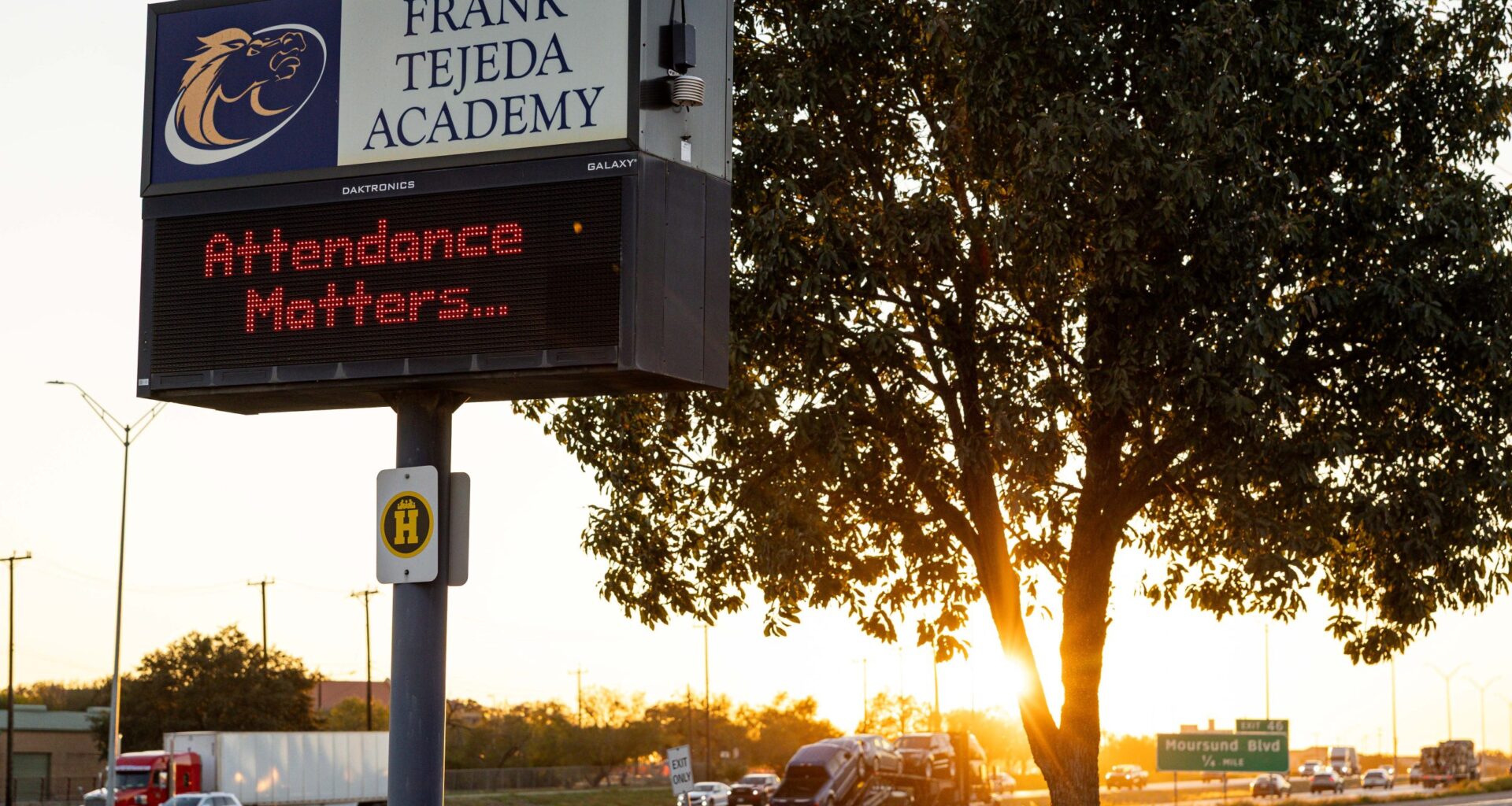
Often labeled as one of the poorest big cities in the country, San Antonio also has some of the largest chronic absenteeism rates.
While school attendance rates have marginally improved across San Antonio and Texas, according to state reports released in December, school districts in the area far exceed the state’s chronic absenteeism rate.
In Texas, a student is considered chronically absent once they miss 10% or more of the school years, usually 18 days. Across the state, 19% of students were chronically absent during the 2023-24 school year, according to the most recent data. The previous year, 20.03% of Texas students were chronically absent.
In San Antonio, more than a quarter of students were chronically absent during the 2022-23 cycle, slightly improving to 24.3% during the 2023-24 school year.
Attendance challenges intensify in District 5
Across the city, some parts of town are worse than others. City Council District 5, which includes the West Side and chunks of the urban core, has schools with the largest absenteeism rates in San Antonio.
Schools with the worst attendance records attend Tafolla and Rhodes middle schools in San Antonio Independent School District and Brentwood and Gus Garcia middle schools in Edgewood ISD.
At all four campuses, more than 50% of students were chronically absent during the 2023-24 school year.
Councilwoman for District 5 Teri Castillo said the absenteeism stems from a range of socioeconomic factors, including economic instability in the area, lack of access to health care and scarcity of child care options.
“And then, of course, as we know, transportation, next to housing, is one of the top expenses for our families,” Castillo said during a November interview with the Report, a month before the state released its more recent absenteeism data.
That’s why Castillo advocates for affordable housing, she said, so families can afford to live near neighborhood schools, easing both transportation and housing concerns.
And most community members may be leaving their neighborhoods for work and school at higher rates than in other parts of town, said Rebeca Canizales, director of strategy and programs at Prosper West, an organization working to foster economic growth on the West Side.
Most parents often work multiple jobs and irregular hours, working in manufacturing or retail and service industries.
Canizales also pointed to the city’s transportation barriers, more pronounced on the West Side, which has some of the busiest highway corridors in San Antonio on top of other physical barriers like railroad tracks, bridges and inconveniently located creeks.
“It makes for very weird parcels or pieces of land where sidewalks are made very narrowly or very low and close to the street — having to cross the street between Commerce or Buena Vista when you’re going north to south is really difficult,” she said.
City elected leaders don’t have control over San Antonio’s many school districts, often taking the route of investing in youth programming and workforce initiatives to address the city’s poor education outcomes. But local groups, including teacher unions and youth advocacy groups, have recently been pushing for city and county officials to take a more active role in K-12 and public education.
A recent survey by Futuro San Antonio, a group aiming to mobilize parents in education, found that 55% of parents say families are missing school because of family health challenges, and 43% blamed transportation barriers. Futuro surveyed 505 parents and caregivers across San Antonio last year.
From Castillo’s perspective on the dais, the city could do more to support San Antonio’s school districts and address absenteeism without directly entering the K-12 space. Her ideas include advocating for higher wages so parents aren’t forced to work multiple jobs, improving public transit and political lobbying in the interest of local school districts at the state level.
“I do believe we have a responsibility when it comes to our city’s legislative agenda,” Castillo said. “I have gone to testify at the Capitol against the use of vouchers, because we do have that responsibility to stand alongside our school board members.”
Some of SAISD’s schools with the highest attendance rates are also in District 5, including Irving Dual Language Academy, with a 95% average daily attendance and a 12% chronic absenteeism rate, much lower than the state average.
Anxiety over immigration enforcement
Though absenteeism data for the 2024-25 school year won’t be made available until later this year, a more recent challenge to attendance according to local officials is the federal government’s heavy-handed immigration enforcement under the Trump Administration.
School districts don’t keep records of citizenship or immigration status of students and their families, but it’s not hard to parse what’s going on, said Eduardo Hernández, superintendent for Edgewood ISD.
Edgewood ISD had the largest chronic absenteeism rate in San Antonio for the 2023-24 cycle, with 51.2% of students missing at least 10% of the school year.
“The immigration issue continues to come up,” exacerbating mental health issues and anxieties in the Edgewood community, Hernández said during an interview in December.
Hernández doesn’t ask about a family’s status, but administrators have learned how to read the signs: students discussing ICE amongst themselves and older students struggling to navigate college enrollment processes without social security numbers or help from their families.
“There’s some legal challenges, if you will, that we can counsel students through,” he said. “But right now, there doesn’t seem to be any way around it.”
 A few students are missing from class while others work at East Central ISD’s Tradition Elementary School on Oct. 31. Credit: Amber Esparza / San Antonio Report
Literacy and funding consequences
The four campuses with the highest absenteeism rates in District 5 — Tafolla, Rhodes, Brentwood and Gus Garcia — are all F-rated schools, academically “unacceptable” by state standards.
Transition years, typically middle school grades and freshman year of high school, tend to have the worst attendance rates, education officials say, which is also why those schools typically struggle academically.
Attendance tends to smooth out during high school, since credits are based on attendance and grades, whereas younger students usually only need good grades to pass from one level to the next.
An analysis by local education advocacy group Futuro San Antonio found that for every 0.5% that chronic absenteeism goes down, literacy goes up by 1%.
Once students miss two or more days a month, schools start seeing a dip in academic performance through testing, said Diane Fernandez, director of enrollment at SAISD.
It doesn’t happen for all children, she said, but it does happen for a good amount of them.
“I think parents sometimes just need to know the impact that it has,” Fernandez said.
Missing 18 days of school, or a tenth of the typical school year, over a student’s K-12 journey adds up to a full year of instructional time, Fernandez added.
SAISD had the second-largest absenteeism rate in San Antonio for the 2023-24 school year at 37.7%, following only Edgewood ISD.
In Texas, absenteeism also has financial implications because public school funding is tied to a district’s average daily student attendance.
Jennifer Herrera, SAISD director of attendance and graduation protection programs, said the district missed out on $24 million it would’ve gotten from the state had students achieved perfect attendance during the 2024-25 school year.
Due to recent changes in student funding at the state level, SAISD could miss out on even more dollars per student this year even if attendance records remain the same.
At Edgewood ISD, the district tends to gain an additional $800,000 for every 1% increase in attendance.
“You think about what you can do with that money,” Hernández said. “Everything from additional personnel support to increasing salaries… We could look at additional resources for the classroom.”
Housing instability in San Antonio
San Antonio has the second largest homeless population in Texas.
All school districts are required to provide special services for students considered homeless under the federal McKinney-Vento Act — including providing transportation for students forced into temporary housing or shelters.
Haven For Hope, a downtown San Antonio organization serving the city’s homeless population, has someone dedicated to coordinating with local school districts to connect McKinney-Vento students with transportation, social services and other resources in schools.
Haven’s “hub schools” are designated for students who stay at the downtown shelter if they don’t stay at the school they attended before becoming homeless. They include Margil Elementary School, Tafolla Middle School and Lanier High School in SAISD.
Chronic absenteeism rates at Haven’s hub schools range from 39% to nearly 60%. Of the 162 school-aged children temporarily homed at Haven, 97 are enrolled at SAISD, said Ashley Miller, senior manager of youth and family enrichment.
“We work really, really closely with the schools, which really helps with the attendance, because we can kind of get ahead of it before it becomes chronic,” Miller said.
It’s a requirement for school-aged children at Haven to attend school, and there’s incentive programs for families with good attendance.
The high absenteeism rates may reflect what happens after families leave Haven, Miller explained, especially if a student continues bouncing between homes and shelters or enrolls in another school district without notifying their first school district.
Possible solutions
Most districts have interventionists that reach out to parents once a student has three absences. If phone calls don’t work, campus and district staff follow up with meetings and emails.
SAISD also employs seven retention specialists across the district and holds weekly campus attendance committee meetings where administrators, counselors and other support staff talk about absentee students, comparing notes and discussing solutions.
Edgewood ISD takes similar steps, but the district automatically files truancy charges as soon as a student misses 10% of the school year, Hernández told the Report.
This year, SAISD also implemented a recognition ceremony for schools improving their attendance records every nine weeks as an added incentive.
“Not only do we celebrate those that have the highest attendance rate at the end of the nine weeks, but we also celebrate those that have demonstrated that have demonstrated the most growth,” said Jennifer Hernandez, who oversees attendance efforts at SAISD.
Since at least 2015, when Texas largely decriminalized truancy, the City of San Antonio has deployed some resources to tackle attendance issues.
Currently, the city’s municipal court has 10 case managers working with 11 San Antonio-area school districts and four charter school networks. Usually embedded on school campuses, their goal is mediation between families, school districts and the court before a district files any criminal charges against parents for truancy.
“What I would always tell the families that I worked with was that my job was to help them address the issue and fix attendance to avoid any further court of involvement,” said Katie Kappler, a senior juvenile case manager for the city.
School districts can file criminal charges against parents through the city attorney’s office if mediation doesn’t work, but cases like that are rare and the punishment includes fines.
What the municipal court often finds, Kappler said, is that students aren’t missing school for no reason — families who go through the system are often facing housing issues and food insecurity.
Soon, the city also plans to address another prong of the issue: transportation.
City Council is considering a funding agreement between the city and VIA Metropolitan Transit for up to $150,000 to fund semester bus passes for middle and high school students as part of a pilot program to combat chronic absenteeism. If approved, the investment could fund passes for more than 5,000 students this year.
Marginal, but positive results
While absenteeism rates remain high, even five years out from the COVID-19 shutdown that threw a wrench in public education, school districts are seeing improvements.
In San Antonio, most school districts saw chronic absenteeism rates drop by a few percentage points from 2022-23 to 2023-24.
SAISD went from a 40.6% absenteeism rate to 37.7%, and Edgewood ISD went from 53.6% to 51.2%. Before 2020, only about one in 10 of SAISD students were chronically absent, said the district.
More recent projections for 2024-25 and the current 2025-26 cycle are optimistic.
Fernandez said SAISD ended the 2024-25 school year with 34% chronic absenteeism rate. The start of the current school year saw 23% of students chronically absent.
Jennifer Hernandez attributes the progress to interdepartmental collaboration within SAISD and outside agencies, like the municipal court and Haven For Hope.
But the job is nowhere near done.
“We are seeing some gains, but still a lot of work to do on the attendance side,” Hernandez said. “Attendance and enrollment belong to everyone.”