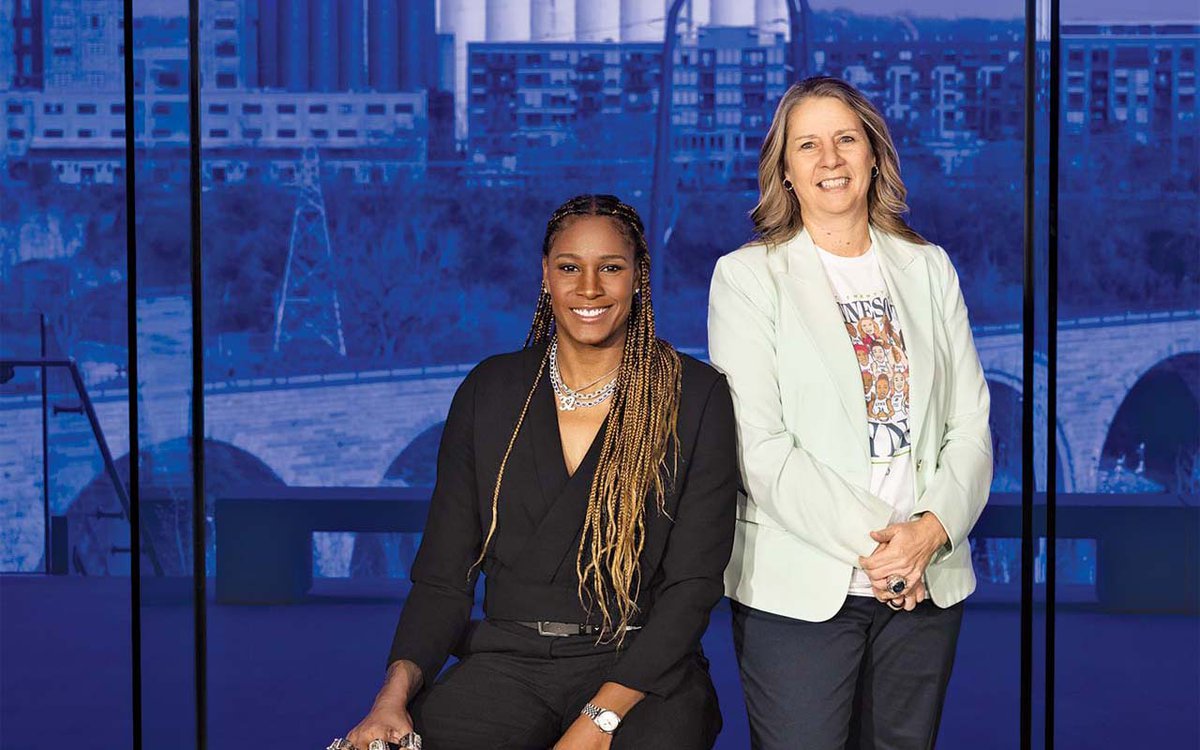
Before Cheryl Reeve was named Lynx head coach, she had already won two championships in Detroit as an assistant. Her vision for elevating the Lynx’s culture was focused on bringing in proven winners, like former Gopher Lindsay Whalen, who had been to a WNBA Finals, and Rebekkah Brunson, who had won a championship with Sacramento. The Lynx won the Maya Moore lottery in 2011 and won their first championship at the end of that summer. Reeve’s core—Moore, Whalen, Brunson, and Seimone Augustus—went on to win three more titles, at one point playing in six of seven finals. With Reeve being named to the 2026 Hall of Fame, that means all of them are in the Hall, except for, ludicrously, Brunson. (This injustice cannot stand!) Reeve is still the Lynx’s head coach, now with both Brunson and Whalen as her assistants. They are hard at work on bringing home a fifth ring together in Minnesota. Reeve and Brunson hopped on a Zoom to discuss what winning at the highest level feels like from the inside.
What was the franchise like when you first got here, and what was your vision for success?
Cheryl: I’d been coming here for 10 years, and I always enjoyed coming as a visitor. But that was part of the problem—I don’t think you should enjoy coming to your opponent’s city. We wanted Minnesota to be a place you don’t enjoy. The food doesn’t taste as good; the experience at the club isn’t as fun when you came here and you got your ass kicked, right?
Rebekkah, you won a championship in Sacramento before that franchise folded, and you came here in the 2010 dispersal draft. How did you instill a winning culture from the players’ side?
Rebekkah: Seimone Augustus was a generational talent—you could see that [the Lynx] were so close to being good. There wasn’t this feeling of, ‘Oh my gosh, I got to go play with this bad team.’ Now, I didn’t know a lot about the city, because you fly into Minnesota, all you see is what’s surrounding the arena downtown. From a basketball perspective, I mean, I probably thought there won’t be that much distraction.
Haha. It’s quiet!
Rebekkah: Obviously, we didn’t do what we needed to do in 2010, and we ended up with Maya. And I’m very, very grateful for that.
Cheryl, when the Detroit Shock relocated to Tulsa, you were offered a job on Nolan Richardson’s staff. You’ve been quoted regarding that time: “I’m done propping up these men. Grinding my tail off and not being thought of because I’m not a man with an NBA background.” Blunt-force truth! I think it speaks to both your desire to be a head coach and your belief that championship-level players want honesty.
Cheryl: Rebekkah can attest to this—I’ve kind of assigned her to be my filter in a way with this generation of players. She didn’t have the benefit of the filter when she was playing.
Rebekkah: I had [assistant coach] Jim [Petersen]!
Cheryl: Yeah, you had Jim. But I would say that I’ve always opened my mouth. With age comes wisdom, but ultimately, I think the moment for me was working for Bill Laimbeer. In a couple of previous experiences I had coaching in the WNBA, I had to sort of creep around. That didn’t feel great. And when I worked with Bill, I felt like I could be my 100 percent authentic self, because he was his authentic self. The people around him were their authentic selves. But being able to mature, to grow in your delivery—I’m still on that journey. And like we’d say, with family, it’s not supposed to be easy. As I was teaching my son recently, a coach or a teacher gets paid to tell you the things you’re not that good at. And that’s a lonely place sometimes. But I want to be surrounded by truth tellers. I believe it works the best.
Did you ever have to modulate your message depending on the player?
Cheryl: I try to thank the team every year for allowing me to be myself. In some years it was easier than others, but I would say most of my time here I tried to allow the players to be themselves. And that meant that Seimone, you know, cussed back at me. That’s great. I wanted to get Seimone where she was kind of kind of hitting me back hard, because that rose her level of play, right? Some players, those things work. Coaching Lindsay Whalen was a different scenario. Whay is an oldest child in her family. And with that comes a pleasing dynamic—pleasing her parents or, in this case, you know, pleasing me. And if she felt like I was disappointed in her, it really affected her. And so I had to kind of pick my spots a little bit more with Whay.
BB, you have this wonderful diplomatic ability as a basketball pundit. So, how is modulating your message for a television audience different than delivering a message as a coach?
Rebekkah: If I’m talking about a Wolves game and a player had a poor game, if I am sitting further than arm’s length away, then I’m just talking shit. But if I see them at practice and be like, “Hey, get under your shot,” it’s OK to say those things to their face. As an analyst, my job is to let the viewers know there’s hope. So, it’s important to point out the positives. But as a coach, it’s my job to help the players be better.
Which role is more closely aligned with your authentic self?
Rebekkah: As an analyst, I’m just watching. I can help the viewer understand, but coaching is so much more rewarding because I have an influence on the result. Not to say I don’t like the analyst part, but as far as what fills my cup, it’s the coaching, for sure.
After getting Maya Moore your second year here, you immediately won your first championship. And then you contended almost every year until BB’s retirement in 2018. What did it feel like from the inside?
Cheryl: When we traded for Lindsay, she said, “Coach, if we win, they’ll come.” She experienced it at the U when they were a Final Four team. So, we certainly felt that rise of interest. And externally, one of my favorite things is to go on the road and beat the home team. Live for it. In 2010, going into a place, they were real happy to see you. And then it changed to getting booed. Probably after maybe the third championship, there started to be some real Lynx fatigue.
What did it feel like as a player, BB?
Rebekkah: I feel like it took a while. I mean, from the inside, I don’t feel like people ever really wanted to see us be great. That’s just my opinion. Like, certain situations where you feel like you should have had an MVP and you didn’t. Maybe it’s because we’re the small-market team, nobody was like, “Yes, the Lynx again!” But our fans were behind us—Target Center was always rocking.
You’re both true Minnesotans now—feeling jobbed by the national media, jobbed by the refs. You got that small-market chip on your shoulder.
Cheryl: I’ve moved around—and though I was born in Nebraska and was a Vikings fan as a youth, I’m more of an East Coaster. But should market size matter? To me, it’s like, “Who cares how big the population is?” But to Rebekkah’s point, you know, why weren’t they more talked about? Why didn’t they get more award recognition? I think maybe in some ways the rationalization could’ve been we had five starters that are Hall of Fame. (You know, we obviously still have to have Rebekkah get in on that.) Now, that hurt a Seimone Augustus, who without us is a 20 ppg scorer and with us is 16 ppg. But those players were some of the most likable players ever. Now the coach, not as likable—maybe that’s what it was.
Rebekkah: At home versus LA in 2016, it was the refs not understanding the rules. I don’t think there was a conspiracy, just stupidity. This year, in the Phoenix series, I’ve never been in a season that had such an abrupt ending. It was weird. I really feel like the market-size effect only hit us in the New York series, when you had the ability to make the right decision several times, and you didn’t. That was the one where you could clearly say, “OK, the big market has entered the chat.”
Cheryl, we were talking during the cover shoot about how it feels like the W is experiencing what the NBA experienced in the ’70s—when Magic Johnson and Larry Bird went from college to the pros.
Cheryl: As someone that entered the league in 2001, we’ve always had a belief that if we were invested in properly, we would take off. But sometimes it takes a while for sports leagues to find their footing. You mentioned the NBA in the ’50s and the ’60s—they needed the Harlem Globetrotters for people to come, right? Then they had their merger with the ABA. They had teams that were relocating, folding—all the things that the WNBA experienced. The NBA had their inflection point with Larry Bird and Magic Johnson. Not unlike what we experienced with Caitlin Clark and Angel Reese. And unfortunately, race is a factor—in terms of creating those conversations and those divisions. So, when did I notice things changing for us? After Caitlin Clark declared for the draft, Carley Knox, our president of business, my wife, said, “Oh my gosh, the amount of calls we’re getting for people wanting to come—not just to the Indiana games.” It was a surge of interest—a massive lift, in every market. For so long, we weren’t able to get fans to follow our players from college to pro—that’s the nut we’ve been trying to crack. We have it now.
But in the selection process for USA Basketball, did it feel like you were being pitted against Caitlin Clark’s fans?
Cheryl: I think the unfortunate part, when you get a fan base of a certain player, whether Caitlin or Angel, those fan bases are very large. And they don’t always understand the inner workings, whether it’s the league or USA Basketball and its processes. And so it’s a lack of education, which often leads to problems. So I think the fan base pitted themselves against me. They just needed someone to blame, I guess. And I took a lot of bullets for USA Basketball.
You sure did.
Cheryl: But ultimately, I’ve had conversations with Caitlin’s family. They know—I’ve openly talked about Caitlin and her skill. And there’s controversy every time the national team is announced to go to the Olympics—it’s the Olympics. Everyone wants to go.
Rebekkah, with the league blowing up, is a part of you asking, “What took so long?”
Rebekkah: I’m excited about it. I think that for me, it started to happen during Caitlin and Angel’s senior seasons, when the media got involved. The media plays a huge role in our product. For so long, we were on the last page of the paper; no one was talking about it on major sports networks. We’re funny as consumers; whatever you put in front of us is what we’re going to take. And if you never put women’s basketball on the front page, then the consumers are not interested. So, the change happened when the media put Angel and Caitlin on the front page.
So do you feel like you’re getting respect from the players who are playing now?
Rebekkah: I don’t think that the lack of respect ever comes from the players. Like when you hear dudes talk poorly about the WNBA, it’s never NBA players. I mean, you do have your instances, but for the most part, it’s Joe Schmo over here, right? And the same thing with the W players—they respect the vets. They watched the game before they got into the game. They know it and they understand it. You talk about pay—somebody had to pave the way. We did this because we love the game and we believed in women’s basketball and we believed in what we were doing. That was it, right? I’m so excited for what is happening with this league right now. I’m so excited for the way the players are going to be able to benefit from it. It’s just a great place to be—to be able to watch the growth of women’s basketball. Not the peak—the growth. Because we’re absolutely still pushing forward to higher things, but it’s exciting to see it.
Cheryl: In some ways, sports are just a microcosm of society. Though we’re nowhere close to where we need to be, look at what’s happened in the growth of women in business, in politics. We still haven’t elected a woman president—we will. And those things are also happening in sports. And it doesn’t come without hard conversations and battles—like a CBA where the players know their worth. It’s just a tremendous time.
What needs to happen in this offseason to get back to the Finals and to get over that hump for that elusive fifth championship ring?
Cheryl: Obviously, it’s an unprecedented offseason, considering the timing of the collective bargaining agreement, with none of the players signing because they knew it was going to be a transformational CBA. You talked about so many great things about our franchise. Well, that’s known by players around the league—the respect they have for what Rebekkah and her peers have helped to build with the Minnesota Lynx, and for her to still be a part of it. So we’re an attractive destination for a lot of players. So our priority is a combination of retention and addition in places that we feel can position us to compete for another championship in 2026.
The Minnesota Lynx Top 10 (+1)
- #23, Maya Moore, Shooting Guard; 2011–2018
- #34, Sylvia Fowles, Center; 2015–2022
- #33, Seimone Augustus, Small Forward; 2006–2019
- #13, Lindsay Whalen, Point Guard; 2010–2018
- #32, Rebekkah Brunson, Power Forward; 2010–2018
- #24, Napheesa Collier, Power Forward; 2019–present
- #30, Katie Smith, Shooting Guard; 1999–2005
- #21, Kayla McBride, Shooting Guard; 2021–present
- #8, Alanna Smith, Center; 2024–present
- #10 & 2, The StudBudz! (Courtney Williams and Natisha Hiedeman), Point Guards; 2024–present