Of the 4,592 rostered players in men’s professional sports, there are exactly zero who are out as queer, according to an Outsports report from September 2024. As for the Women’s National Basketball Association alone? Over 25% of the league’s players are out — and a significant chunk of the WNBA’s fanbase falls somewhere within the LGBTQ+ umbrella. (Also, water is wet.)
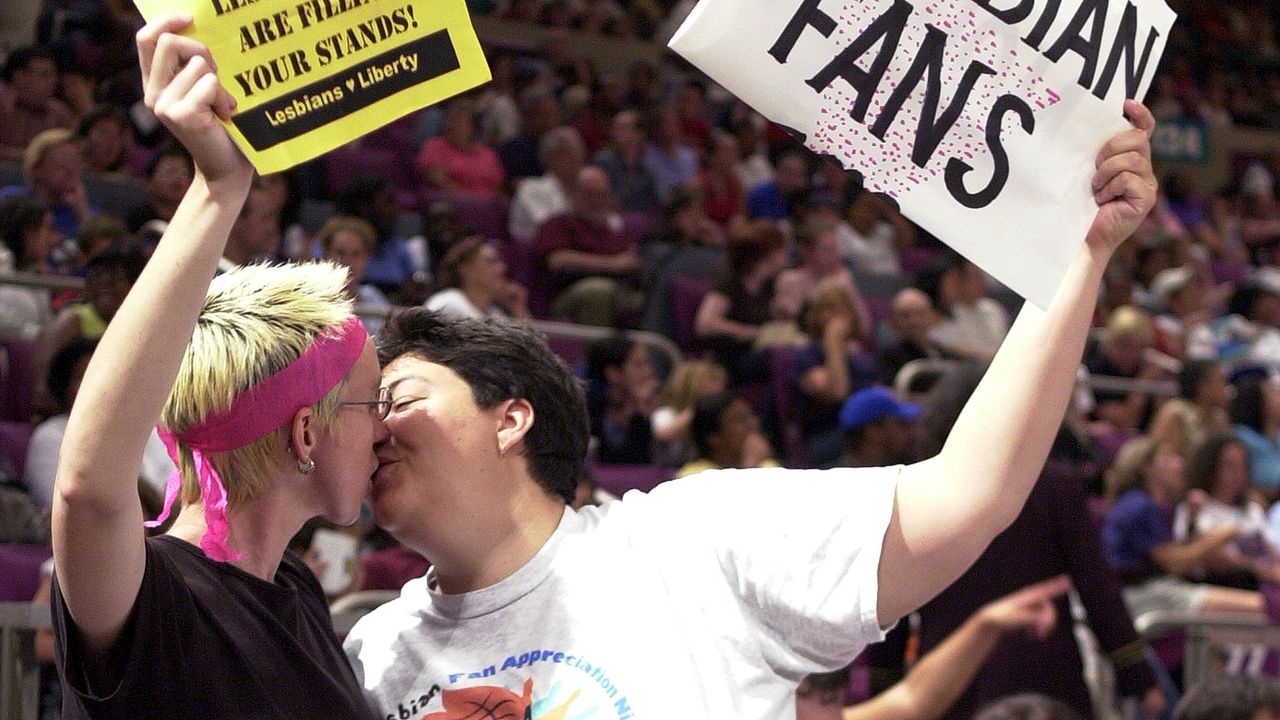
Today, the WNBA is often praised for its embrace of its queer players and fans. In 2014, the W became the first pro sports league to announce that it would officially recognize Pride every June. But that wasn’t always the case; though many of us might take something like a WNBA Pride game for granted now, such recognition was scarce in the early days of the league. In fact, in those first few years of the WNBA, queer fans — specifically lesbians — had to fight to be seen at all.
The WNBA was founded on April 24, 1996, with the first game taking place on June 21, 1997, between the New York Liberty and the Los Angeles Sparks. In some ways, the league was “well-positioned to inherit already existing sports fan cultures” among lesbians, says Rachel Corbman, who describes herself as a “long-time coordinator of the Lesbian Herstory Archives, and an even longer-time fan of the New York Liberty.” Amateur softball leagues, in particular, were central to lesbian organizing from the ’70s onward, from Atlanta to Massachusetts’ Pioneer Valley to California’s Sonoma County. The forced outings of tennis stars Billie Jean King and (now renowned transphobe) Martina Navratilova in 1981, while complicated, also paved the way for greater queer visibility in sports. And with Ellen DeGeneres coming out just a few months before the WNBA’s first game took place, not to mention the numerous queer direct action groups that blossomed in the ’90s, the time was ripe for lesbian protest — on the streets, yes, but also in Madison Square Garden.

Lesbians for Liberty
As Corbman tells me, early lesbian activism at WNBA games was something of a “weird side project” for many of those who partook, as they were largely involved in other groups. “Nobody was like, ‘The main thing I want to change in the world is that I want the Liberty to have a Pride game,’” she jokes. Beyond the history of the WNBA though, the much-overlooked lesbian protests against the league in those early years also serve as a fascinating window into the history of queer activism in the ’90s.
In 1998, the direct action group the Lesbian Avengers staged the first known “visibility action” at a Washington Mystics game against the New York Liberty in D.C. According to the Washington Post, the group bought a block of 60 seats and wore Lesbian Avengers shirts to the game, before demonstrating in front of the Family Research Council, the headquarters of which are located around the corner from D.C.’s Capitol One Arena. (The conservative Christian group has been pushing anti-LGBTQ+ legislation for decades.) Season ticket holder and Lesbian Avengers member Jessica Brown told the Post at the time, “They have extreme lesbian support and yet there’s such an effort to heterosexualize the sport and cover up the gay fan base.” Notably, one feature at games that summer was a “Couple of the Game” segment — but that conveniently never included a same-sex couple.
Jess Dobkin, who was then a New York-based member of ACT UP and the Lesbian Avengers, started attending Liberty games in 1998. She remembers how “miraculous” it was to see women’s sports being played at Madison Square Garden, then the Liberty’s home stadium. “It was just remarkable to see a space of families — in many cases, heteronormative families — and lesbians together in one space all cheering” for female basketball players, Dobkin tells me over a phone call, which felt “kind of wildly revolutionary.”