Have you ever walked into a restaurant where the health score is listed as a “D” and thought to yourself, “Yes, I am comfortable eating here.” Now place that score on your multifamily property. How excited will your renters be? How thrilled will your marketing team be? Welcome to New York where building performance takes on a new, visible and potentially expensive status.
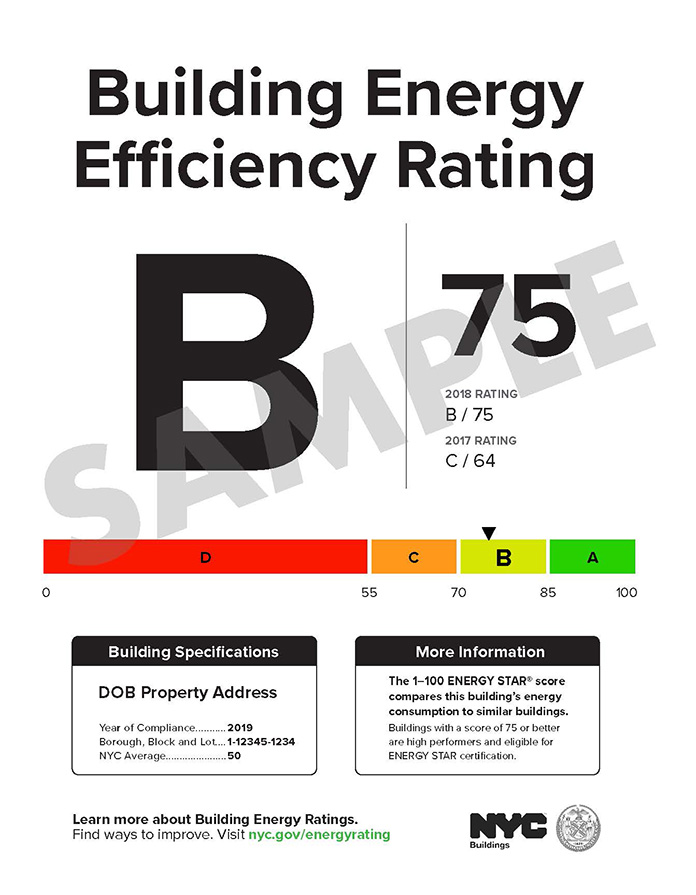
There are two components to building performance in New York that you should be aware of: Local Law 33 and Local Law 97. While Local Law 97 (LL97) focuses on carbon limits, a related regulation—Local Law 33 (LL33)—requires buildings to literally wear their performance on their sleeve. Like the letter grades seen in NYC restaurant windows, multifamily buildings over 25,000 square feet must publicly display a Building Energy Efficiency Rating label as shown below.
These labels feature a letter grade (A through D) and an Energy Star score (1–100) based on the building’s annual benchmarking data. Owners are required to download this label from the DOB NOW portal every year between October 1st and October 31st. It must be printed and posted in a “conspicuous location” near every public entrance, positioned between four and six feet from the ground. Failing to display the current year’s grade results in a $1,250 annual fine and a Department of Buildings (DOB) violation.
Meanwhile, as New York City marches toward its goal of carbon neutrality (net zero) by 2050, LL97 stands as one of the most significant pieces of legislation impacting the real estate industry. Part of the Climate Mobilization Act, this law mandates strict greenhouse gas (GHG) emissions limits for the city’s larger buildings.
For multifamily owners and operators, understanding these requirements are a current financial and operational priority with the first reporting having been due on May 1, 2025, for building consumption during the period of January through December, 2024.
Which multifamily buildings are covered?
LL97 applies to “covered buildings,” which generally include:
- Individual buildings exceeding 25,000 gross square feet. You must include all square footages in determining the building’s size, including any amenity space, leasing office, commercial or retail space that is in the building.
- Two or more buildings on the same tax lot that combined exceed 50,000 square feet. This means that if your property consists of ten, five thousand square foot buildings on the same tax lot, LL97 applies to your property. The law is also unique in that the Building Performance standard and scoring occurs at the property level, not the building level.
It is important to note that there are alternatives offered for Affordable Housing: If more than 35 percent of your property is rent-regulated then you can often choose a “Prescriptive Pathway,” which involves implementing 13 specific low-cost energy conservation measures (e.g., insulating pipes, weatherstripping) instead of meeting strict carbon caps. If less than 35 percent of your property is rent-regulated (but you have rent-regulated units) then generally you must meet the standard emissions limits but were granted a delayed start, with their first compliance reports due in May 2027 (covering 2026 data). This gives the owner a little more time compared to conventional properties which already need to be in compliance.
The compliance landscape: Average scores and performance
The good news is that currently, many multifamily buildings are well-positioned for the initial target phase:
- 2024–2029 Period: Approximately 94 percent of multifamily buildings already meet these emissions limits.
- 2030–2034 Period: The standards tighten significantly. Current data suggests only about 49 percent of multifamily buildings meet the 2030 limits today. Without intervention, nearly half of the city’s multifamily stock will face fines starting in 2030.
What multifamily buildings need to do to comply
To stay below the emissions caps, buildings must reduce their “carbon footprint,” which in NYC is largely driven by onsite fossil fuel combustion (think boilers, gas appliances, etc.).
- Annual reporting
As mentioned previously, starting in 2025, owners must submit an annual emissions report by May 1st for the previous calendar year. This report must be certified by a Registered Design Professional (a licensed architect or engineer).
- Energy efficiency upgrades
Common retrofits for multifamily buildings include:
- Heating systems: Tuning steam systems, replacing old boilers with high-efficiency models, or switching to electric heat pumps.
- Envelope improvements: Adding roof insulation, sealing air leaks (weatherization), and upgrading windows.
- Lighting: Transitioning all common area and unit lighting to LEDs (often required by Local Law 88 as well).
- “Good faith effort” extensions
If a building cannot meet its limit, the DOB may grant an extension if the owner demonstrates a “good faith effort.” This requires a filed Decarbonization Plan and proof that work is underway.
Penalties for non-compliance
The financial consequences for ignoring LL97 are designed to be more expensive than the cost of upgrades.
Important deadlines: The first penalty period
The first compliance period officially began on January 1, 2024.
- First reporting deadline: May 1, 2025. This report covers the building’s energy usage for the 2024 calendar year.
- Grace period: For the 2025 filing only, the city provided a grace period through June 30, 2025, allowing owners to file without late fees.
- First fines: Penalties for exceeding 2024 carbon limits are assessed based on the May 2025 filings.
Buildings that have not yet assessed their 2024 data are already in the “penalty zone” for the current cycle and should act immediately to file an extension or a “good faith effort” plan to mitigate late fees.