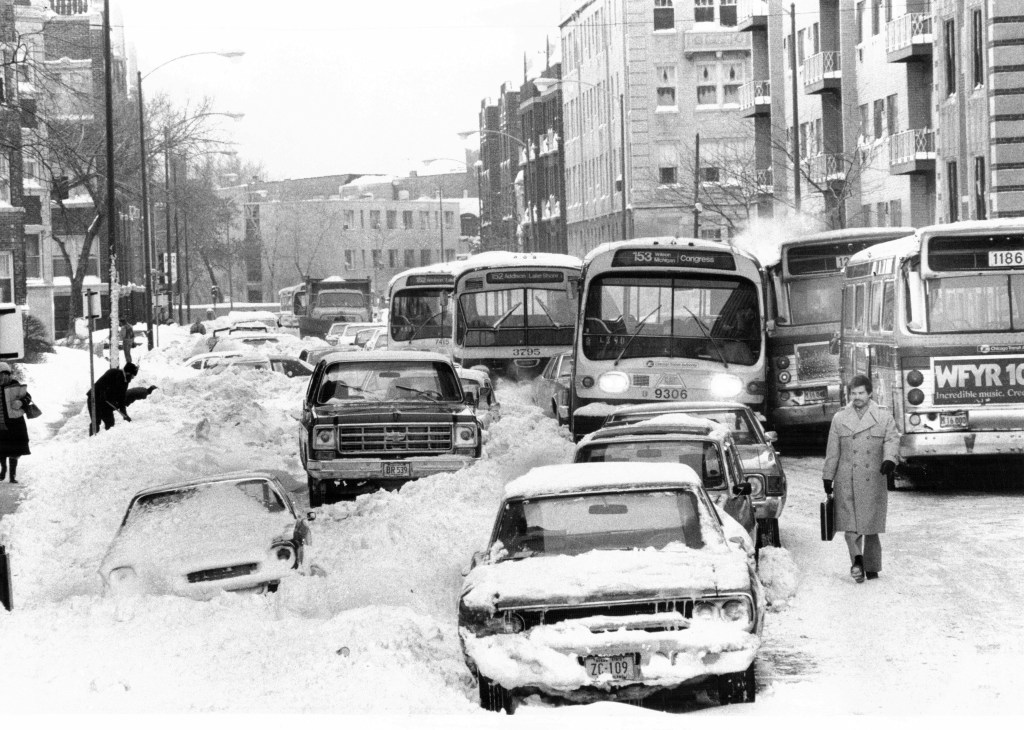
Here’s a look back at what happened in the Chicago area on Jan. 12, according to the Tribune’s archives.
Is an important event missing from this date? Email us.
Front page flashback: Jan. 13, 1928
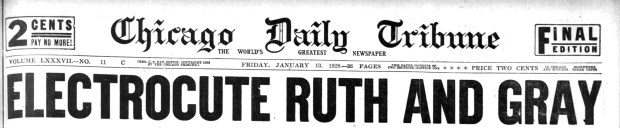 Ruth Snyder and Henry Judd Gray were electrocuted within a few minutes of each other at 11 p.m. on Jan. 12, 1928, at Sing Sing prison in New York. They were found guilty of killing Snyder’s husband 10 months prior. (Chicago Tribune)
Tribune photographer Tom Howard — on loan to the New York Daily News — captured a photo of Ruth Snyder at New York’s Sing Sing Prison as she was electrocuted. The photo, however, was not published in the Tribune.
Weather records (from the National Weather Service, Chicago)
- High temperature: 62 degrees (2005)
- Low temperature: Minus 14 degrees (1918)
- Precipitation: 2.76 inches (1960)
- Snowfall: 7.4 inches (1908)
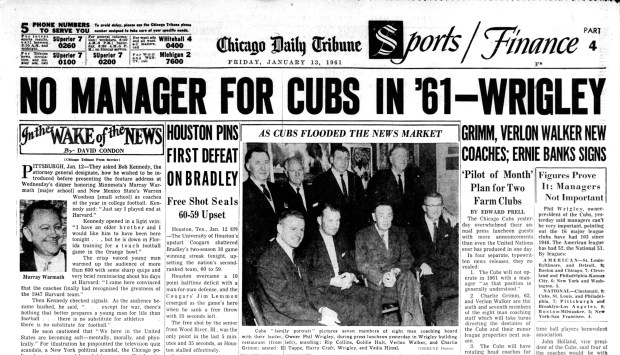 Chicago Cubs owner Philip K. Wrigley claimed on Jan. 12, 1961, that the term “manager” was antiquated. That’s why he instituted the “college of coaches,” eight men rotating in positions of leadership, for the 1961 season . The idea was abandoned by the 1963 season. (Chicago Tribune)
1961: “Now, about the word ‘manager,’” Chicago Cubs owner Philip K. Wrigley said as he addressed the team’s annual press luncheon. “I looked it up and the pure definition is ‘dictator.’” (Tribune editors balked at this explanation.)
With that, Wrigley announced a plan to have the team run by a revolving college of coaches. He produced a sign for the meeting that said, “Anyone who remains calm in the midst of all this confusion simply does not understand the situation.”
The team finished next-to-last in the standings in 1961 and 1962 before the experiment was abandoned.
1978: Mayor Michael Bilandic announced a special committee to study the feasibility of a new stadium complex that would be the new home for the Chicago Bears and also include horse racing and jai alai, a game that attracted large crowds and high-stakes gamblers in Florida. The complex never materialized.
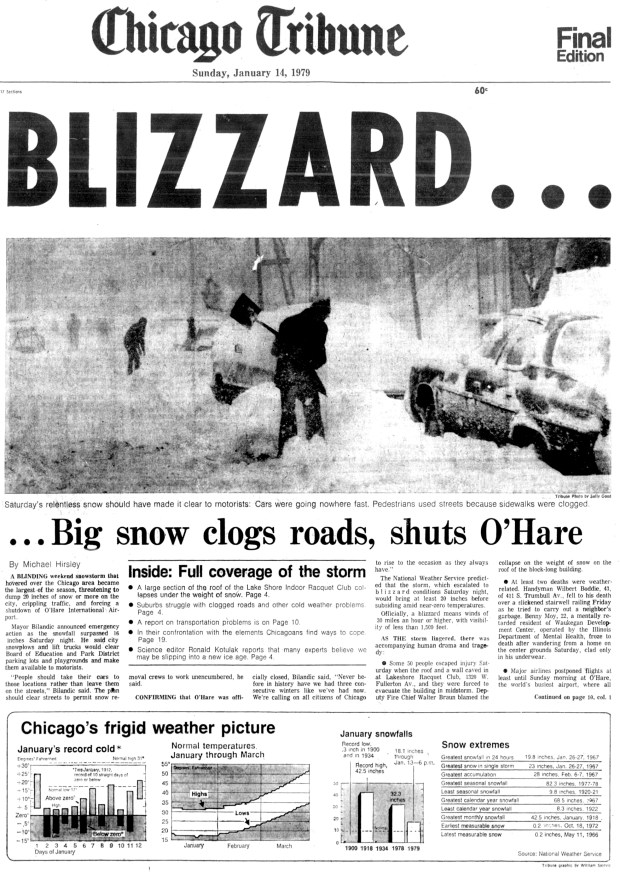 The storm of Jan. 12-14, 1979, dropped more than 20 inches of snow on the city. This was the worst storm of a winter in which almost 90 inches of snow, the all-time season record, fell on the city and was also remembered as the second-coldest in Chicago’s recorded history. (Chicago Tribune)
1979: The city was walloped by a massive blizzard that dumped 20.3 inches of snow. At the time it was the second-largest snowfall in city history. Today, it’s the fourth-largest. It was not only the worst storm of that winter, the snowfall was also be a major factor in the city’s next mayoral election.
Vintage Chicago Tribune: Do you remember when 90 inches of snow fell almost 50 years ago?
After observing the city by helicopter, Chicago Mayor Michael Bilandic ordered city snowplows to clear 250 school and Park District parking lots so residents could move their cars off the roads, but that effort was a failure. Many motorists couldn’t make it past double- and triple-parked cars on the still unplowed side streets. Garbage couldn’t be collected for at least 10 days. Mail was delivered late.
Chicago’s 10 largest snowfalls since 1886 — and how the Tribune covered them
Instead of taking responsibility for the mishandling of the snow removal, Bilandic lashed out, saying police would be ticketing vehicles and ordering them towed if not removed from Chicago’s streets. He also said there would be “no exceptions” for sick, elderly or poor people who couldn’t move their cars. “If there are hardship cases, they can tell that to a judge. That’s what a judge is for,” he told reporters. Bilandic later apologized for his mishandling of the snow removal, but Chicago residents — and voters — weren’t satisfied.
2000: The U.S. Supreme Court decision in Illinois v. Wardlow gave police broad authority to stop and question people who run at the sight of an officer.
The 5-4 ruling reversed an Illinois Supreme Court decision that held two Chicago officers were wrong to chase and stop William Wardlow when he ran away after seeing them cruising a street on the West Side.
Want more vintage Chicago?
Subscribe to the free Vintage Chicago Tribune newsletter, join our Chicagoland history Facebook group, stay current with Today in Chicago History and follow us on Instagram for more from Chicago’s past.
Have an idea for Vintage Chicago Tribune? Share it with Kori Rumore and Marianne Mather at krumore@chicagotribune.com and mmather@chicagotribune.com