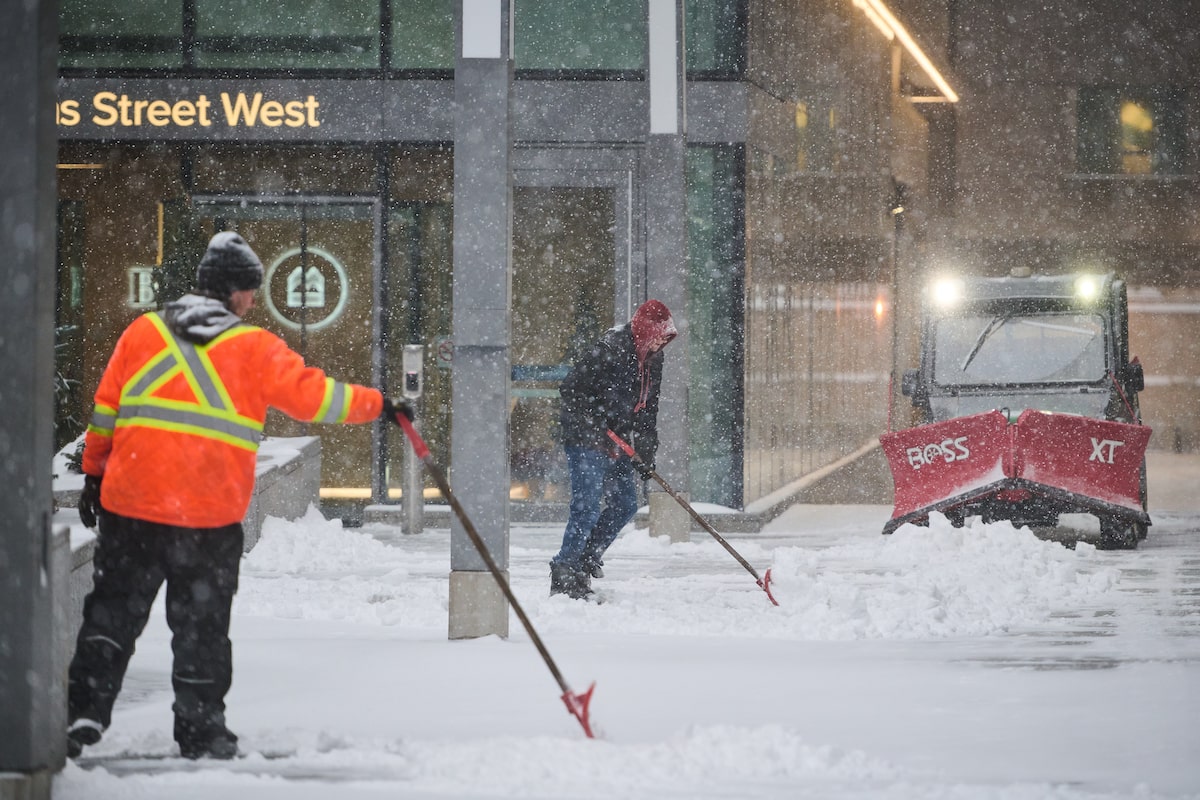
Workers clear snow during a storm on Boxing Day in Toronto, in 2025.Sammy Kogan/The Canadian Press
If all goes according to plan, Calgarians will be able to return to their bathrooms this week without worrying that a simple flush of the toilet could push the city’s ailing water system toward another catastrophe.
For nearly two weeks, residents have faced emergency water restrictions as city crews repair the second major rupture in 18 months along a water main that supplies up to 60 per cent of the municipality’s potable water. Officials anticipate easing restrictions early this week but warned that the frail Bearspaw South Feeder Main could blow again before a more permanent solution is ready.
“We have a ticking time bomb underneath our streets,” Mayor Jeromy Farkas said.
The recent break coincided with the release of a report into the last major failure along the line, in June, 2024, that pointed to an array of political and bureaucratic reasons the pipe has fallen into disrepair. But it gave little consideration to sodium chloride, a chemical culprit that saturates local soils and has become both a saviour and a scourge across the country, racking up an estimated $5-billion in infrastructure damage annually.
Every year, the City of Calgary covers its roads with between 40,000 and 50,000 tonnes of road salt, an unrefined version of the sodium chloride found in table salt. A previous city-commissioned investigation found that elevated chloride levels in the soil from road salt contributed to the water pipe’s 2024 blowout.
City of Calgary ignored two decades of warning signs about water system, report finds
The failing portion of the Bearspaw South Feeder Main was made of a combination of concrete and steel wrapped with high-tensile wires. It was supposed to last 100 years, but 50 years into its service life investigators found that chloride had caused hydrogen embrittlement and stress corrosion in the wires.
The same chemical used to keep the city’s winter roads safe was endangering its water system.
That tension extends far beyond Calgary. Every year, Canada scatters around seven million tonnes of sodium chloride on public roads. That’s enough to fill a line of dump trucks stretching from Vancouver to Toronto, and it likely makes us the biggest per-kilometre salt users in the world, according to a 2020 Norwegian study.
We’re all safer for it. One widely cited Marquette University study determined that spreading salt on icy roads can reduce collisions by around 90 per cent.
“Of course, salt is important for safety,” said Kamal Hossain, associate professor in transportation engineering at Carleton University. “But it goes into our water system, destroys our vegetation, kills aquatic life, corrodes our vehicles and infrastructure.”
2024: Sixty years of road salt has destroyed Ottawa’s Alexandra Bridge, officials say
Those salt-induced casualties include the steel and concrete underpinning Toronto’s Gardiner Expressway (currently undergoing a nearly $2-billion renewal); Montreal’s old Champlain Bridge (replaced after just 57 years owing in part to heavy salt corrosion); and a mall parking lot in Elliot Lake, Ont., that collapsed in 2012, killing two people. Canada’s Ecofiscal Commission, a non-governmental group of economists, estimates that these hidden costs add up to $5-billion a year.
“We have aging infrastructure and we’re accelerating that aging through oversalting,” said Julie Wright, national director of Our Living Waters, a non-profit group, and a city councillor in Waterloo, Ont., where chloride originating from road salt has infiltrated the groundwater residents rely on to drink.
The region’s water treatment systems do not desalinate, a costly and energy-intensive process.
The Canadian Council of Ministers of the Environment considers chloride in water safe for aquatic life as long as it doesn’t exceed 120 milligrams a litre. But waterways around big Canadian cities routinely measure more than 10 times that threshold.
Zooplankton are especially sensitive. Because they eat algae and, in turn, are eaten by small fish, they are a vital link in aquatic food chains, converting algal growth into animal energy.
The Decibel: The sorry state of Canada’s water pipes
“Is that where we want to go – lakes that are full of algae and lacking in diversity? I don’t think so,” said Shelley Arnott, a Queen’s University biology professor specializing in aquatic ecology.
Her research has found that organisms in many water bodies start to show adverse effects at chloride levels of between 5 and 40 mg/L, suggesting Canada’s guidelines could be too forgiving.
“We simply have to do something other than apply so much salt,” she said.
But do what? Road authorities are experimenting with an array of food-based alternatives – coffee grounds, cheese brine, pickle juice and beet juice, which Dr. Arnott has found can be more toxic than salt.
Many municipalities are reducing salt by using brines and adopting technology that adjusts salt application based on vehicle speed and road conditions.
Yet for all the reduction efforts, salt continues to accumulate in the environment. Chloride levels in Lake Simcoe, for instance, about 60 kilometres north of Toronto, have increased steadily by about 0.7 mg/L a year since the 1970s despite reduction programs throughout the region.
Opinion: Calgary’s water-use restrictions are a symptom of a much larger problem in Canada
Along portions of the Bearspaw line that failed in Calgary in 2024, investigators found chloride levels had spiked by as much as 15 times in just a decade.
One underexamined source is private property. In Ontario, private contractors tend to use far more salt than necessary out of liability fears, said Joe Salemi, executive director of Landscape Ontario, an industry group representing snow-removal companies.
“Just being named in a lawsuit usually means spending $20,000 or $30,000 in a lawsuit,” he said.
Municipalities face the same liability concerns, said Wyatt Weatherson, a PhD student in Toronto Metropolitan University’s Urban Water program focusing on road salt use.
He says governments could focus on public education, encouraging people to use winter boots and winter tires to reduce the need for salt. But over all, he says the outlook for eliminating road salt is bleak – at least until climate change wipes out winter in much of the country by 2100 or so.
“It’s a wicked problem,” he said. “There’s no clear solution.”