By Erick Johnson
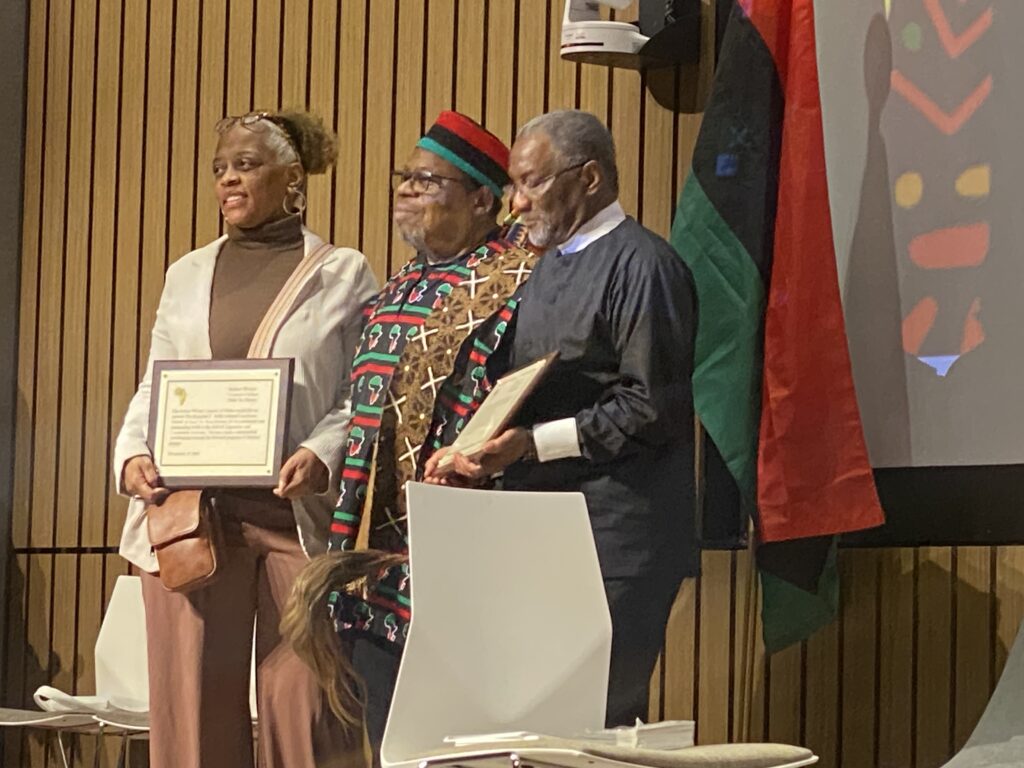
Kim Dulaney, a former employee of the DuSable Black History Museum and Education Center who was fired after filing whistleblower complaints, was recently honored for her contributions to African culture.
Dulaney received the Bolozi Wazee Shule Watoto Award, presented by the Council of Elders, during a Kwanzaa celebration on December 27 at Malcolm X College.
The award reinforced the day’s Kwanzaa principle of Kujichagulia, the Swahili word for self-determination.
The DuSable terminated Dulaney in October, citing organizational restructuring. Dulaney, however, has said she was fired for speaking out against what she described as poor business practices at the museum.
While serving as the museum’s vice president for education and programs, Dulaney filed whistleblower complaints with the Chicago Park District, Mayor Brandon Johnson’s office, and the Illinois Attorney General’s office. In December, she filed a lawsuit alleging the museum retaliated against her after she raised concerns about the alleged misuse of funds.
Kwanzaa is over, but this year there were no African dancers, thumping drumbeats, or Kinaras at the DuSable Black History Museum and Education Center.
The museum did not celebrate Kwanzaa during the holiday season as it continued to promote and showcase its latest exhibit focusing on African American artists and intellectuals who once lived in Paris. Those seeking Kwanzaa celebrations instead traveled to other venues across the city to experience African and Pan-African culture.
During the award presentation at Malcolm X College, neither Dulaney’s termination nor her lawsuit against the DuSable was mentioned. Instead, speakers highlighted her academic background and recent coverage in multiple news outlets.
A former professor of African American studies at Chicago State University, Dulaney currently works as a cultural consultant.
Gimbu, a member of the Council of Elders, said Dulaney received the award for her “consistency in making outstanding contributions to the African American community.”
After accepting the award, Dulaney said, “I never get awards like this because I make people upset. I hold people accountable. I ask people to do things they wouldn’t do. I put pressure on them to contribute to the community. But this is the work I do for the people who sent me in there to work.”
Before her termination, Dulaney reinstated the DuSable’s Kwanzaa celebration, which had been discontinued for several years under the leadership of President and CEO Perri Irmer.
After Dulaney was fired on October 3, the DuSable did not hold a Kwanzaa celebration during the holiday season last December.
The Chicago Crusader has learned that plans for a Kwanzaa celebration at the DuSable had been underway. However, about two weeks before Kwanzaa began on December 26, the museum decided not to proceed, according to sources familiar with the discussions.
Sources said members of the Council of Elders held talks with the DuSable following Dulaney’s firing. While some members opposed holding a Kwanzaa event at the museum, others continued discussions with museum officials.
With the DuSable’s auditorium closed for renovations, sources said there were conversations about the museum sponsoring a Kwanzaa celebration at Little Black Pearl, a cultural arts center in Kenwood. However, when members of the Council of Elders proposed including a community forum addressing the museum’s financial concerns, the DuSable withdrew from the plans, sources told the Crusader.
By contrast, major Black museums in Detroit, Philadelphia, and Charleston, South Carolina, held extensive programs observing all seven days of Kwanzaa.
At the same time, the DuSable is promoting “Paris in Black,” an exhibit examining the lives of Black writers, performers, and intellectuals—including Richard Wright, James Baldwin, Langston Hughes, and Josephine Baker—who found artistic and personal freedom in Paris amid racial discrimination in the United States.
The exhibit includes rooms dedicated to Hughes and Baker and features Wright and Baldwin, along with lesser-known Black artists who lived and studied in Paris through fellowships.
Wright lived on Chicago’s South Side before writing his most famous novel, “Native Son.” The Bronzeville home where he lived is a designated Chicago Landmark.
Hughes’ 1951 poem “A Dream Deferred,” which includes the line “Does it dry up like a raisin in the sun?” later inspired Lorraine Hansberry’s 1959 play “A Raisin in the Sun,” based on her family’s experiences in the then predominantly white Washington Park neighborhood.
These writers were central figures in the Chicago Black Renaissance of the 1940s and 1950s. Their Chicago connections, however, are not highlighted in the Paris in Black exhibit.
Nor does the exhibit reference Baldwin’s 1968 interview in Chicago with Esquire magazine, in which he commented on racial inequality on the city’s South and West Sides during the administration of Mayor Richard J. Daley.
“And you walk along Chicago’s South Side, and I don’t care how many liberals are in Chicago—you can tell by looking at the streets, the faces, the children, the houses what Chicago really means to do with its Black population,” Baldwin said at the time.
Some Chicago residents expressed disappointment that the DuSable did not host a Kwanzaa celebration while focusing on the Paris in Black exhibit. During the holiday season, the museum’s website made no mention of Kwanzaa, while promotional images for Paris in Black dominated its homepage.
“The DuSable is our cultural mother,” said Sel Dunlap, who has protested outside the museum since October. “She is being prostituted. Our culture should be the priority. Paris in Black has its place, but it’s secondary.”
Gloria Norwood, a resident of Avondale Park, said, “Every now and then, we have to reflect back on our roots.”
Kwanzaa is an African and Pan-African holiday observed from December 26 through January 1. It was founded in 1966 by scholar and activist Dr. Maulana Karenga following the Watts uprising in Los Angeles.
Rooted in traditional African harvest celebrations, Kwanzaa centers on seven principles, with a different principle observed each day.
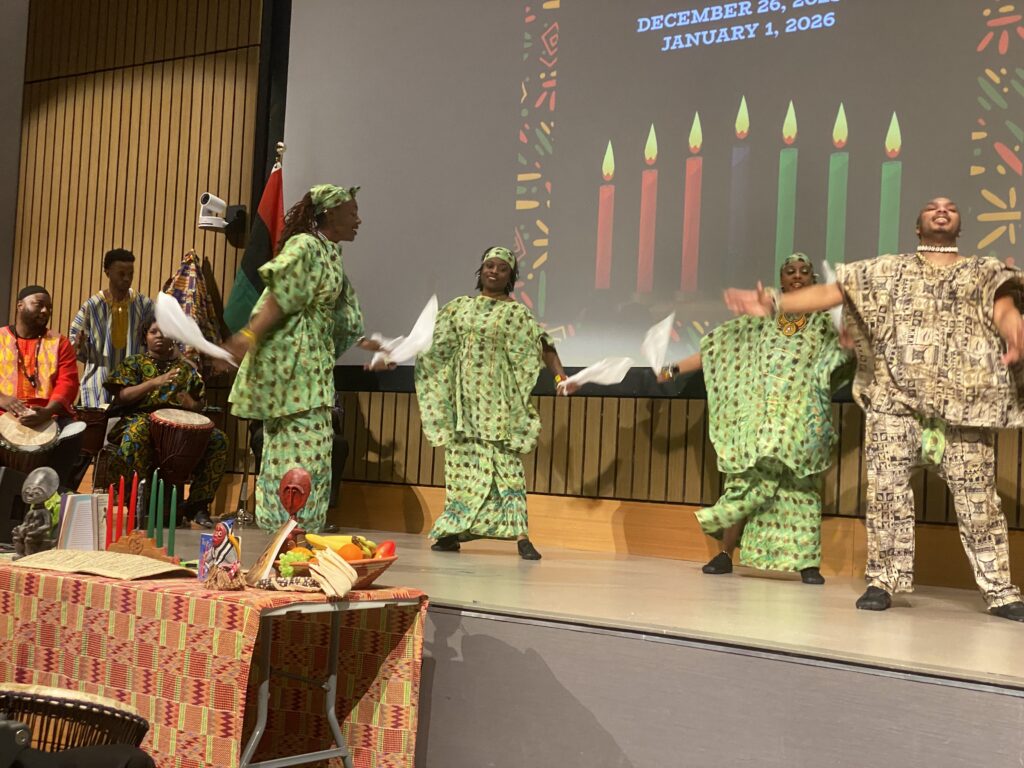
Across Chicago and the country, Kwanzaa celebrations continued throughout the holiday. The Charles H. Wright Museum of African American History in Detroit and the African American Museum in Philadelphia both hosted multi-day programming.
At Malcolm X College on the first day of Kwanzaa, African-clad drummers led a procession to open the celebration, followed by libations and the lighting of the Umoja candle.
The day’s emcee, M3ec Khalfani Nubian Malik, emphasized the importance of Kwanzaa as a cultural reaffirmation.
“As African people, it’s important that we engage in Kwanzaa,” Malik said. “It’s an opportunity for us to embrace who we are as African people and to reconnect with our village.”