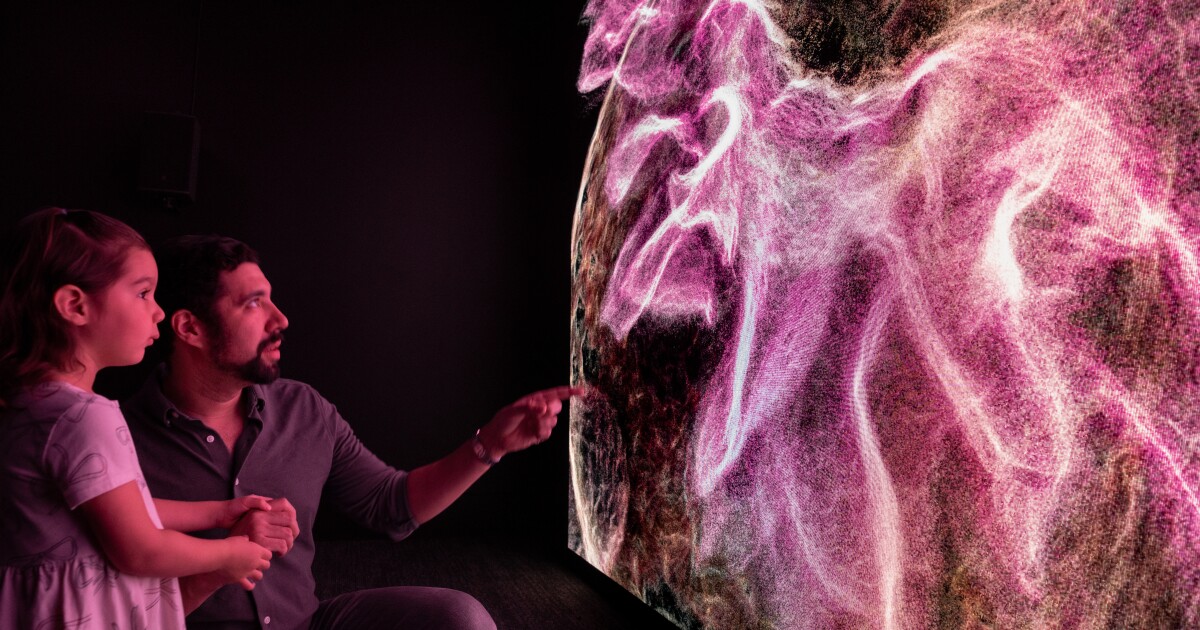
An art exhibit at Desert Botanical Garden in Phoenix invites visitors to take a new look at their surroundings.
“What ScanLab has done with this show has allowed us a new way to see the desert,” said Elaine McGinn, the chief experience officer at Desert Botanical Garden.
She’s talking about the work done by the London-based studio ScanLAB Projects, called “FRAMERATE: Desert Pulse.” It was a two-year process to put together, and involved sensors and other technology at around 20 locations — both inside the garden and elsewhere around metro Phoenix.
Those devices took readings every day for a year; the results show up on screens throughout the garden, complete with an original soundtrack.
The images look a little like time-lapse videos and show changes that can be easy to miss in real time — some can happen overnight while others can take a year or longer: plants blooming and then withering; cacti expanding after a rain; homes being built; Chase Field filling up and then emptying out after a Diamondbacks game.
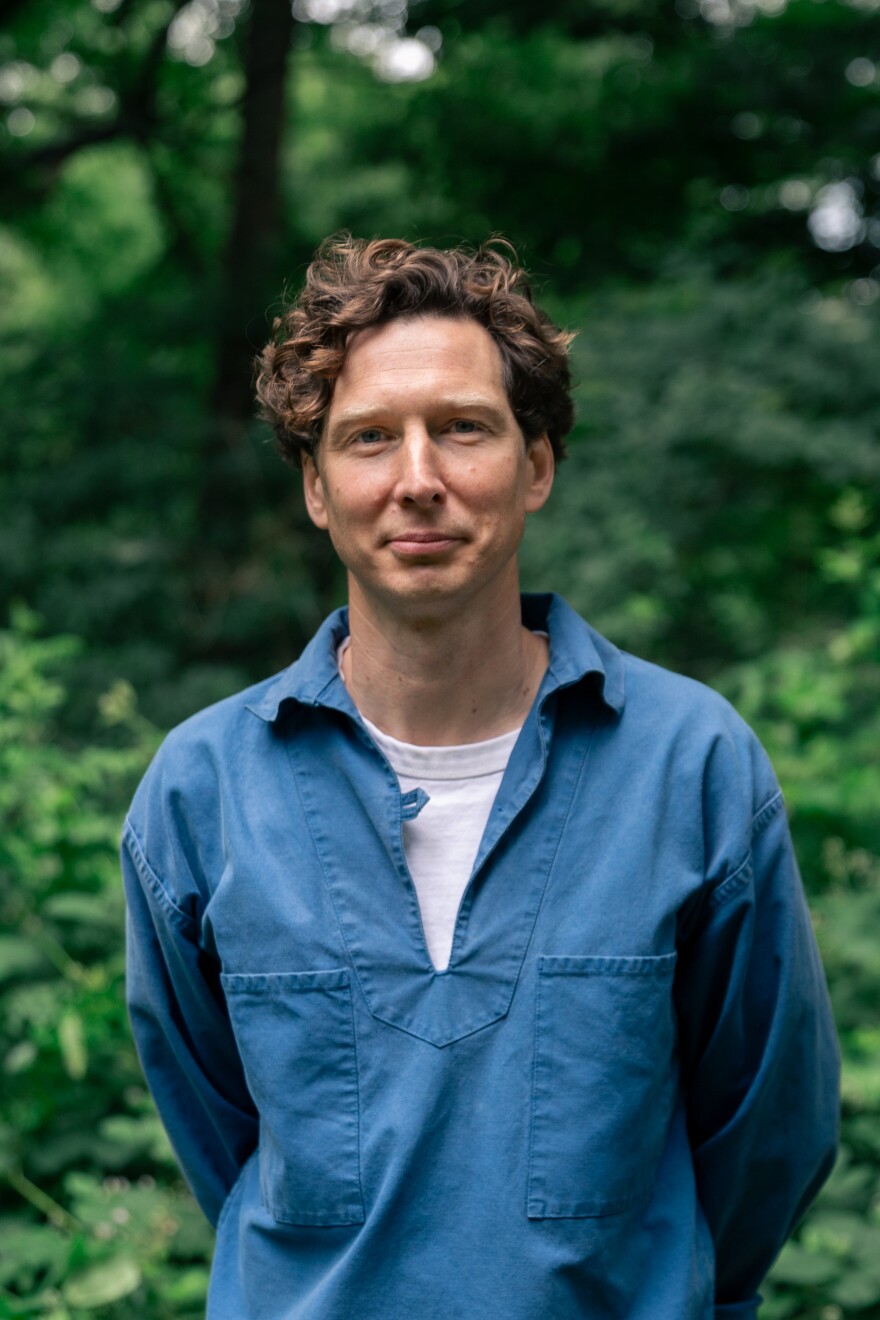
Matthew Shaw is ScanLAB’s co-founder and creative director.
“‘Desert Pulse’ is a portrait of a place over time. It’s kind of our studio’s homage in a way to Phoenix and to the Sonoran Desert. And I think it offers audiences an entirely new way to see that landscape evolve over time — to see the way the landscape shifts due to natural causes but also due to the way that we as humans are influencing,” Shaw said.
Shaw says ScanLAB has been doing this kind of work for a few years — but never in a place like the Sonoran Desert.
ScanLAB Projects
/
Handout
Matthew Shaw
So that meant he and his team had some learning to do. He says they were looking for a series of locations where they could really see natural change occur — like how the flora of the desert, including cacti, change over time; spaces where the presence or lack of water was influencing change; and spaces where humans are directly influencing the environment.
Shaw said coming from the UK, the word desert meant a few things to him. But he said Phoenix and the Sonoran Desert have proven almost all of them totally wrong.
“I think the biggest thing that I take away is just how filled with life the natural world is there. The way that cacti have evolved and the way that cacti shift over the course of a year to deal with the conditions in which they are growing is just absolutely incredible,” Shaw said.
And, that overwhelming teeming with life aspect of the desert was something I was just not expecting at all.”
“And we work with this very special technology. So, 3D scanning and in particular a form of 3D scanning called LiDAR scanning. And this is the technology that enables driverless vehicles to see the world around them. It’s a technology that everybody is starting to have on their mobile phones as well,” Shaw said. “It’s really, at least from our studio’s perspective, the future of photography. You know, photography is no longer a 2D thing. It’s a 3D thing. It’s a 4D thing when you think of kind of 3D movies as well.”
“So, ‘Desert Pulse’ uses the very, very cutting edge of that technology to document these landscapes in a way that they’ve never been documented before, and to document them with this level of precision and this level of intensity that is totally kind of groundbreaking science as well as a groundbreaking piece of artwork, hopefully.”
1 of 6
— desert-pulse-ephrocactusGeometricus-20260112.png
“FRAMERATE: Desert Pulse.” Tephrocactus Geometricus, 2025. Pointcloud animation still.
ScanLAB Projects / Handout
2 of 6
— Desert-Pulse_Horizon-20260112.jpg
“Horizon | Imprint” in the FRAMERATE: Desert Pulse exhibit at Desert Botanical Garden in Phoenix.
Rick White-Pickett / ScanLAB Projects
3 of 6
— desert-pulse-elsewhen-20260112.jpg
“Elsewhen” in the FRAMERATE: Desert Pulse exhibit at Desert Botanical Garden in Phoenix.
Rick White-Pickett / ScanLAB Projects
4 of 6
— desert-pulse-kid-20260112.jpg
The FRAMERATE: Desert Pulse exhibit at Desert Botanical Garden in Phoenix.
Rick White-Pickett / ScanLAB Projects
5 of 6
— desert-pulse-calyx-20260112.jpg
“Calyx” in the FRAMERATE: Desert Pulse exhibit at Desert Botanical Garden in Phoenix.
Rick White-Pickett / ScanLAB Projects
6 of 6
— desert-pulse-calyx-2-20260112.jpg
“Calyx” in the FRAMERATE: Desert Pulse exhibit at Desert Botanical Garden in Phoenix.
Rick White-Pickett / ScanLAB Projects
That 3D and 4D tech Shaw mentioned? He says that helps viewers walk through these landscapes in a way that’s just not possible to do otherwise.
Each scan is made up of millions of precise data points — Shaw hopes that’s revelatory for the scientists who study the desert and its plants. It offers a different perspective for scientists who walk past a cactus every day to be able to watch it over the course of a year all at once.
McGinn with Desert Botanical Garden calls that one of the beauties of the project.
“That data will be available to our scientists for years to come. Some of it they don’t know yet. I mean, they may have a question ten years down the road and say, ‘Oh, wait, we have something that could show us that,'” McGinn said.
“The footage taken of the fire in north Scottsdale is a great example — watching that over the course of a year come back to life and regenerate. They’ll be able to utilize that moving forward. Also, the saguaro site that one of our botanists uses to monitor the growth of cacti. Already we have seen some pretty interesting data there where some of the saguaros are growing faster than others, and we don’t know why,” McGinn said.
McGinn said that data will also be made available to any scientist doing research on desert plants. But beyond the scientific information, she believes “Desert Pulse” will help both residents and visitors see — and feel — this place a little differently.

Rick White-Pickett
/
ScanLAB Projects
“Calyx” in the “FRAMERATE: Desert Pulse” exhibit at Desert Botanical Garden in Phoenix.
“It was important to the ScanLAB team to tell the story not just of the nature, the natural environment, but also the people who live here as well. And not just from the impact that people have on the desert environment, but also the ways that we also are very resilient and have community,” McGinn said.
“There’s one scene from a baseball game, for instance, where the stadium fills up, the game goes on, and it’s just kind of that sense of being together and community. But there’s also the impact that we are having — the housing site, for example, was right there where our, Raul Puente, our curator of collections, has one of his research sites where he’s monitoring saguaros and their growth. And almost overnight, this housing development in north Scottsdale was going up, so we took advantage of that.”
So that’s a place where the humans are encroaching upon the environment — I don’t want to say encroaching — humans and environment are getting right next to each other in close proximity,” McGinn said. “So, what’s that impact, what it looks like?”
McGinn shared what surprised her about first seeing the images.
“You know, I’ve been living with these images for a long time. I was seeing bits and pieces of them. The first thing that surprised me is the dancing cholla, I call it. I’ve been working in the Desert Botanical Garden for 28 years, and I always think, ‘Oh, you know, they’re not there’s not a lot of movement here. There’s not a lot of growth that you would see, like in a forest or in a woodlands area,'” McGinn said.
“But to see that these cactus are actually moving throughout the year — they’re drooping when it’s hot, but they come alive when it’s rain. Saguaros, you know, contracting and expanding with water. So, really it has completely changed the way I see the desert,” she said.
Rick White-Pickett
/
ScanLAB Projects
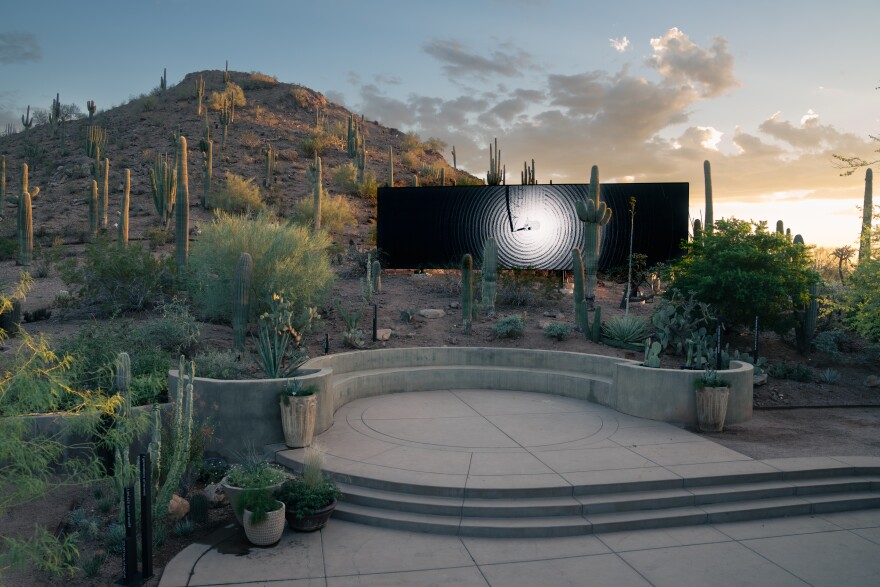
“Horizon | Imprint” in the “FRAMERATE: Desert Pulse” exhibit at Desert Botanical Garden in Phoenix.
And — no shade on any of the other art shows the garden has hosted over the years — this one, McGinn said, is a little different.
“This is the first one where it feels like it’s about the plants, and they are the stars, rather than art sitting among the plants, the plants are the stars,” McGinn said.
And that is part of the point, said ScanLAB’s Shaw. He wants viewers to see the desert in a new way, to pause and reflect — specifically on the changes happening over all kinds of timespans.
“At one end of the spectrum there, we allow people to see the blooming of a cacti, something that might be over just in one night — and many people miss that moment,” Shaw said. “And then at the other end of the spectrum, we’re watching landscapes shift over the course of an entire year, and we’re alluding to the way that landscapes have evolved over the life cycle of a saguaro, 175 years potentially. We’re alluding to the way that landscapes have formed over the lifespan of a river, like millions and millions of years.”
Shaw said he hopes those perspectives will allow viewers to think about the Sonoran Desert differently — its past, present and future.
“Desert Pulse” will be on display at Desert Botanical Garden through mid-May.
If you go
When: On display through May 10, 2026.
Where: Desert Botanical Garden, 1201 N. Galvin Parkway, Phoenix, AZ 85008.
More information: dbg.org/desertpulse