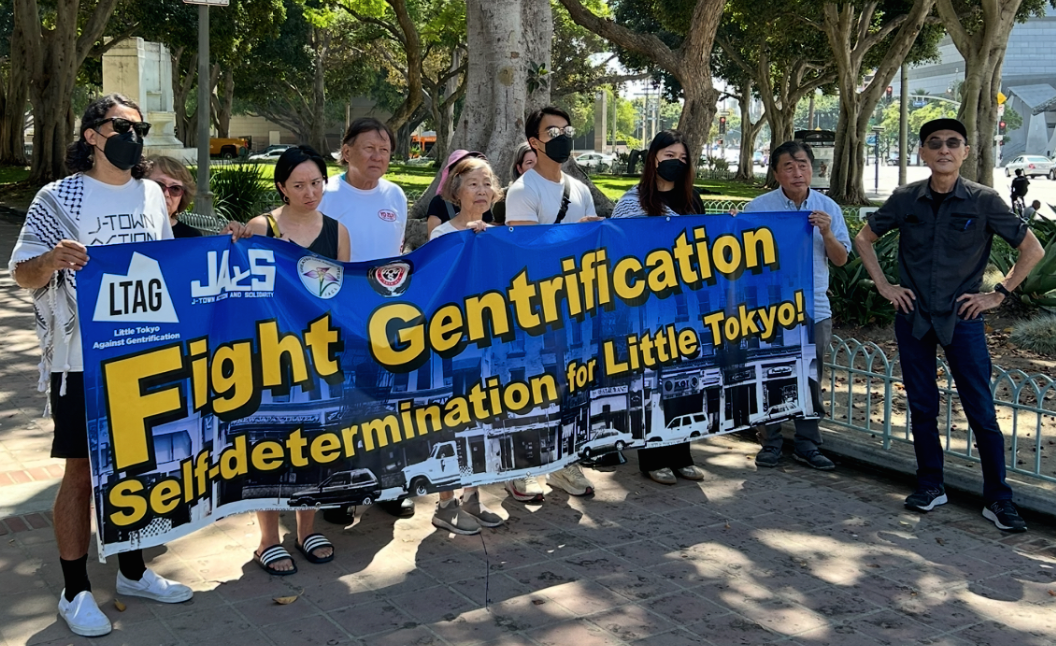
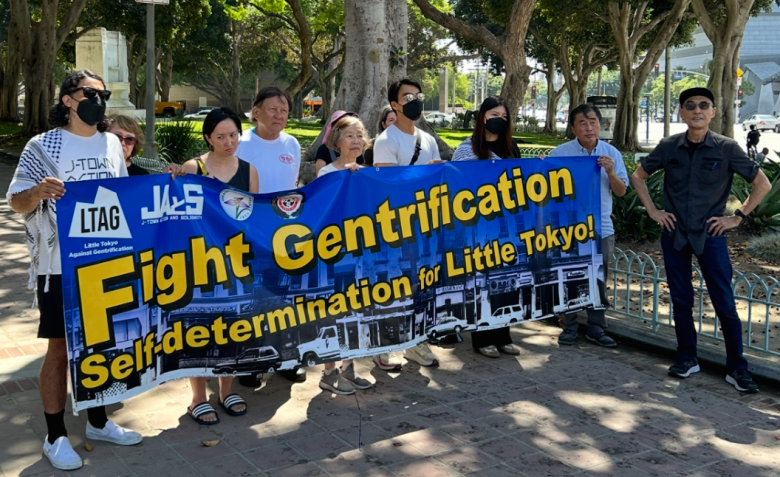
 Members of Little Tokyo Against Gentrification
Virtual town hall set for Jan. 11 to feature Little Tokyo residents, workers, business owners
Little Tokyo Against Gentrification
The 4th and Central mega-mall is a massive $2 billion development planned for the southeast edge of Little Tokyo. It spans 7.5 acres and is designed as a mixed-use complex, with 10 buildings originally proposed from 6 to 44 stories.
There will be hundreds of spaces for offices and stores, a public green space and about 1,600 housing units. The law requires 16% be some combination of extremely-low and low-income rental and condos units.
Issues of concern from the community to be discussed at the town hall: 10 buildings would block out the sun from parts of Little Tokyo with five of them at 44, 27, 27, 18, and 12 stories. The Little Tokyo Community Council, in which LTAG participates, negotiated with the developer to reduce the height of the one 44-story building to 30. And to get rid of the hotel originally proposed.
The developer’s current proposal of about 16% of 1,600 units at low income is the very minimum mandated by law. No language says it cannot be increased. Little Tokyo seriously needs more affordable low-income housing.
There are about 400-500 seniors and other low-income Asian families in two federally subsidized housing programs that face rising rents and potential loss of Section 8 housing vouchers due to Trump’s housing edicts. About 58,000 citywide. There are dozens of Little Tokyo residents who are currently unhoused.
Little Tokyo Against Gentrification (LTAG) grew out of support for Suehiro Cafe during its eviction in 2024. Hundreds of supporters gathered on First Street and spoke out. Unfortunately, Suehiro was evicted and moved to 400 S. Main St., but is slated to return to Little Tokyo at the First Street North Project. LTAG also secured that no dispensary replaced Suehiro by picketing for two months on Saturdays.
Recently, tenants at Japanese Village Plaza and Little Tokyo Galleria have also reported rent increases.
The estimated construction period, seven years, is a long time for fine particles (PM2.5) to spread. Within 1,000 feet the largest senior housing facility with 90% Japanese and Korean residents are the Lumbini Childcare Center and two temples with daily community programs.
During Trump 1.0, when safe air regulations were relaxed, Chinatown and surrounding areas including Little Tokyo had “some of the worst PM2.5 pollution in Los Angeles,” according to The L.A. Times. Although the developer promises “green construction,” LTAG is concerned about what that really means in detail.
LTAG wants: Adequate low-income housing, low rents for Little Tokyo legacy small businesses, zero-emission green construction measures, public green spaces, and a venue for community events.
There are two more public hearings left: City Council’s Planning and Land Use Management hearing and the final City Council hearing.
Little Tokyo once spanned from Temple Street to 9th Street, the home of many Japanese American produce businesses with offices on 1st or 2nd Street. And from Alameda to Los Angeles Street (east to west). Today, it has been reduced to just 2-1/2 blocks.
Due to the internment camps, LAPD’s Parker Center and waves of gentrification, thousands have been evicted. LTAG is confident that the Issei and Nisei who established Little Tokyo 140 years ago would be standing with the community. The 4th and Central mega-mall will irreparably harm and reshape the character of the last remaining Little Tokyo in the U.S. for generations to come.
LTAG is a 100% volunteer group composed of J-Town Action & Solidarity, Save Our Seniors Network, and Greater Los Angeles JACL. The zoom meeting will be Sunday, Jan. 11, from 2 to 3 p.m. To receive the Zoom link, email: LTUnitedFront@gmail.com
Articles for you