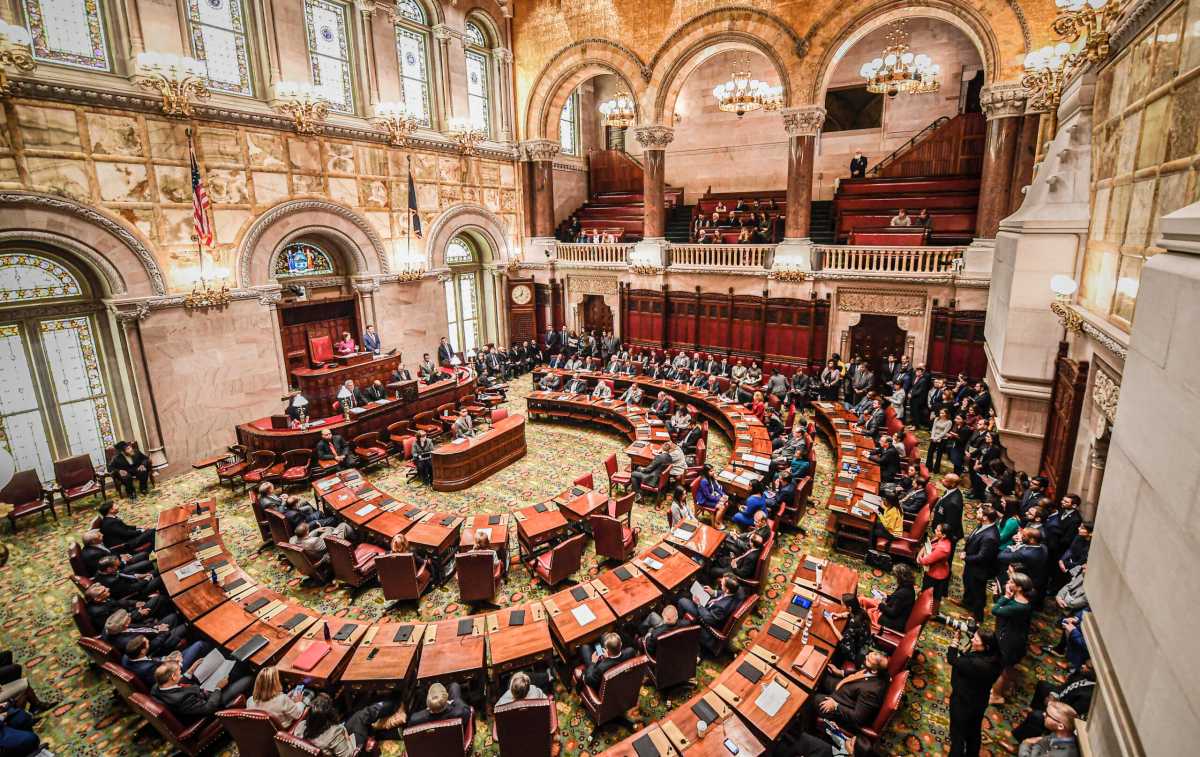
FILE – The New York state Senate meets in the Senate Chamber on the opening day of the legislative session at the state Capitol in Albany, N.Y., on Jan. 8, 2020. Democrats in the New York Legislature on Monday, Feb. 26, 2024, rejected a congressional map drawn by the state’s bipartisan redistricting commission, setting the stage for the party to craft lines that help Democrats in battleground House races that could determine control of Congress.
(AP Photo/Hans Pennink, File)
As the calendar turns to 2026, those running New York businesses have a lot on their minds. Inflation, economic uncertainty, tariffs, rising supply chain and labor costs, immigration enforcement’s impact on the workforce. The list is long.
It is understandable some things may not show up high on the radar, but are important nonetheless. We tracked four late-year 2025 changes that will impact employers in 2026. It is critical employers are aware of these December changes so they meet these compliance obligations in 2026.
Here’s what employers need to know:
Prohibition on retaliating against individuals requesting reasonable accommodations
Gov. Kathy Hochul signed Senate Bill S3398 into law to amend the New York State Human Rights Law (HRL) because that law was silent on whether requesting a reasonable accommodation constitutes a protected activity for purposes of retaliation claims.
The HRL requires covered employers to provide reasonable accommodations to employees with disabilities and prohibits retaliation against employees who engage in protected activity.
Since the statute did not expressly state that requests for reasonable accommodations were protected, courts have frequently grappled with this issue and often concluded such requests did not qualify as protected activity.
The amendment aligns the HRL with the New York City Human Rights Law to expressly provide that requesting a reasonable accommodation constitutes protected activity. As a result, New York employers should more carefully consider employment decisions involving employees who request accommodations, as adverse actions based on such requests may give rise to retaliation claims under the amended HRL.
New York formally establishes disparate impact framework within the HRL
The HRL was further amended to directly respond to the federal government’s newly adopted position on the treatment of “disparate impact” claims. It formally codifies disparate impact as a basis for proving unlawful discrimination under New York’s HRL.
The disparate impact theory generally provides that even facially neutral workplace policies may be deemed discriminatory if they disproportionately disadvantage a protected group.
The Trump administration has strenuously opposed the disparate impact theory, issuing an executive order declaring “it is the policy of the United States to eliminate the use of disparate impact liability in all contexts to the maximum degree possible to avoid violating the Constitution, Federal civil rights laws, and basic American ideals.”
The executive order also directed federal agencies to deprioritize enforcement of all statutes and regulations that include disparate impact liability. In response, the Equal Employment Opportunity Commission issued an internal memorandum stating it will no longer investigate charges based solely on a disparate impact theory. Instead, individuals seeking to pursue such claims must do so in court, rather than through the EEOC’s administrative process.
As a result of this federal shift, New York amended the HRL to ensure disparate impact claims remain fully recognized and enforceable under state law. New York employers should continue to evaluate their policies and practices to determine whether they may disproportionately impact protected groups and, if so, take steps to mitigate the risk of liability.
The ‘Trapped at Work Act’
The New York Labor Law was amended to include a component known as the “Trapped at Work Act.” The act prohibits the use of stay-or-pay agreements, referred to within the statute as “employment promissory notes.”
The act defines an “employment promissory note” as “any instrument, agreement, or contract provision that requires a worker to pay the employer, or the employer’s agent or assignee, a sum of money if the worker leaves such employment before the passage of a stated period of time.” The act further prohibits any agreement that characterizes repayment as reimbursement for employer-provided training. Such agreements or provisions are deemed unconscionable, contrary to public policy and, therefore, null and void.
The act provides four limited exceptions to the general ban on employment promissory notes:
- repayment of payroll advances unrelated to training;
- payment for employer-provided property sold or leased to the worker;
- agreements tied to sabbatical leave for educational personnel; and
- programs agreed to under a collective bargaining agreement.
Failure to comply with the act can subject employers to civil penalties ranging from $1,000 to $5,000 for each violation. Additionally, workers who are sued by an employer to enforce the provisions of an employment promissory note covered by the act will be able to recover attorneys’ fees for a successful defense.
While it is not specifically addressed in the statute, it appears to apply to existing agreements signed before its effective date and likely makes such agreements null and void.
Employer use of credit reports in New York
New York’s General Business Law has been amended to extend the same protections afforded under New York City’s existing legislation that prohibits employers from requesting or using consumer credit histories when making employment decisions.
The law defines consumer credit history as: “(1) a consumer credit report; (2) credit score; or (3) information an employer obtains directly from the individual regarding (i) details about credit accounts…or (ii) bankruptcies, judgments, or liens.”
Under the new legislation, it is an unlawful discriminatory practice for an employer to use an applicant’s or employee’s consumer credit history for employment purposes or to otherwise discriminate against an applicant or employee with respect to hiring, compensation, or the terms, conditions or privileges of employment.
The law does, however, provide several exceptions. Employers may still request or use an applicant’s or employee’s consumer credit history for certain roles, including:
- persons applying for positions as or employed as police officers or peace officers;
- persons in a position that is subject to a background investigation by a state agency;
- persons in a position in which an employee is required to be bonded under state or federal law;
- persons in a position in which an employee is required to possess a security clearance;
- employees that have regular access to trade secrets, intelligence information or national security information; and
- persons in a position in which an employee has significant financial responsibilities.
While these new laws may not have garnered huge headlines during the holiday season, they’re worth paying attention to so your business remains in compliance in 2026.
Roy R. Galewski and Corey J. Butts are members of Harris Beach Murtha’s labor and employment practice group