
Nearly six years after the city’s watchdog warned that the Department of Correction’s paper logbooks were so unreliable they obscured hundreds of violent incidents, jail officials announced Tuesday that they are finally testing a digital replacement.
The pilot, launched last fall in one unit at Rikers Island, marks the agency’s first move toward abandoning handwritten logbooks that the Department of Investigation once blamed for a systemic undercounting of jail violence.
For years, correction officers and supervisors have been using old-school books, where they manually detail basic information about incidents and detainee checkups.
Deputy Warden Wayne Prince told the city Board of Correction that the department began rolling out an electronic logbook system in mid-October inside the special management unit at Rikers’ Otis Bantum Correctional Center.
“This pilot represents a new and significant operational endeavor for the department,” Prince said, adding that the project is deliberately limited in scope while officials test its functionality and gather staff feedback.
More than 100 correction officers and supervisors have been trained to use the system so far, Prince said, and staff feedback has been “generally positive.”
Officers are able to make entries in real time, he said, and have reported that the electronic system improves legibility and allows supervisors to more easily review activity across shifts.
That activity includes things like minor scuffles, detainee transfers, and routine officer checks of the housing unit.
According to Prince, the new digital system allows users to quickly retrieve specific logbook entries — a task that has long been cumbersome with paper records — and is designed to support supervisory oversight.
But there’s no public timeline for when the new system will be rolled out beyond this one unit.
“We are currently discussing expansion at OBCC,” Prince told the board.
Further complicating matters, as part of the Rikers shutdown plan, the city is currently in the process of building four new jails close to criminal courthouses.
The digital logbook pilot currently runs on desktop computers permanently mounted inside housing areas, not tablets or mobile devices. Prince said the terminals are encased in protective materials made by DOC’s facilities division and secured to prevent tampering or damage.
“There’s no tablet application as of yet,” he added, “The agency may explore that.”
Infrastructure poses challenges
Prince said the department is eager to expand the pilot but cautioned that officials are still assessing potential challenges, particularly given the age of the jail system’s infrastructure. “Our infrastructure was not originally designed to support this type of technology,” he told the board.
That limitation surfaced earlier this month, he said, when a temporary system outage knocked out one terminal for several days. During that period, staff reverted to paper logbooks to maintain operations. Once the system was restored, officers resumed using the electronic records.
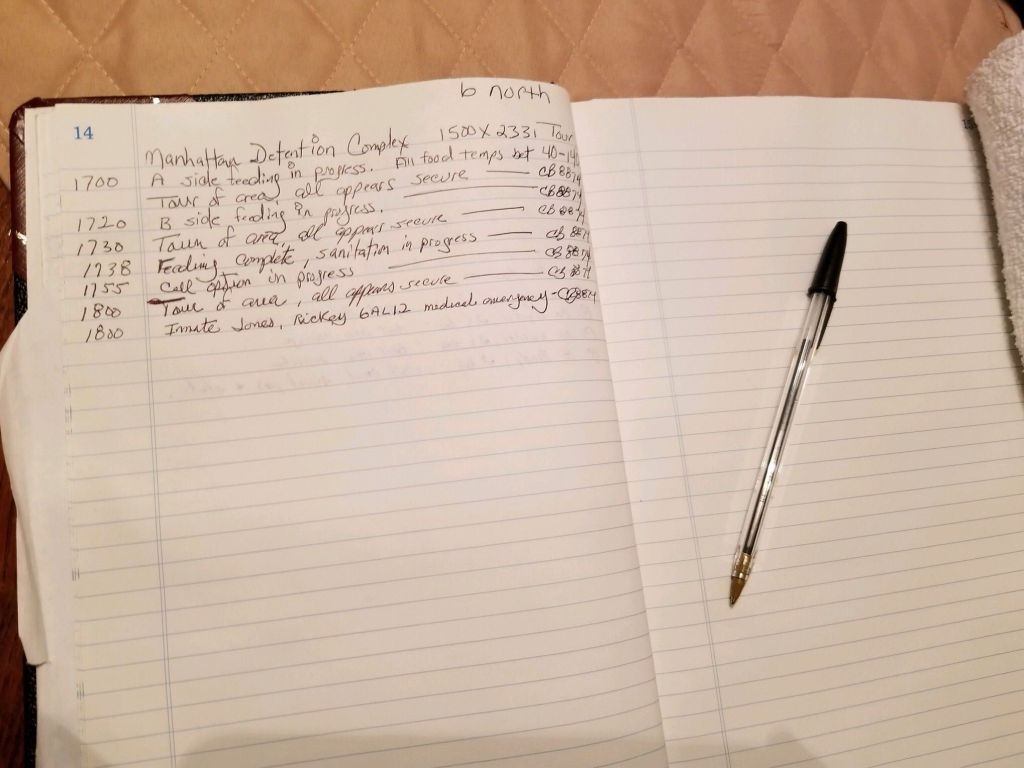 A logbook from the Manhattan Detention Complex. Credit: Obtained by THE CITY
Jim Conway, DOC’s top lawyer, said the electronic system functions as a digitized version of the existing process, but with additional auditing safeguards. Any changes to an entry is tracked, showing who made the change and when, and who authorized it, he said.
“In the current process, quite candidly, we have a logbook, if we have to change it, you draw a line through it,” Conway said. “This is now a digitized version of that, with probably more guardrails.”
In March 2019, the city’s Department of Investigation concluded the books were “unreliable” and significantly undercounted dangerous incidents. The agency recommended that the DOC digitize the operation, but that never happened.
Two years later, former Mayor Bill de Blasio was surprised when he was asked about the physical log book records.
“I will check into what’s going on with logbooks, and if it’s something that can be computerized or done better, I think that’s a valid question,” he told THE CITY during one of his daily press conferences. “We’ll get you an answer back on that.”
The mayor and his office never responded to follow up questions.
Criminal justice watchdogs and some union leaders have long argued city jail stats are unreliable. There have been multiple stories about how stabbings, slashings and officer abuses against detainees have not been logged in department records.
Related