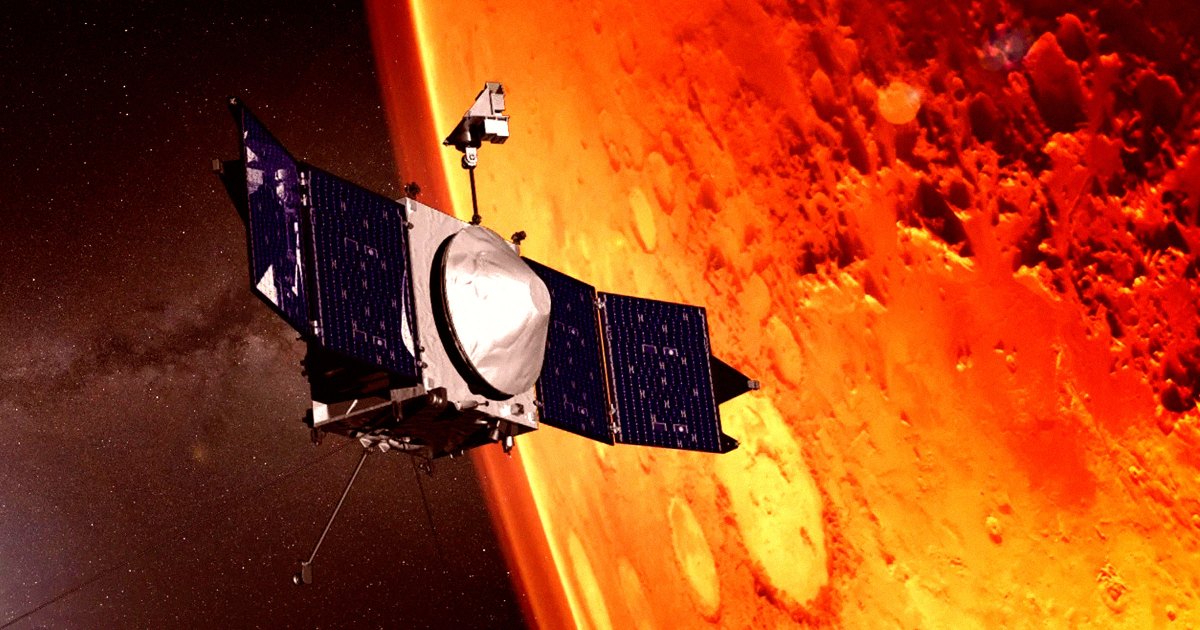
On December 6, NASA’s MAVEN (Mars Atmosphere and Volatile EvolutioN) spacecraft, which has been studying the Red Planet’s upper atmosphere for over a decade, mysteriously went offline.
The spacecraft was expected to send telemetry back to Earth, signals that were never picked up by NASA’s Deep Space Network, a global system of massive radio antennas making up an interplanetary communications network.
Less than a week later, NASA issued a new update, admitting that MAVEN appeared to be “rotating in an unexpected manner when it emerged from behind Mars.” Then, on December 23, the agency issued its last update, promising that it’s “continuing efforts to recontact” its lost spacecraft.
But weeks later, things aren’t looking much better. As SpaceNews senior writer Jeff Foust pointed out, NASA planetary science division director Louise Prockter conceded during a Tuesday meeting that the agency is “very unlikely” to recover the MAVEN orbiter.
Not all hope is lost. Mars’ solar conjunction, a weeks-long period when Mars and Earth are on opposite sides of the Sun, will end on January 16, which will give NASA a new opportunity to reestablish contact.
In its latest December 23 update, NASA explained that the MAVEN team was attempting to “create a timeline of possible events and identify the likely root cause of the issue” by analyzing “tracking data fragments recovered from a December 6 radio science campaign.”
NASA also leveraged the Mastcam instrument attached to its Curiosity rover to attempt to take a picture of MAVEN, but failed to detect the missing spacecraft.
It’s a sad state of affairs, but fortunately there are three other spacecraft that can still relay communications between Mars missions and the Earth. A next-generation orbiter, dubbed Mars Telecommunications Orbiter, was also recently revived in president Donald Trump’s so-called “Big, Beautiful Bill” act — though it remains unclear when it will launch.
For now, all we can hope is that NASA’s renewed efforts to make contact with MAVEN will prove successful once it emerges from behind Mars once again. But given Prockter’s latest comments, the situation isn’t looking promising.
More on MAVEN: NASA’s Mars Spacecraft Spinning Helplessly After Signal Lost