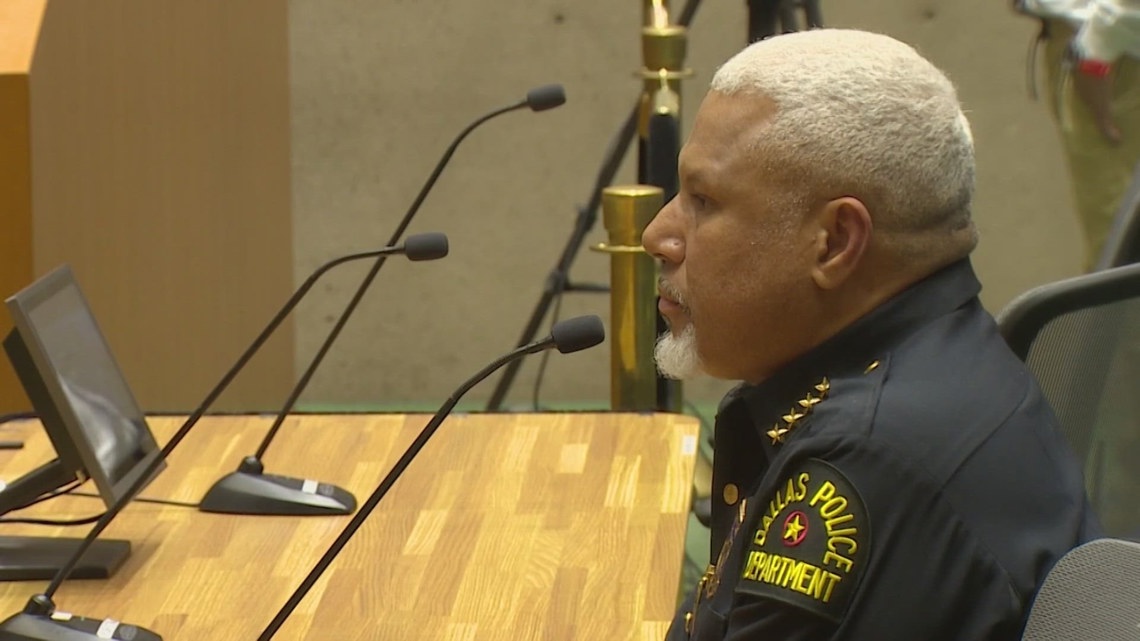
Police Chief Daniel Comeaux cited safety concerns for officers as a reason he won’t give an oversight board data about ICE in Dallas.
DALLAS — Dallas Police Chief Daniel Comeaux declined to disclose how often his officers encounter U.S. Immigration and Customs Enforcement agents on city streets, arguing that releasing the information could put officers at risk amid heightened tension in communities across the country.
The Community Police Oversight Board sent Comeaux a two-page memo asking for monthly reports on ICE-related encounters, how and why DPD was involved in those incidents, and what the outcome was. This comes following demonstrations against ICE across the country, including in North Texas.
Comeaux attended Tuesday night’s oversight board meeting and declined to provide the information.
“At this time, the best thing to do is not provide that information,” Comeaux told the board. “It’s just not the right thing to do right now.”
He said disclosing details about interactions could endanger officers.
Board members voiced frustration with the response, saying they aren’t asking for real-time data, but a monthly anonymized report.
“I’m a little disappointed in that,” said board member Brandon Friedman. “Let me take a step back — I’m very disappointed in that.”
Comeaux told board members multiple times that the Dallas Police Department does not conduct immigration enforcement and is not involved in immigration investigations.
He said officers may provide a safety perimeter around ICE operations but do not participate in the operations themselves.
“I can assure you DPD is not immigration officers, and we have not conducted any immigration investigations, nor will we,” Comeaux said.
Some board members questioned whether even DPD’s presence could still be perceived by the public as an endorsement of immigration enforcement activity.
“If I’m just setting a perimeter, I’m still letting it happen,” one board member said.
Community members said fear is growing, as masked and armed agents conduct operations.
“We’re being told armed individuals can operate in our neighborhoods without showing credentials, without showing verification, and we’re just supposed to trust it?” asked Azael Alvarez. “You’re supposed to make us feel safe. Not confused. Not afraid.”
“If the department believes in transparency, prove it,” Alvarez later said.
Comeaux also said Dallas police officers are not receiving any training or guidance on how to interact with ICE, which also caused concern among board members who question how federal agents are verifying they are who they say they are.
“They’re masked. They have badges that say police, but you can buy those at the Army Navy store. How do we know who these people are?” asked board member Chauncey Lander.
Members are now weighing whether they should escalate the issue to the Dallas City Council, which could have more power to demand data and answers from DPD.