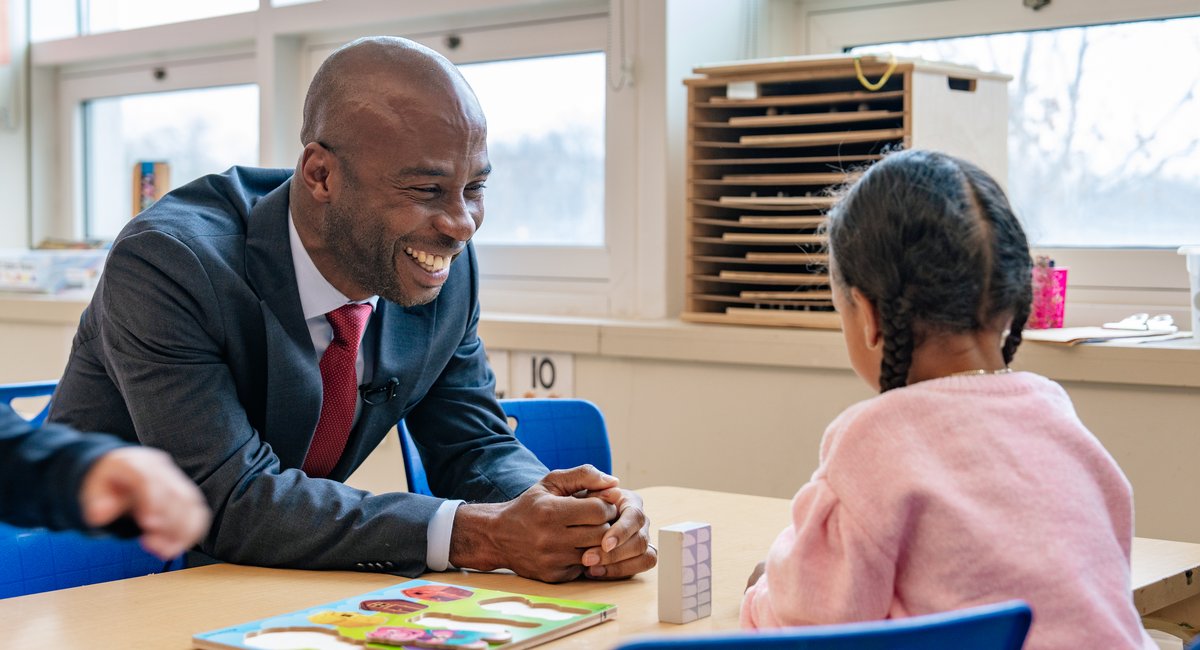
New Schools Chancellor Kamar Samuels is promising changes to New York City’s controversial math reforms for middle school and high school students.
The initiative, known as NYC Solves, has faced criticism from educators for assuming kids have mastered skills, leaving some lost and frustrated, while failing to teach several key concepts needed for Regents tests.
Samuels, who taught fifth and sixth-grade math in the Bronx at the beginning of his career, said he wants to ensure students have a grasp of the basics, including multiplication and division, as they engage with the new curriculum.
The materials emphasize inquiry-based group work, real-world problems, and discussion over old-school “skill and drill” problem solving.
“It’s really good work,” Samuels said of the curricular shift as he visited an algebra class at Emma Lazarus High School on the Lower East Side on Friday. “We are focused on trying to get to the conceptual understanding of math. It’s not just about doing the algorithm. … I want you to make sense of what we’re doing.”
But, he said, in a school system where just over half of students in the third through eighth grades test proficient in math, it’s important to make sure all kids have command of the fundamentals of arithmetic as they enter upper grades. “You want automaticity, you want to be able to do that fast, or else you’re going to struggle.”
Automaticity refers to the ability to recall basic math facts instantly. He said the education department will do a better job communicating to educators and families the importance of practicing the basics.
He described the changes as “tweaks” to the curricula.
Over the past two years, the city has required all schools to adopt a curriculum called Illustrative Math for Algebra, and began requiring one of three vetted curricula – Illustrative Math, i-Ready or Amplify Desmos – for middle school.
The goal, similar to the reading overhaul championed by the Adams administration, is to ensure that schools are working from a more unified, vetted playbook for teaching math.
The initiative reflects a philosophical shift in how math is taught. Instead of teachers modeling a problem on the smartboard at the beginning of class, students are encouraged to talk to each other first about possible ways to solve it – in what former Schools Chancellor Melissa Aviles-Ramos called “productive struggle.”
There is also a stronger focus on practical applications of math.
There are signs that the reforms may be helping. On the most recent state tests, math scores for third to eighth graders ticked up 3.5 points, with 56.9% of students scoring proficient. But some teachers and parents have criticized the rollout.
Teachers told Gothamist that students with disabilities and children learning English have had an especially hard time.
A survey of 100 teachers by the group Educators For Excellence found that a majority felt positive about the shift, but said they need more support to make it work for students.
“NYC Solves, the way it was implemented was not done properly,” said Michael Mulgrew, president of the United Federation of Teachers. “There was not even the basic prior knowledge to deal with some of the learning that was inside of the curriculum. … It was like you had to go backwards and try to teach them all of these things that they should have already known.”
Mulgrew, who said he’s heard “great frustration” from teachers, called on the new chancellor to create more supplemental materials for teachers.
Lauren DeVita, a middle school math teacher in Queens, said she welcomed the chancellor’s decision to continue the curriculum, with additional support for educators and students.
“I’m really excited to hear that the chancellor plans to continue with the initiative because we really have worked hard, and we do see a lot of improvement with engagement with students,” DeVita said.
She said she likes starting class with a group activity and discussion, such as a recent lesson on exponential growth that began with an animation of a rapidly growing fish.
“Rather than memorize some notes, and then you’re going to take a test on it in a week, the kids really get a chance to engage with it and explore it, and they can internalize those concepts,” she said.
On Tuesday, Gov. Kathy Hochul also called for a “back to basics” approach to teaching math in her State of the State address.
Samuels, who grew up in Jamaica before coming to the Bronx in high school, studied accounting at Baruch College. After serving as a teacher and principal, he became a superintendent and helped oversee the initial implementation of the math reforms.
“It’s amazing work,” he said of the new way of teaching math. But he said students need to master the basics first. “There is something to knowing your times tables,” he said.