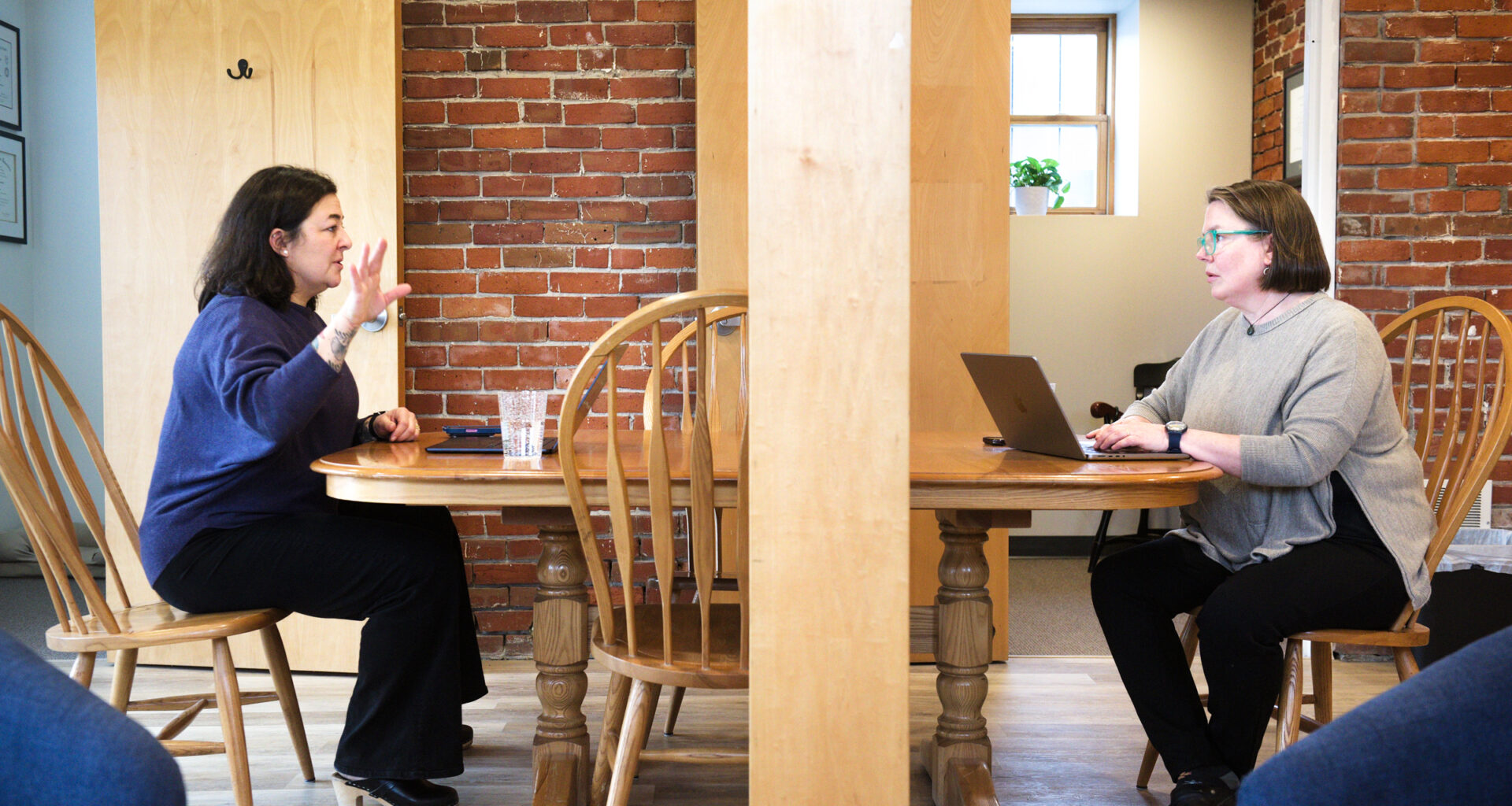
LEBANON — Alex Grossman and Elizabeth Wolfe have each been practicing internal medicine in the Upper Valley for 20 years. About a year and a half ago, the two doctors started thinking about a change.
This week, they began seeing patients at their own subscription-based practice on Hanover Street, Upper Valley Direct Primary Care.
“As we’ve learned more about the direct primary care model, it really felt like returning to a simpler model of care which was what I imagined when I decided to go into medicine,” Wolfe, 54, said in a Tuesday interview at the new practice, which sits across the street from two Lebanon schools.
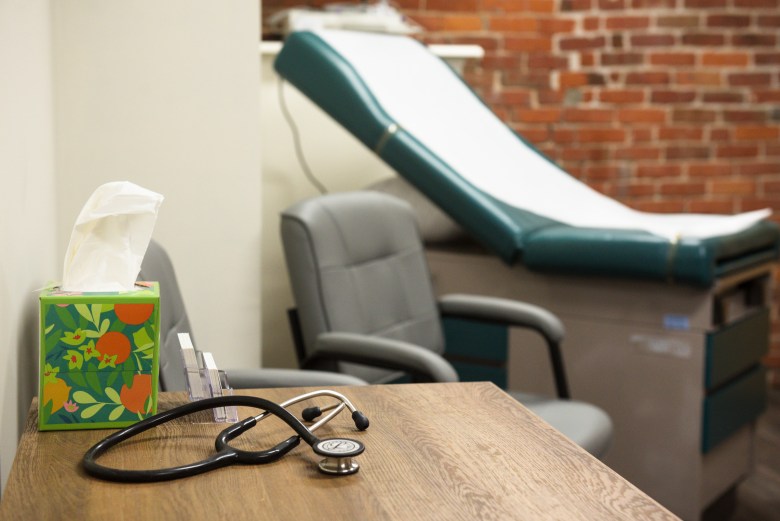 A stethoscope rests on a desk in an exam room at Upper Valley Direct Primary Care, in Lebanon, N.H., on Tuesday, Jan. 13, 2026, where physicians Elizabeth Wolfe and Alex Grossman began seeing new patients this week. Wolfe and Grossman are partners in the practice and have no other employees, focusing on a model in which patients have direct access to their doctor. JAMES M. PATTERSON / Valley News
They are the only staff at the new clinic. But its small size isn’t the only thing that sets the practice apart.
Under a direct primary care model, medical services are not billed to insurance. Instead, patients pay a set monthly fee that covers all of their primary care needs throughout the year.
By cutting out insurance, not having staff and keeping their patient panels small, both doctors hope to focus on building relationships with patients.
“This was the balance for us to be able to provide the kind of care we want,” Grossman, 51, said.
Cutting out insurance
In many ways, starting a direct primary care practice “felt simpler” than launching a more traditional private practice that relies on insurance, Grossman added.
“I think we all know in the grand scheme of things, bringing in insurance brings complexity and it brings a lot of sort of loss of control over how you care for patients,” Grossman said.
Patients at the practice will pay $235 per month, or $2,820 per year, plus a $100 registration fee.
The subscription fee covers all appointments, including annual physicals and checkups, sick-visits and chronic condition management. The doctors will be able to provide services including routine blood work, routine women’s health exams, basic procedures such as wart removal, and electrocardiograms to check heart activity.
Grossman and Wolfe recommend that patients also have health insurance alongside a direct primary care subscription. The subscription does not cover everything insurance may cover, including specialist visits, emergency care, X-rays, or advanced imaging or surgery.
Changes in primary care
The two doctors first met almost 20 years ago when they overlapped working at Dartmouth Hitchcock Medical Center, where they both completed their residencies in internal medicine. After two years at DHMC, Grossman moved on to work at the White River Junction VA Medical Center, where Wolfe eventually joined her. They worked together there for six years.
Grossman and Wolfe hope the direct primary care model can help to address some of the challenges they’ve faced working in large traditional medical systems.
It was “an honor” to be able to work with veterans at the VA and practice in a setting that “really provides the model for health care” that can be “much more comprehensive” than the private sector, Grossman said.
But, the two doctors have seen primary care change over the years and become increasingly complex. They found themselves “under so much pressure” to spend more time completing paperwork and focus on seeing more patients in a day than on providing the best possible care, Wolfe said.
The changes didn’t come from directives to work faster and to increase revenues, but were driven by a shortage of primary care providers and the increasing complexity of providing comprehensive care to patients, Grossman said.
“The system really hasn’t for many, many years, supported this specialty of primary care in the way that it maybe really requires,” Grossman said.
Nationwide, access to primary care has been dropping for years and as of 2024 “the state of access to primary care in the United States has crossed a line from which recovery will be difficult,” according to a study from the Robert Graham Center, a research institute within the American Academy of Family Physicians, the Milbank Memorial Fund, a foundation focused on population health, and the nonprofit Physicians Foundation.
Two of the driving factors are under-investment and limited research into primary care, according to the study. Other driving factors include population growth and an aging population, which increases demand for care.
There will be a national shortage of 87,150 full-time equivalent primary care providers by 2037, the Health Resources and Service Administration projects.
Creating relationships
The changing health care landscape coupled with lifestyle changes for Grossman and Wolfe, who are both mothers and have sent their youngest children off to college in the past few years, made 2026 an ideal time to start their new practice.
Appointments are held in an office building backing up to the Densmore Brickyard that is adorned with the Lebanon-made bricks inside and out. The clinic has two exam rooms, a lab room, a gathering area and offices for each doctor.
The three-story historic school building was most recently occupied by Willowbrook Prosthetics and Orthotics, and includes two other empty office spaces above the ground floor that holds the new practice.
With their backgrounds in primary care, both Grossman and Wolfe feel confident in their ability to handle “complex” chronic illness and “people who need a lot of care coordination,” Grossman said.
Under the model, Grossman and Wolfe hope that they are patients’ first call when they feel unwell or even just unsure of their well-being.
Though they don’t have a specific number of patients they plan to take on, Grossman said it will be “a fraction” of the size of that of a full-time primary care physician in a traditional medical system who see about 2,000 patients on average, “we’re just not sure what that fraction is.”
“Relationships take time, and we want to make sure that we have the time to devote to our patients,” Wolfe said.
The doctors have started accepting patients and holding appointments, but declined to say how many patients they have so far. Each patient at the clinic will be assigned to one doctor they see regularly.
Wearing all the hats
The new clinic joins at least two other direct primary care practices in the Upper Valley. Monarch Family Medicine in Lyme opened in 2017 and Advanced Practice Registered Nurse Audrey Lohr opened Flora Primary Care in White River Junction in April.
Lohr previously worked at North Star Health in Springfield, Vt., and found herself having to take on “larger and larger panels and less and less time with patients,” she said Wednesday.
Previously, Lohr was expected to see about 18 patients a day and is now able to see about four to five, though she is still growing her practice.
Lohr’s first 10 months in direct primary care have “absolutely exceeded expectations,” in terms of providing the care she was aiming for. She has found that her practice, which costs $90 a month for primary care, has filled a gap for patients who have had to forego insurance or are under-insured because of rising rates.
Like Upper Valley Direct Primary Care, Lohr is running Flora Primary Care without administrative support and said learning to do all of the administrative work and customer service has been challenging at times.
“You wear all of the hats in direct primary care,” Lohr said. “That is a learning process for somebody that is otherwise trained in medicine.”
The new venture in Lebanon has come with some challenges as the providers become small business owners. Seemingly simply tasks such as setting up a phone line have turned out to be complex, Wolfe said.
“Every little thing has been a big learning adventure from finding furniture and painting (to) buying office supplies,” Wolfe said.
Still, they are optimistic about what the clinic will mean for their patients.
“We can know people when they’re well, we can help them with improving their lives or reaching health goals or just walking beside them as they go through their life,” Wolfe said. “But then, importantly, by having that base … if something happens, we know them.”