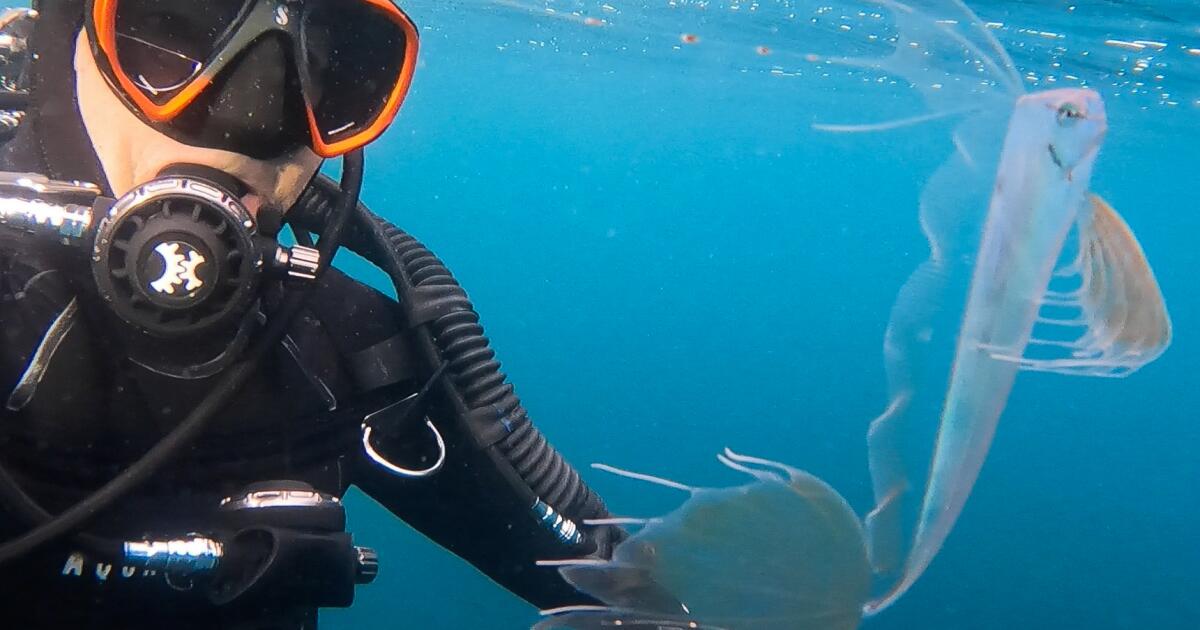
It looked like the silvery blade of a knife.
Peering through his goggles, diver Ted Judah had laid eyes on a deep-sea creature rarely encountered by humans. He and wife Linda were diving off McAbee Beach in Monterey County in late December when, near the surface, he spotted the “undulating thing.”
“It was some kind of ribbon fish,” he wrote in a post on the Facebook group Monterey County Dive Reports.
Kevin Lewand solved the mystery. The Monterey Bay Aquarium marine biologist was among those chiming in with their assessments on the group, which is popular among local divers. He said he’d shared the image with an ichthyologist who had identified it as a juvenile king-of-the-salmon, scientifically known as Trachipterus altivelis, which is part of the ribbonfish family.
“I wanted to stay with it, but I felt like I was harassing it,” Judah wrote of his encounter. He posted snapshots of the tiny creature. “It had this keen ability to orient itself so that its narrowest profile was always facing me.”
The king-of-the-salmon got its name from the Makah, Indigenous people of the Pacific Northwest coast who believed the species led salmon back to their spawning grounds, according to the Monterey Bay Aquarium Research Institute.
Bruce Robison, a senior scientist at MBARI, said this was a rare occurrence as this type of fish is typically found at depths that are hundreds of feet lower.
“They live in a place that, for the most part, is inaccessible, except for people who have submersibles or remotely operated vehicles,” Robison said in a phone call.
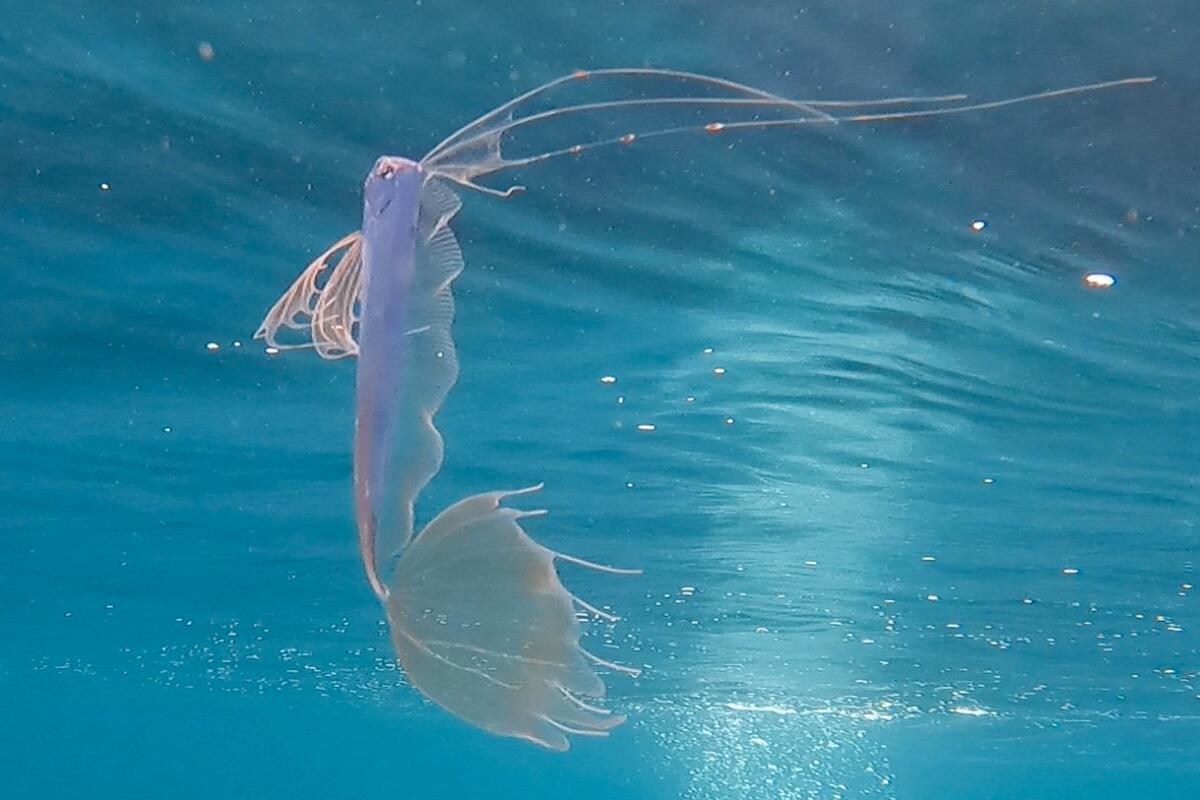
Ted Judah came across a rare king-of-the-salmon ribbonfish while diving in Monterey on Dec. 30, 2025.
(Ted Judah)
In nearly four decades of ocean exploration, MBARI has logged 16 sightings of king-of-the-salmon, and six sightings of closely related ribbonfish. The most recent was in 2021, according to the institute.
In terms of beauty, “ it’s hard to beat the king-of-the-salmon,” said Robison, adding that part of its allure comes from its enormous lacy red fins and silver sides.
One reason for the rare sighting could be the fish’s feeding time. At nighttime, various ocean animals migrate to the surface to avoid predators. Robison suspects that this majestic creature might have stayed there after feeding on small crustaceans and larval fish.
Another reason could be climate change.
“ These are regarded as warm-water fishes. The fact that the ocean, including Monterey Bay, is getting warmer may indicate that the geographical range of these animals is expanding,” Robison said.
Warm water holds less oxygen than cold water does, and as the ocean gets warmer, it can drive animals toward another region. According to Robison, fish, crustaceans, squid and other warm-water species are moving into what used to be considered cooler waters.
“It could be” climate change, Robison said of this latest king-of-the-salmon sighting. “We haven’t nailed it down yet.”