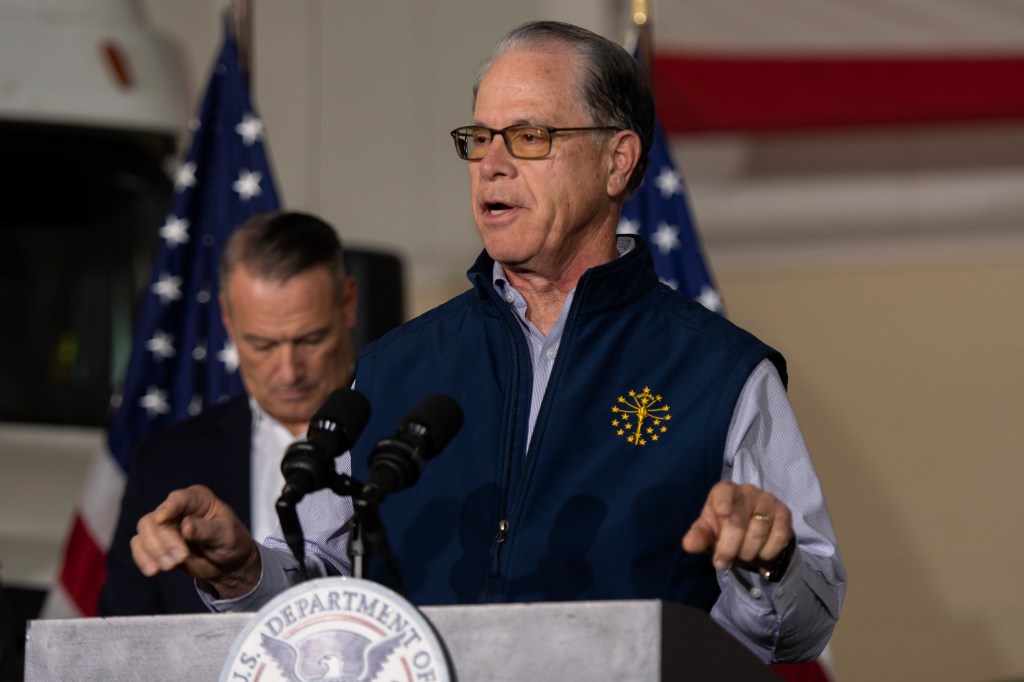
Indiana Gov. Mike Braun addressed the Chicago Bears potentially moving to Northwest Indiana during his 2026 State of the State address, but kept any specifics close to the vest.
While touting businesses coming to Northwest Indiana and the state’s “strong business environment,” Braun said “it’s not surprising that another organization has noticed that Indiana is open for business, the Chicago Bears.”
“We are working hard to bring the Chicago Bears to the Hoosier state so they can really see what a great place is to have a business. We’ll work hard to do it. Let’s get it across the finish line,” Braun said.
Bears President and CEO Kevin Warren and Chairman George McCaskey took NFL Commissioner Roger Goodell on a tour of the Arlington Heights site the team owns, and two sites in northwest Indiana, including one near Wolf Lake in Hammond, the Chicago Tribune reported.
The tour took place Saturday before the Bears’ epic come-from-behind victory over the archrival Packers. The visit is significant because the National Football League may loan $200 million or more for the stadium project, if it is approved by league owners, the Chicago Tribune reported.
Northwest Indiana received a few more shout outs in the state of the state address, like the growth of U.S. Steel and the expansion of the Whiting Refinery, Braun said.
While discussing data centers, Braun highlighted Amazon building a $15 billion data center in northwest Indiana. Amazon will “pay for every cent for their new power needs, and then some.,” Braun said.
Braun said AI will be a part of the future of the workforce, but that data centers “can’t stick Hoosiers with the power bill.”
“Companies that want big power in Indiana should pay their own way,” Braun said, highlighting Amazon in northwest Indiana. “If other companies will follow this model, we’ll lead the country in the AI race and Hoosiers’ electric rates won’t go up – they’ll go down.”
Braun claimed that Indiana’s Gross Domestic Product is growing faster than the national rate, double the rates of Illinois and Ohio, triple the rate of Kentucky and six times the rate of Michigan, but recent data from the U.S. Bureau of Economic Analysis doesn’t bear out those numbers. In the first half of 2025, U.S. GDP grew 3.8%, while Indiana’s was 3.1%, Illinois’ was 4.9%, Ohio’s 3.9%, Kentucky’s 4.6% and Michigan’s 3.6%.
“The time is now, and the place is Indiana and the state of our state is strong,” Braun said.
Braun said affordability is his priority after former President Joe Biden’s administration “unleashed inflation that’s still making it hard for families to get by.”
To address affordability, Braun said the key is to create new jobs and higher wages. Average hourly earnings for Hoosiers rose more than 4% last year, and wages have grown faster than the national average, he said.
In 2024, Indiana spent about $46,000 to bring a job to the state, but now the state spends $15,000 per job, Braun said. The average wage for those jobs has increased 10%, or an increase of $7,500 a year, he said.
To address utility rates, Braun said he appointed Abby Gray to be the state’s official consumer advocate to fight for Hoosiers “to hold the line on utility price hikes.” When she received a request for a rate increase, Gray responded with a request for a rate decrease, he said.
Braun said he supports House Bill 1002, electric utility affordability, authored by State Rep. Alaina Shonkwiler, R-Noblesville, because it will “hold investor-owned utility companies accountable to provide affordable energy before they can increase their profit margin.”
Further, Braun said he appointed three “rate-payer conscious” members to the Indiana Utility Regulatory Commission.
Braun touted Senate Enrolled Act 1, which he signed into law last year, that he said will save taxpayers $1.5 billion over the next 3 years.
Senate Enrolled Act 1 established a new property tax system by saving two-thirds of taxpayers up to $300 on their 2025 property tax bill while local governments will lose $1.4 billion through 2028.
“It ensures local governments have resources for essential services, and Hoosier homeowners can keep more of their money in their pocket,” Braun said.
But, many Hoosiers can’t afford to own a home “because we aren’t building enough and unnecessary regulations are driving up costs,” Braun said.
Braun said he supports House Bill 1001, authored by State Rep. Doug Miller, R-Elkhart, because it would “get government out of the way” and make it easier to buy a home in Indiana.
Health care is “too darn expensive,” Braun said, and he’d like to see the state address the costs through wellness and prevention not expensive remediation.
“It’s the biggest part of our economy. It shouldn’t cost us that much. We need to do something about it,” Braun said.
Braun highlighted State Senator Justin Busch, R-Fort Wayne, and State Reps. Martin Carbaugh, R-Fort Wayne, and Julie McGuire, R-Indianapolis, for proposing bills that would keep Hoosiers “out of crushing medical debt.”
To further address affordability, Braun said the state decreased its budget with most agencies operating with 10% cuts.
“The projected budget shortfall last year has been neutralized, and next year’s revenue forecast shows strong growth across the board,” Braun said.
Jabbing at Minnesota, Braun said while “some states are in the news for billions in Medicare and Medicaid fraud,” Indiana saved $465 million this year.
“Indiana is making Medicaid responsible and sustainable for those who need it most,” Braun said. “For Medicaid recipients who can work, work requirements foster self-sufficiency and build a foundation for a better life.”
Last session, the legislature passed a bill that established work requirements for Medicaid. This session, State Sen. Chris Garten, R-Charlestown, filed Senate Bill 1 “which codifies several of the actions we’ve taken already and positions us to lead the nation,” Braun said.
The 24-page bill will end the state’s participation in the use of expanded categorical eligibility within the federal Supplemental Nutrition Assistance Program, set gross income standards and countable resources for SNAP eligibility, and establish immigration eligibility requirements for SNAP.
If a SNAP applicant’s immigration status can’t be verified, the applicant’s information will be “immediately referred to the U.S. Department of Homeland Security for investigation and potential deportation proceedings,” Garten said in a release.
This year, SNAP recipients won’t be able to use the benefit for sugary drinks and candy but rather “real food” Braun said.
“We’re continuing to deliver high-quality essential services that Hoosiers rely on, while you keep more of your money — because it’s not ours, it’s yours,” Braun said.
Addressing education, Braun said every public state university has frozen tuition and mandatory fees for the next two years. Braun also said his administration took action ban transgender athletes from collegiate sports.
Braun touted that after “decades of trying” Indiana has Universal School Choice.
“Competition and choice are good things. We’ve always funded public education to the best amount as well, and we’ll continue to do so,” Braun said. “This fall, every Hoosier parent will have the opportunity to choose the school that best fits their child’s needs.”
During last year’s budget cycle, Braun said the state fully funded K through 12 education and increased teacher salaries by $5,000.
“Everything we did was based around one simple principle: Parents are in charge of their own kids’ education,” Braun said.
Braun said he supports Senate Bill 78, authored by State Sen. Jeff Raatz, R-Richmond, that would prohibit students from using a cell phone during the school day and “gives parents veto power over their kids and social media.”
“That’s a decision for you to make as parents, not Big Tech,” Braun said.
In the next budget session, Braun said he’d like to focus on making child care “more affordable and available.”
Braun thanked Indiana’s Secretary of Education Katie Jenner for her leadership in improving education for students.
Braun also thanked a 9-year-old boy from Shoals, Indiana, who asked Braun if school could be delayed on Tuesday morning so he could stay up late and watch Indiana University play in the national championship game on Monday night.
“I’ll leave it up to each school district to decide, but I think that sounds like a hell of a good idea,” Braun said.
Braun also highlighted the work of the Indiana State Police, which has worked to “Crack down on drug trafficking” on Indiana highways. In 2025, ISP seized over 1,300 pounds of cocaine from bulk shipments and 84 pounds of heroin and fentanyl.
In a single traffic stop last week, the Indiana State Police seized over 300 pounds of cocaine, with an estimated street value of $7 million, Braun said.
In the last year, overdose deaths dropped more than 60% from 1,610 in 2024 to 562 in 2025, Braun said.
“That’s hundreds of Hoosier lives saved,” Braun said.
Braun said he supports Senate Bill 3, authored by State Sen. Eric Koch, R-Bedford, which would allow for ballot language for a constitutional amendment concerning bail, and Senate Bill 2, authored by State Sen. Aaron Freeman, R-Indianapolis, which would make offenses other than murder not bailable under certain conditions.
Last year, the State Police launched Operation Guardian Angel, with the mission of saving children from abuse, which has resulted in 48 arrests.
Braun said he supports House Bill 1303, authored by State Rep. Wendy McNamara, R-Evansville, which would help police arrest child predators.
Indiana Senate Democratic Leader Shelli Yoder, D-Bloomington, said Braun’s agenda mirrors long-standing Democratic priorities from addressing medical debt, housing costs and utility bills.
“Affordability is not a slogan. It is a test of how leadership serves the people,” Yoder said. “If policies were working, Hoosiers would feel it. Right now, they don’t.”
Yoder said Senate Enrolled Act 1 has reduced revenues for local governments.
“SEA 1 cut funding that cities and towns rely on for police, firefighters and emergency medical response. No matter how it’s framed, that undermined public safety,’ Yoder said. “After 22 years of Republican control, Indiana is in an affordability crisis.”
Indiana Democratic Party Chairwoman Karen Tallian, a former state senator, said while Braun made a “rosy assessment of the state’s economy, Braun didn’t mention hurting small businesses and failing road infrastructure. Braun didn’t acknowledge that Senate Enrolled Act 1 will cut funds for local governments, she said.
“Braun and the Republican legislature continue to drive our economy off the cliff,” Tallian said. From my position in the Senate, I watched years of failed Republican policies on so many counts: road funding, worker rights, health care and more.” Each ‘fix’ required a subsequent ‘fix.’ They are responsible for every mistake.”
Senate President Pro Tem Rodric Bray, R-Martinsville, said he was pleased to hear Braun highlight Indiana’s economic growth, educational freedom and responsible government.
“My caucus is proud to be collaborating with the governor and House Representatives on these and other issues that matter to Hoosiers, and we look forward to another strong year for Indiana in 2026,” Bray said.
House Speaker Todd Huston, R-Fishers, said he was pleased to hear Braun talk about the state’s “strong progress and positive momentum.”
“House Republicans are laser focused on continuing this momentum while addressing affordability. We look forward to continuing to work together on legislation this year to make it more affordable to own a home, reduce energy costs and get government out of the way to unleash opportunities for Hoosiers,” Huston said.