A new archaeological discovery in Sulawesi, Indonesia, has uncovered significant evidence of early human occupation, shedding light on the complex interplay between archaic hominins and Homo sapiens. This discovery, published in the journal PLoS ONE, comes from Leang Bulu Bettue, a rock-shelter site that has yielded one of the most complete records of human presence in the region.
The Sulawesi Discovery and Its Significance
The research team, led by Griffith University’s Basran Burhan, unearthed an array of artifacts, stone tools, and animal bones that span much of the Pleistocene epoch. These finds, covering several layers of archaeological material, paint a rich picture of human activity on the island of Sulawesi. The excavation site at Leang Bulu Bettue is now considered a key location for understanding the overlap of human lineages in Wallacea, the region between Asia and Australia. Burhan explained that the site’s deep and continuous cultural sequence makes it an ideal place to study whether Homo sapiens and archaic hominins ever lived alongside each other.
In particular, the earliest evidence of human occupation at the site, dating back to around 208,000 years ago, highlights a period when the island was home to a distinct group of archaic hominins. These early inhabitants left behind heavy-duty stone tools known as picks, marking an established cultural tradition long before modern humans arrived on the island. According to Professor Adam Brumm of Griffith University, “These activities appear to represent an archaic hominin cultural tradition that persisted on Sulawesi well into the Late Pleistocene.”
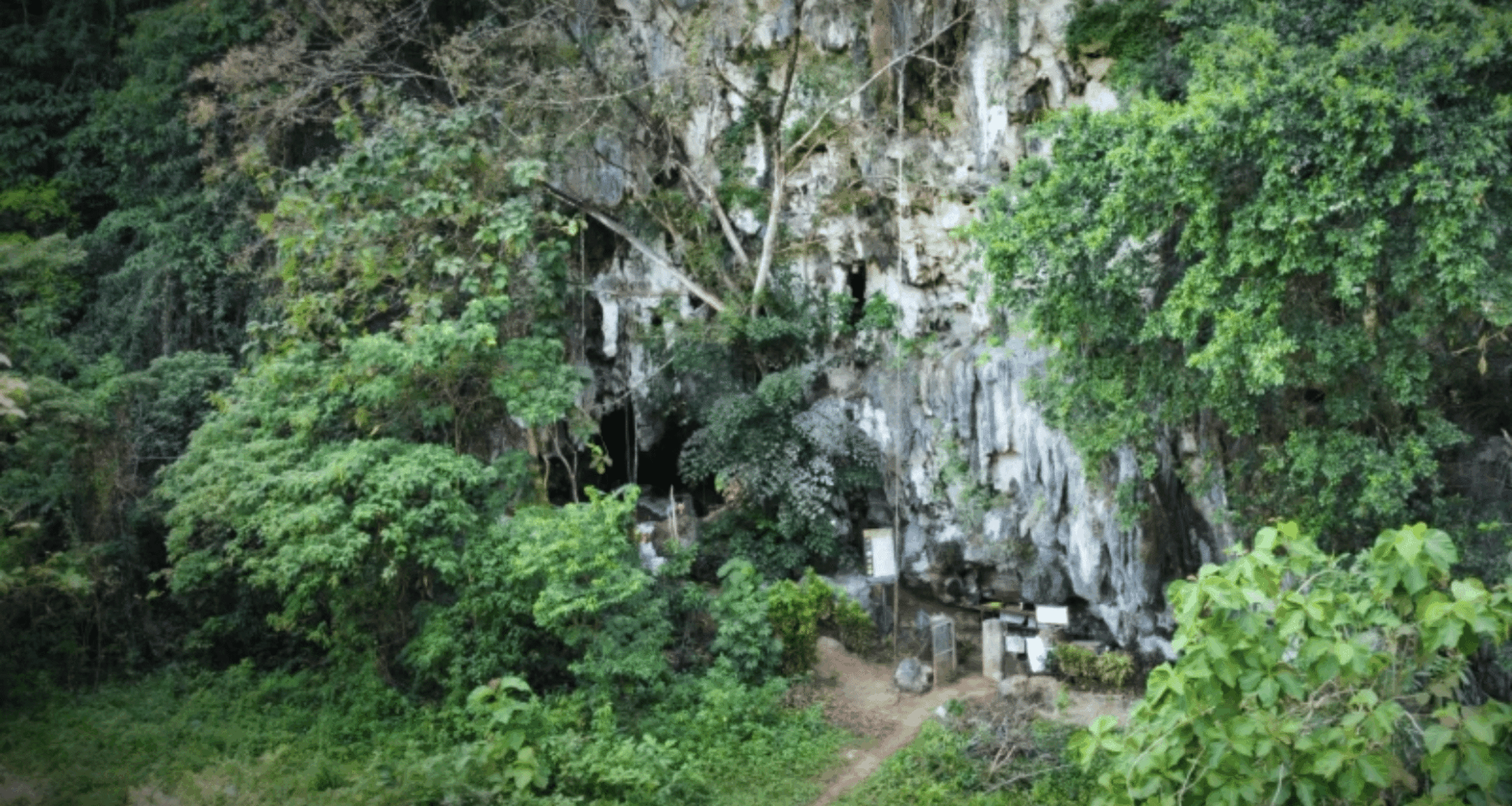
 Leang Bulu Bettue in the Maros-Pangkep karst area of South Sulawesi. Image credit: Burhan et al., doi: 10.1371/journal.pone.0337993.
Cultural and Technological Transitions: The Arrival of Homo Sapiens
One of the most striking findings from the research at Leang Bulu Bettue is the dramatic shift in cultural and technological practices around 40,000 years ago. This change is marked by the appearance of a new set of tools and the earliest evidence for symbolic behavior on the island. Burhan emphasized,
“This later phase featured a distinct technological toolkit, and the earliest known evidence for artistic expression and symbolic behavior on the island.”
The transition from simple tools to more advanced ones represents a major cultural shift. This shift coincides with what many researchers believe was the arrival of Homo sapiens in the region, bringing with them new technologies and cognitive abilities. The new artifacts found at Leang Bulu Bettue, including intricate stone tools and signs of early art, are consistent with the behaviors typically associated with Homo sapiens, such as the production of symbolic art and more complex social structures.
Professor Brumm suggested that this cultural break may reflect a
“major demographic and cultural transition on Sulawesi,” which likely marked the arrival of Homo sapiens and the gradual replacement of the earlier hominin population. “That is why doing archaeological research in Sulawesi is so exciting,” he stated.
The site offers an opportunity to study the ways in which different human species may have interacted, coexisted, or replaced one another over time.
 Typical Phase II faunal remains and lithic artefacts from Leang Bulu Bettue.
A, radial core, square -G2, layer L4c/5 (scale bar 50 mm); B-D, chert bipolar artefacts (scale bars 10 mm); B, -I1, layer 4a, C, -H1 layer 4a, D, layer 4a; E, anvil made on volcanic rock (scale bar 50 mm); F, conjoining flakes from A1 and A2, layer 4, semi-desilicated (scale bar 10 mm); G, chert redirecting flake with a second embedded bulb of percussion, layer 4b (scale bar 10 mm); H, maxillary and mandibular elements attributed to Sus celebensis (Sulawesi warty pig); I, layer 4a (scale bar 30 mm); J and K, layer 4a (scale bars 10 mm); L, layer 4a (scale bar 20 mm); L-N, maxillary and mandibular elements, Ailurops ursinus (bear cuscus) (scale bars 10 mm); L, layer 4b, M and N, layer 4a; O-Q, A. ursinus postcranial elements; O and P, layer 4b (scale bar 10 mm), Q, layer 4a (scale bar 10 mm).
The Uncharted Potential of Sulawesi’s Archaeological Layers
The excavation at Leang Bulu Bettue has only just scratched the surface of what could be an even deeper historical record. The team has suggested that there may be several more meters of undiscovered archaeological layers beneath the site’s current excavation level. Basran Burhan noted, “Further work at this site could therefore reveal new discoveries that will change our understanding of the early human story on this island, and perhaps more widely.” The potential for more finds at the site is immense, and future research could reveal even older evidence of human occupation, potentially pushing back the timeline of human history in the region.
Sulawesi’s rugged terrain and dense forests have historically made archaeological work difficult, but these latest findings, published in the journal PLoS ONE, underscore the island’s importance in the broader context of human evolution. As one of the few places where evidence of multiple hominin species can still be uncovered, Sulawesi offers a unique window into the past. The ongoing research has the potential to rewrite parts of the human evolutionary story, providing insights into the coexistence of different human species and their adaptation to the environment.