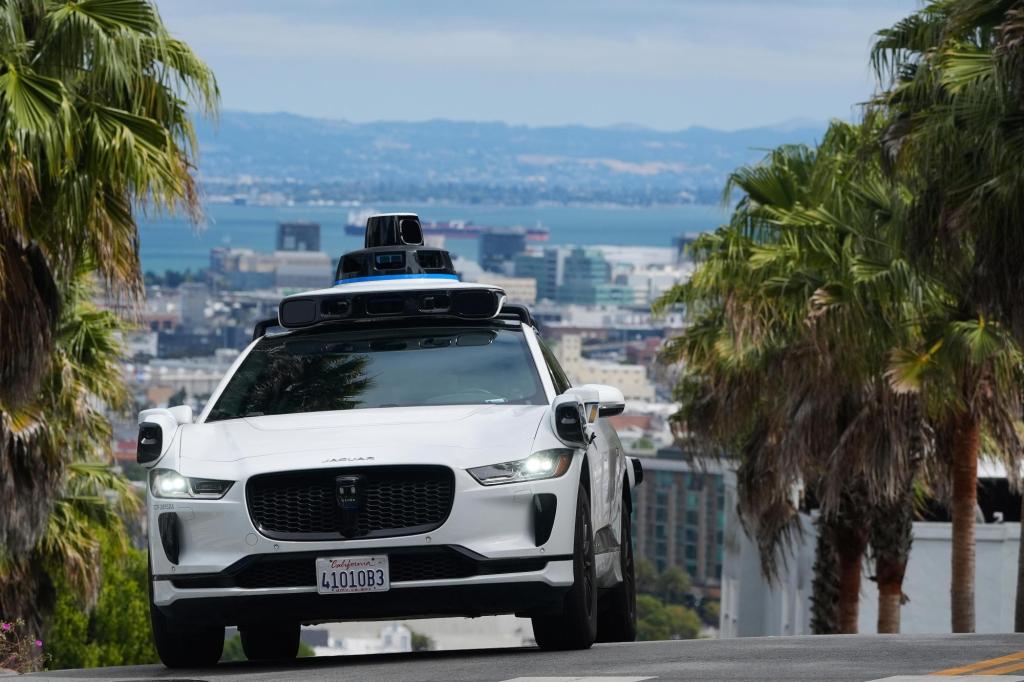
The city’s transit board wants to pump the brakes on Waymo’s rollout.
The San Diego Metropolitan Transit System passed a resolution Thursday opposing the expansion of Waymo’s robotaxis. In a 12-1 vote, the MTS Board of Directors passed a resolution that calls for more local control over the deployment of autonomous vehicles.
The resolution included a three-pronged recommendation to:
- Restore local control, letting communities vote on whether autonomous vehicles may operate in their jurisdiction;
- Submit a formal protest to the California Public Utilities Commission and California Department of Motor Vehicles regarding Waymo’s local deployment; and
- Support prohibiting driverless vehicles from operating at San Diego International Airport to protect airport ground transportation workers and ensure public safety.
Currently, the state — not local government — is overseeing driverless vehicles. The DMV issues permits to manufacturers that test and deploy autonomous vehicles on California’s roads. The CPUC determines whether autonomous vehicle companies can operate within the state and oversees data collection and reporting requirements to help ensure safety.
In February, Waymo began test-driving the all-electric Zeekr RT minivans. Under human supervision, the Waymo fleets started mapping popular ride-share roadways in neighborhoods like Gaslamp Quarter, downtown, Grant Hill, Logan Heights and Pacific Beach — but not as far north as La Jolla.
Just two months ago, Waymo officials announced plans to bring fully autonomous ride-hailing services to San Diego in 2026.
The opposition against self-driving cars was led by San Diego City Councilmember Sean Elo-Rivera, who is also chair of the Taxi Advisory Committee.
“This is not just about rideshare. Allowing autonomous passenger services without guardrails opens the door to expansion into trucking and delivery, threatening even more workers whose livelihoods depend on driving,” Elo-Rivera said. “Autonomous vehicles don’t just change how people move. They literally replace people.”
Elo-Rivera also pointed out the “red carpet” California has rolled out for tech billionaires. He says the system is rigged in favor of the rich, citing the DMV’s 20-day review period for granting permits to test automated vehicles. “Think about the small businesses that try to operate in California, and how many hoops they have to jump through. Meanwhile, Waymo and the tech billionaires behind it can submit a paper into DMV.”
Coronado City Councilmember Mark Fleming cast the only vote against the resolution.
He “would be more in favor of this if the motion were to simply ask for more local control,” he said. “But it seems to me that this motion is more focused on squashing the technology and the innovation that goes behind it. It’s looking backward rather than forward.”
Fleming said he was also concerned about influence from labor unions, which are worried about job losses.
During the public comment period, Crisoforo Gomez, organizer with the San Diego and Imperial County Labor Council, explained that concern. “These workers have already been facing the rising cost of fuel maintenance and insurance alongside the growing economic uncertainty … driverless vehicle deployment would only deepen these challenges for an already struggling class of workers,” he said.
Only two other individuals stood for comment, both of whom represented unions.
Today, 30 companies have permits to test self-driving vehicles with a driver in California. Among the dozens of companies are auto behemoths, tech giants and self-driving startups — Mercedes-Benz, Tesla, Zoox, Apollo and Qualcomm.
Currently, only three companies have permits to deploy driverless vehicles in California: Waymo; Nuro Inc. in San Mateo and Santa Clara counties; and Mercedes-Benz Research & Development North America, which can operate during daytime hours on freeways in the Bay Area, Los Angeles, Sacramento and San Diego, and along interstates 5 and 15.
Qualcomm did not comment on its self-driving technology but did speak to its Snapdragon Ride software. According to the company, it works with a majority of automakers to implement customizable advanced driving assistance — like forward collision warning, adaptive cruise control and pedestrian detection.
Waymo did not immediately respond to a request for comment, but the company’s most recent post on X confirmed it is planning to roll out robotic vehicles in “mid-2026.”