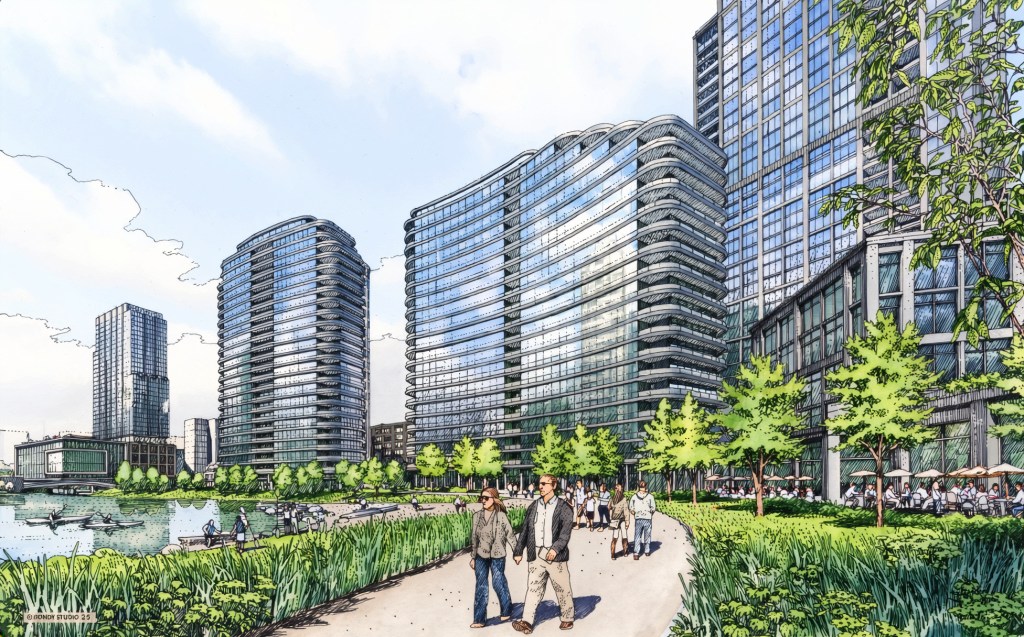
The Chicago Plan Commission on Thursday approved a plan to transform the northern half of the former Lincoln Yards development site into a mixed-use community with more than 3,000 residences, new riverfront parks and a central plaza open to all neighborhood residents.
The 31-acre riverfront site, now called Foundry Park and sandwiched between Lincoln Park and Bucktown, will include a mixture of apartments, townhomes, condos, affordable housing and neighborhood retail, including a 520-foot tower.
The proposal by developer JDL Development still needs a green light from the full City Council.
If launched on schedule this fall, the construction of Foundry Park would be a remarkable turnaround for the vacant site, once home to A. Finkl & Sons Steel, a now-demolished steel plant, and many other industrial businesses.
Developer Sterling Bay won approval for a far more ambitious plan in 2019. The developer bought up dozens of acres along the Chicago River, and wanted to build up to 14 million square feet, including towers more than 600 feet high, offices and a high-tech science hub. It lost control of the site last year after failing to raise sufficient funds.
Jim Letchinger, president of JDL Development, told commission members that the company and its partner Kayne Anderson Real Estate already have enough financing to break ground on the first phase this October.
“We are ready to build this, we have enough capital,” he said. “I can look at you and say, we’re building.”
JDL Development purchased Lincoln Yards’ northern half last year. The company is best known for building the Gold Coast’s No. 9 Walton luxury condominium building and more recently completed the 2.2 million-square-foot One Chicago in the River North neighborhood.
Chicago developer Novak Construction struck a deal late last year to buy the southern portion of Lincoln Yards and is putting together its own development plans.
Letchinger said the $800 million first phase will create more than 700 units on a triangular patch bounded by Kingsbury Street, Cortland Avenue and Southport Avenue. A small boutique hotel is also planned, along with a central plaza and more than 700 underground parking spots.
“It was critical that the first phase would not have a parking podium at all, it’s all underground,” Letchinger said.
The central plaza will include a pavilion, great lawn and gardens. Pedestrian walkways and a reconstructed street grid will connect Foundry Park to the surrounding neighborhoods, and eventually to riverfront parks featuring natural wildlife habitats, walkways and a beach.
“No gates,” Letchinger said. “Not only are we not gating the community, we’re inviting the community in.”
Several local community organizations supported Sterling Bay’s mammoth 2019 proposal, and it was approved during the final months of former Mayor Rahm Emanuel’s administration.
But the developer struggled to secure financing after the pandemic, and encountered opposition from Mayor Lori Lightfoot, who said she was skeptical about Lincoln Yards’ long-term prospects. Other community groups opposed funding the project with a city tax financing district, while Ald. Scott Waguespack, 32nd, said the project was out-of-scale with the surrounding neighborhood.
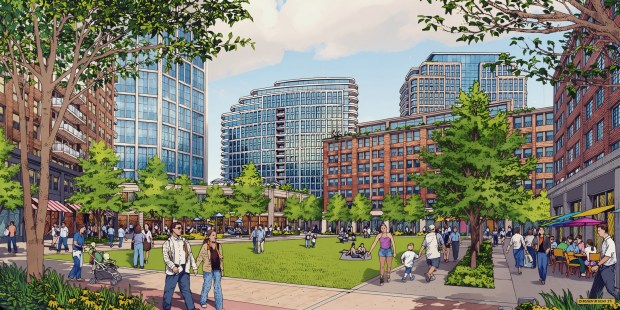 JDL Development has won Plan Commission approval for a new development on the former Lincoln Yards site in Chicago. JDL purchased Lincoln Yards’ northern half last year. (JDL)
Jonathan Snyder, executive director of North Branch Works, a nonprofit advocate for economic development along the Chicago River, told commission members that he opposed Lincoln Yards seven years ago. But he said Foundry Park’s smaller scale will help ensure the neighborhood’s remaining industrial businesses, including concrete supplier Ozinga and Horween Leather Co., which manufactures NFL game balls, can stay in the area.
“With all due respect, they’re not going anywhere,” he said. “They’re investing in their properties and are creating hundreds of great new jobs. (Foundry Park) is less overwhelming to the neighborhood. It’s not a Loop 2.0.”
Chicago resident Jon Feld lives near the site and said he agreed Foundry Park was a better fit than Lincoln Yards.
“It feels more compatible with the neighborhood,” he said. “I look forward to using the riverfront with my family.”
Others at Thursday’s hearing said they opposed a quick approval.
Members of Unite Here Local 1, a hospitality and restaurant workers union, said the city should do more to ensure the jobs created by the planned hotel are well paying and provide good benefits, especially if funds from a city tax increment financing district are used.
“There is no commitment to provide good hospitality jobs for people like me, that’s wrong,” said Lucas Oates, a 32nd Ward resident and doorman at the Palmer House Hilton Hotel. “If Foundry Park uses any TIF dollars it needs to create the world-class jobs our city deserves.”
Ald. Brian Hopkins, 2nd, whose ward used to encompass much of Lincoln Yards, asked commission members to defer a final vote. He praised Sterling Bay for cleaning up and envisioning a new use for Lincoln Park’s riverfront, and JDL Development for carrying it forward.
But the massive transportation upgrades called for in the original 2019 plan, including reconstructed bridges, a realignment of Elston Avenue, and a renovation of the nearby Metra station, might still be needed, even for JDL’s slimmed-down version, he said.
“(The Metra station) is one of the most dilapidated in the system,” he said. “I don’t understand how we can so easily walk away from the promises that were made seven years ago.”
Chicago Department of Planning and Development Commissioner Ciere Boatright said the Plan Commission could only approve site plans, not the financing mechanisms needed for any future infrastructure improvements. Foundry Park’s full build-out will take years, and city planners, the CTA, JDL and the City Council will likely revise the original infrastructure proposal and look for ways to fund it.
“It should look different, because the (Foundry Park) plan is different,” she said. “It’s one thing to have a great plan, but it’s another thing to have a great plan that can move forward.”
Waguespack said he strongly supported Foundry Park. And although the developer promised to build new signaled intersections and provide residents with free shuttle service to the nearby Metra and CTA stations, he agreed much of the local infrastructure is in terrible shape, and badly needs an upgrade.
“You can put your hand through some of that (bridge) steel as you go up and down Ashland,” he said. “This is a huge issue that is not going to go away anytime soon.”