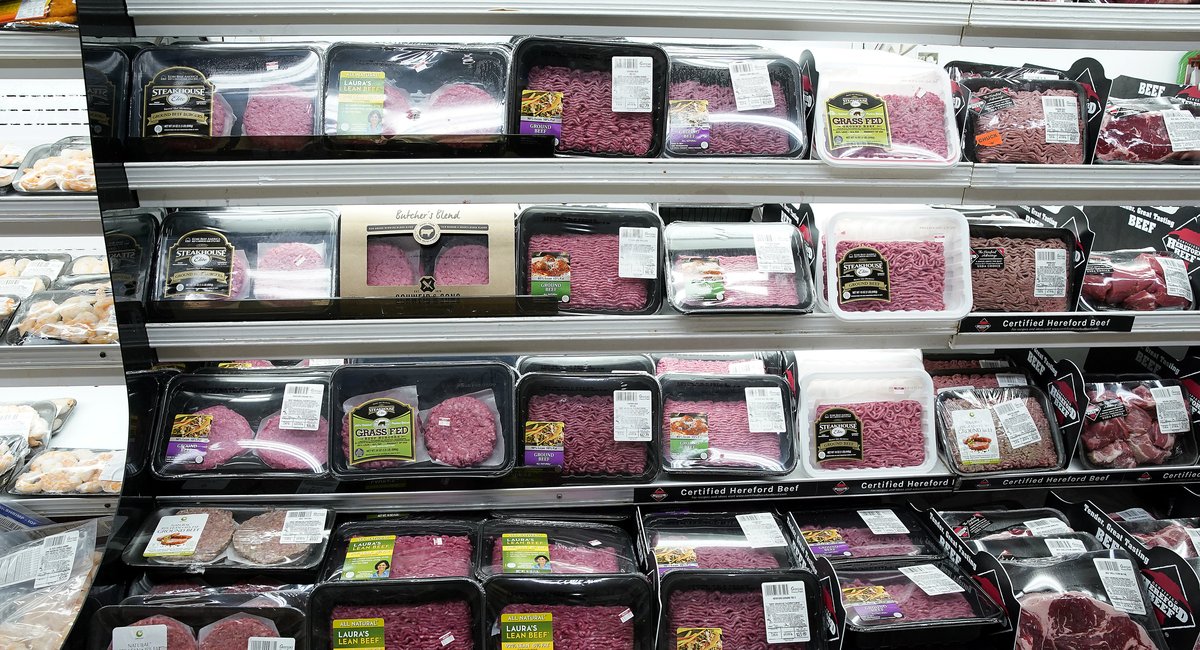
Make no mis-steak, you are definitely paying more for your beef at the checkout counter.
The price for a pound of ground beef skyrocketed 14% in the last six months across 20 New York City grocery stores, Gothamist reporters found. In the middle of summer, shoppers could pick up a pound of beef for an average of $5.80; by December, that rose to $6.62.
Every month since July, Gothamist reporters collected prices for the same items at four grocery stores in each borough. Half were in areas with high child poverty rates and half were in more affluent areas. The stores included large national chains and independently owned businesses.
While beef was a runaway item that saw the biggest price spikes, such drastic increases were rare. Overall, prices for a basket of staple food items across 20 New York City grocery stores actually decreased slightly over the last six months. Of the 11 items Gothamist tracked, four became more expensive — like beef and orange juice — while seven became cheaper.
Here are four takeaways from the price data:
Sometimes, food is more expensive in poor neighborhoods than it is in wealthy ones
You could buy a pound of ground beef in December at Foodtown in Forest Hills, Queens, for $5.49. But at the CTown in Brownsville, Brooklyn, where the child poverty rate is almost three times as high, the per-pound price of ground beef was $7.59.
Overall, Union Market in Park Slope, Brooklyn, had the highest prices, while Aldi in East Harlem had the cheapest. On average, however, stores in low-income neighborhoods had lower prices for the basket of items we tracked. But that’s largely due to a couple of outliers.
Take a look at this chart of prices from all our stores across six months. You’ll see a couple of single lines near the top and bottom. But that messy cluster in the middle shows that many of our stores in low-income neighborhoods (the blue lines) had higher prices than stores in more affluent areas.
Samina Raja, a food systems expert and a professor of urban and regional planning at the University of Buffalo, said the larger national chains typically have lower prices because they’re able to buy from their suppliers at higher volumes. But those stores don’t usually open in the neighborhoods that need them most.
Raja, who studied the practice of “racial redlining” by grocery stores in the Buffalo region, said big retailers like Wegmans and Trader Joe’s could be “leaving money on the table” by not opening locations in lower-income neighborhoods.
“There is a tendency of particular kinds of grocery stores and supermarkets to concentrate in predominantly white neighborhoods,” no matter their income level, Raja said.
Expert tips for saving
Avocados at Jubilee Marketplace in Brooklyn.
Karen Yi / Gothamist
- Prices at regional and national chains tend to be lower than at independent stores. If there’s no big chain in your neighborhood, consider paying $3 each way on the train or subway to get to one.
- Take advantage of coupons and sales, and notice what seasonal items are on sale.
- Freeze products when you can buy them at a good price and save them for several months. For example, ground beef tends to be more expensive in the barbecue-happy summer months. If you buy it in the early spring and freeze it, you may save money.
- You can freeze eggs if you separate the yolks and whites! So next time you see a great deal, buy a bunch.
Raja said her own shopping strategy is multifaceted. She tries to support local businesses and farmers, but also shops around for the best deal. Her research in Buffalo found that shoppers tend to make multiple stops, especially when they’re trying to save money.
“They do not shop just at one place,” she said. “And when you are income-constrained, then you try to be extremely creative.”
So it might be worth taking the bus or train to a big chain nearby if you don’t have one close to home.
Regional chains like Foodtown had the cheapest prices, followed by national chains
Prices at most national retailers we tracked — such as Trader Joe’s, Whole Foods and Aldi — were on average lower than at regional chains like CTown and Foodtown. But H Mart’s higher prices significantly increased the average cost for a basket at a national store.
The average price of a basket for 11 items from the H Mart in Flushing was $10 more, or about 33% higher, than the cost of an average basket from Trader Joe’s and $5 more than the typical basket from Whole Foods. Aldi, on average, was $16 cheaper than H Mart for a basket of 11 items.
Patrick Penfield, a professor of supply chain practice at Syracuse University, said price-conscious consumers need to shop around in order to save their pocketbooks.
“ Take advantage of sales and then freezing things where they can, which can allow them to save hopefully some money,” he said. “The other recourse is looking for coupons, looking for deals.”
Prices for ground beef and eggs changed the most drastically
The average price for a pound of ground beef among 20 stores went from $5.80 in July to $6.62 in December, a 14% increase. That trend is consistent with national averages. The Bureau of Labor Statistics released data this week that found the cost of beef shot up 16% since December 2024.
According to David Anderson, an agricultural economist at Texas A&M University, a smaller supply of beef led to the higher prices. In the past year, Anderson said, beef producers had been shrinking the size of their herds as maintaining them got more expensive.
Our methodology
Fruit & Vegetable Section of Whole Foods Grocery Store.
Photo by: Snap Decisions/GHI/UCG/Universal Images Group via Getty Images
- We chose two stores in low-income neighborhoods and two in more affluent neighborhoods in every borough.
- We identified “low-income” neighborhoods using child-poverty rates.
- From July through December, we visited each store in person, within the first two weeks of each month. On every visit, we took the price for the cheapest available offering that was in stock for each item we were tracking.
- A caveat: One of the stores closed in the middle of our project. The CTown in Park Slope closed back in October after more than 50 years of business. We replaced that store with a Foodtown a few blocks away.
“We’ve linked together growing demand with tighter supplies, and we’ve got higher prices,” Anderson said.
Additionally, the regions of the country producing the most beef have been experiencing droughts, limiting the availability of food for cattle. And then there’s the increasing price of transportation, which leads producers to increase their own prices.
Penfield said there are only four beef producers in the country and “ those four beef producers kind of control pricing to a certain degree in the United States.”
Not only did beef see the biggest price increases, but it was also the item that had the biggest price range in our data collection. The lowest price we found for a pound was $2.22 at Aldi in East Harlem. The most expensive pound was sold by Union Market in Park Slope for $11.99.
According to Anderson, beef will get more expensive before it gets cheaper. He said beef producers will need to hold onto young calves for longer so they can grow to a reproductive age and help grow the herd.
In the meantime, Anderson suggested being aware of seasonal price changes for different kinds of beef. Ground beef is typically more expensive in the summer, as barbecue season picks up. Roasts tend to get more expensive in the winter, when home cooks are more likely to use their ovens.
Egg prices, meanwhile, dropped from an average of $4.49 for a dozen in July to $3.67 in December. Penfield suggests consumers keep an eye on the avian flu, which can affect egg prices.
“ As soon as there is an avian flu outbreak in your area, that usually indicates that there’s probably going to be an increase in price for eggs. So if you hear or see something happening from that vantage point, buy some extra eggs,” he said.
“ You can freeze eggs, you just have to separate the yolk and the white.”
Whole milk, beans, and rice had the most stable average prices
Stores can buy beans and rice in large quantities due to their long shelf lives, which makes pricing easier. Grocers can set long-term prices for these items and expect a steady profit from their sales.
Nevin Cohen, a professor of health policy and management at CUNY who studies food systems, said grocers lose that advantage when it comes to stocking produce, whose prices can “fluctuate day to day.”
Milk is a different story. According to the U.S. Department of Agriculture’s data, milk prices have actually been dropping. Still, several of the stores Gothamist tracked had milk prices listed on laminated sheets of paper that were affixed to their refrigerator walls, a sign that those prices weren’t going to change anytime soon.
But experts say milk isn’t an item grocers are profiting heavily from because those prices affect public perception of how expensive a store is.
”Milk is what we call a key value item, which is like an item that kind of everybody knows the price of,” said Errol Schweizer, former vice president of grocery at Whole Foods, who runs The Checkout Grocery Update on Substack.
“You cannot skim margin on milk, you have to price it to the market… milk is very much an item that retailers will sell as cheaply as possible, which is why they usually hide it in the back of the store.”