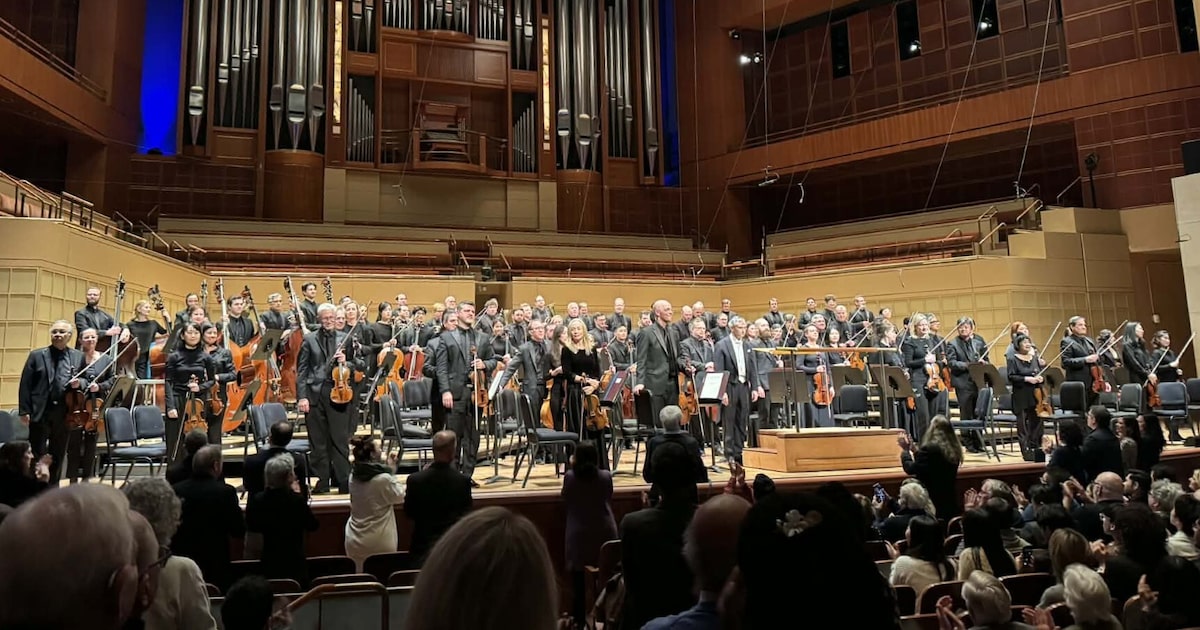
As well as a composer and composition professor, Anton Bruckner was an organist. And his symphonies often build up great masses of sound you can imagine echoing around a vast stone-vaulted church.
Which makes Dallas’ Meyerson Symphony Center a dream setting for those symphonies. At the Dallas Symphony Orchestra’s Thursday night performance of the unfinished Ninth, led by music director Fabio Luisi, massive chords took as much as three seconds to float up and away into hidden reverberation chambers behind grilles ringing the room. Those climaxes exerted visceral intensity, but delicacies at the threshold of audibility seemed physical presences as well.
Along with Bach’s Art of Fugue, the Mozart Requiem, symphonies by Schubert, Mahler and Elgar, and Puccini’s Turandot and Berg’s Lulu, Bruckner’s Ninth Symphony is one of music history’s tantalizing torsos. The Austrian composer labored over it in fits and starts over nine years, but at his death in 1896 the finale was still a collection of sketches, some of which soon vanished.
The symphony is usually performed, as here Thursday, as a three-movement work, and it’s often asserted that the 25-minute third movement is a satisfying finale.
News Roundups
Bruckner didn’t think so, in desperation even proposing his earlier Te Deum as a conclusion to the symphony, although few have found that a convincing solution. During the last 45 years or so, additional sketches for the finale have surfaced, and a number of musicologists and composers have essayed completions of the movement.
The surviving material is strong enough that it deserves hearing in at least conjectural elaboration. We routinely accept completions of the Mozart Requiem and Turandot, why not Bruckner Nine? One of the completions would have added 23 minutes or so to a symphony already more than an hour long, but it seems a pity to be deprived of Bruckner’s last thoughts on his last symphony.
Schumann admired the sometimes “heavenly lengths” in Schubert’s compositions, and the description applies even more dramatically to the vast spans of Bruckner’s symphonies. A man of deep faith, Bruckner assembled majestic cathedrals in sound. But the symphonies’ start-and-stop contrasts and obsessive rhythmic gestures challenge the conductor to manage the ebb and flow of energy within overarching structures.
Luisi did a spectacular job of this Thursday night. His pacing had organic inevitability, with just the right breaths between phrases and daring but strategic yieldings at transitions.
Related

The climaxes were certainly powerful, although the fortissimos were turbocharged 21st-century American rather than late 19th-century Viennese. Even Bruckner benefits from a bit of controlled reserve.
There was much lovely detailing, but as in a number of recent DSO performances first violins weren’t always as tidy as you’d expect in a major orchestra, and winds and brasses weren’t always fastidiously tuned. Luisi can be a revelatory conductor — he’ll be honored at the Friday performance with a medal of honor from the Bruckner Society of America — but the orchestra’s discipline isn’t as consistent as in its best days under former music director Jaap van Zweden.
Unfortunately, the hushed ending of the Adagio was spoiled by immediate applause. This of all movements needs a few seconds of repose at the end.
Related
 Details
Repeats at 7:30 p.m. Friday at Meyerson Symphony Center, 2301 Flora St. $37 to $184. 214-849-4376, dallassymphony.org.
 Review: A vivid semi-staged ‘Madama Butterfly’ from the Dallas Symphony
But a mostly compelling cast was sometimes overpowered by the orchestra.
 Don Stone, Dallas philanthropist and arts advocate, dies
Stone was a lover of the arts who held leadership positions at organizations such as the Dallas Symphony Orchestra, Dallas Black Dance Theatre and Booker T. Washington High School for the Performing and Visual Arts.