A starless discovery by astronomers in Baltimore is shedding new light on dark matter.Astronomers told WBAL-TV 11 News that what’s known as Cloud-9 is the first of a new gas object discovered in the universe called a Reionization-Limited H I Cloud (RELHIC).”It is a starless gas cloud in a dark matter halo, which is effectively a galaxy that wasn’t, or a failed galaxy. It never formed stars, so it has all the components, and it could have become a galaxy, but it never did,” said Dr. Rachael Beaton, an associate astronomer at the Space Telescope Science Institute (STScI) in Baltimore.Beaton explained it’s a relic of when galaxies were forming.”We weren’t sure if we were going to be able to find them today, nearly 14 billion years after the Big Bang,” Beaton told WBAL-TV 11 News.Dr. Andrew Fox, an astronomer with the European Space Agency and the deputy manager of STScI’s Instrument and Science Support Branch, said this discovery sets a new precedent in the field of dark matter research.”I think the importance of this Cloud-9 is that now we know where to find these types of failed galaxies, we’re more likely to know where to find more in the future,” Fox told WBAL-TV 11 News.Fox said utilizing the Hubble Telescope was crucial to confirm Cloud-9’s starless quality. “The thing that amazes me is that even after several hours of pointing Hubble, we couldn’t find a single star, not even one we could confirm was part of the galaxy,” Fox told WBAL-TV 11 News.Beaton said she has been asked why astronomers gave Cloud-9 such a simple name. There’s good reason for that.”It’s the ninth cloud that was found around this galaxy, M94. We just count them,” Beaton told WBAL-TV 11 News.
BALTIMORE —
A starless discovery by astronomers in Baltimore is shedding new light on dark matter.
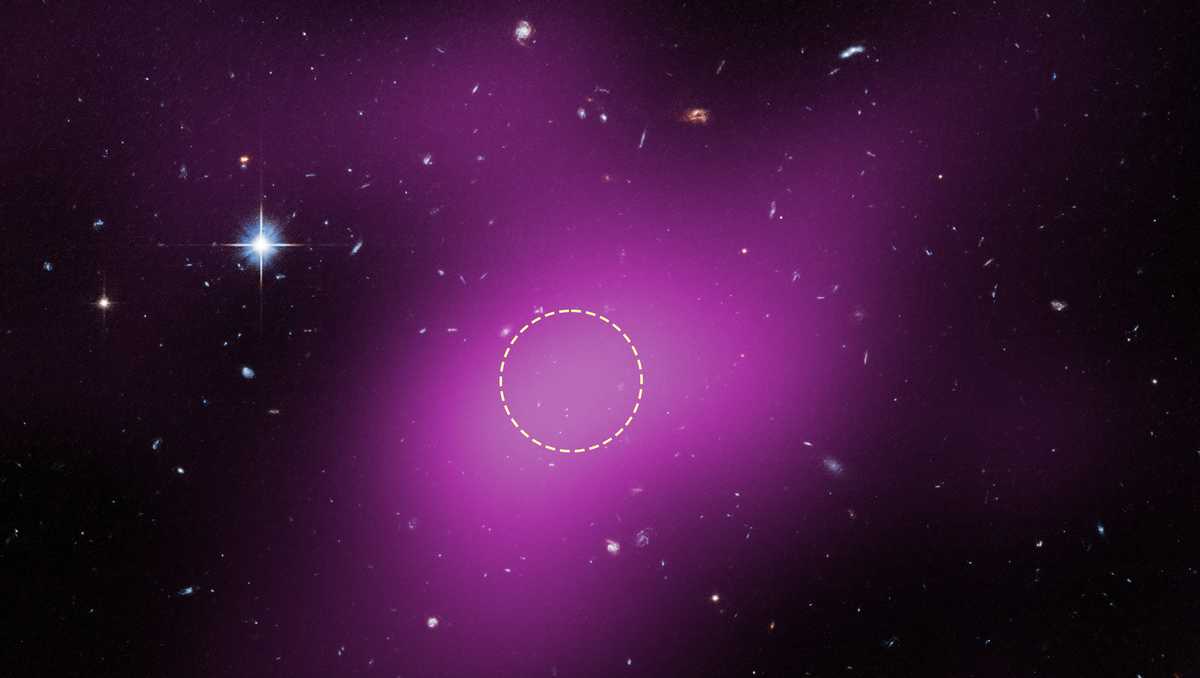
Astronomers told WBAL-TV 11 News that what’s known as Cloud-9 is the first of a new gas object discovered in the universe called a Reionization-Limited H I Cloud (RELHIC).
“It is a starless gas cloud in a dark matter halo, which is effectively a galaxy that wasn’t, or a failed galaxy. It never formed stars, so it has all the components, and it could have become a galaxy, but it never did,” said Dr. Rachael Beaton, an associate astronomer at the Space Telescope Science Institute (STScI) in Baltimore.
Beaton explained it’s a relic of when galaxies were forming.
“We weren’t sure if we were going to be able to find them today, nearly 14 billion years after the Big Bang,” Beaton told WBAL-TV 11 News.
Dr. Andrew Fox, an astronomer with the European Space Agency and the deputy manager of STScI’s Instrument and Science Support Branch, said this discovery sets a new precedent in the field of dark matter research.
“I think the importance of this Cloud-9 is that now we know where to find these types of failed galaxies, we’re more likely to know where to find more in the future,” Fox told WBAL-TV 11 News.
Fox said utilizing the Hubble Telescope was crucial to confirm Cloud-9’s starless quality.
“The thing that amazes me is that even after several hours of pointing Hubble, we couldn’t find a single star, not even one we could confirm was part of the galaxy,” Fox told WBAL-TV 11 News.
“It has all the components, and it could have become a galaxy, but it never did.”
Beaton said she has been asked why astronomers gave Cloud-9 such a simple name. There’s good reason for that.
“It’s the ninth cloud that was found around this galaxy, M94. We just count them,” Beaton told WBAL-TV 11 News.