From Camden and Cherry Hill to Trenton and the Jersey Shore, what about life in New Jersey do you want WHYY News to cover? Let us know.
Since its inception, the Camden County Police Department has invested heavily into cameras to catch crime happening in real-time. The department’s use of them has been documented by Vice News and The Atlantic.
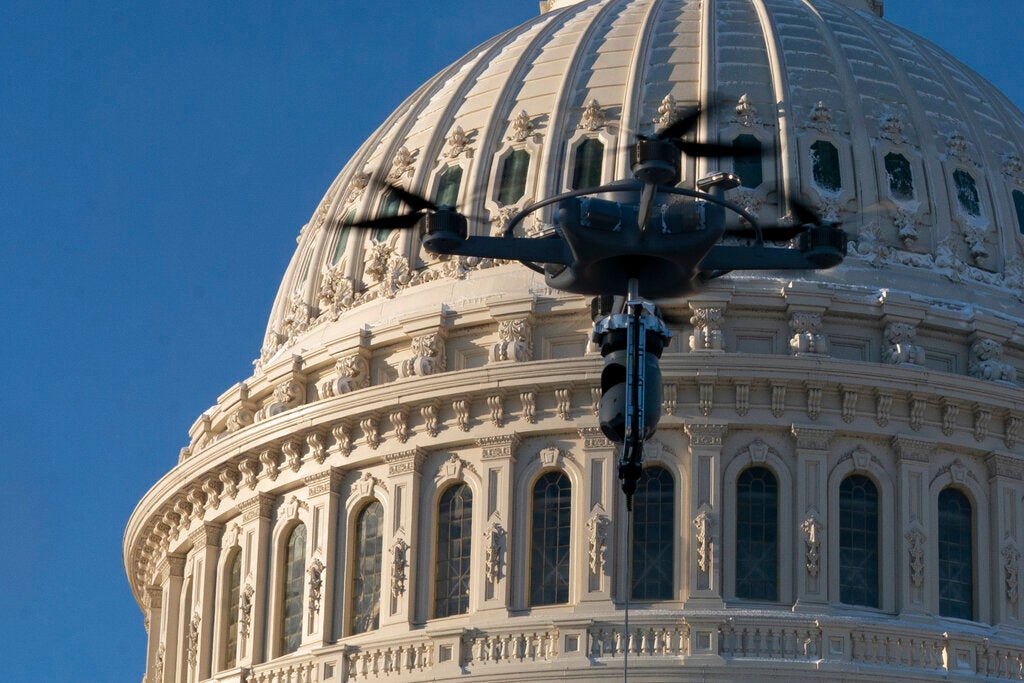
The agency expanded its use of technology last year with the launch of its drone program.
Earlier this month, South Jersey Democratic heavyweight and businessman George E. Norcross III and NFI CEO Sidney R. Brown donated more than $400,000 to expand the drone program, through their foundations.
“This generous donation will support the department in expanding this program through the purchase of new drones and software, which will in turn support criminal investigations and crime prevention throughout the City of Camden,” Camden County Commissioner Director Louis Cappelli Jr. said in a press release.
The drone donation comes as crime continues to trend downward in the city. The drones have already been credited with recovering illegal firearms and intercepting all-terrain vehicles.
But Dillon Reisman, a staff attorney with the American Civil Liberties Union of New Jersey who focuses on technology, said although Camden has come a long way in public safety, there should be more transparency and limitations to ensure the safe use of technology like drones.
“We shouldn’t let that be the justification for mass proliferation of technology,” he said. “[It] actually can run counter to community well-being.”
Is New Jersey becoming a surveillance state?
Reisman said he “would almost say” there has been “exponential growth” in the use of cameras by New Jersey law enforcement — at the local and state level.
“It’s so ubiquitous,” he said. “You could go down the list of all sorts of places, and you’ll see the expansion of surveillance tools to kind of keep constant surveillance on the people who live there.”
Camden County spokesman Dan Keashen said the department follows guidelines established by the attorney general’s office. He added that they are “very cognizant” of issues involving technology, which is why they do not use facial recognition technology, for example.
Policies for body cameras were written by the Policing Project at the New York University School of Law. The department’s drone program was modeled after the New York Police Department’s initiative.
Keashen said the city benefits from the technology.
“We want to make our department smarter and the community safer,” he said.
The department, Keashen adds, has rules about what’s recorded and how long it’s kept.