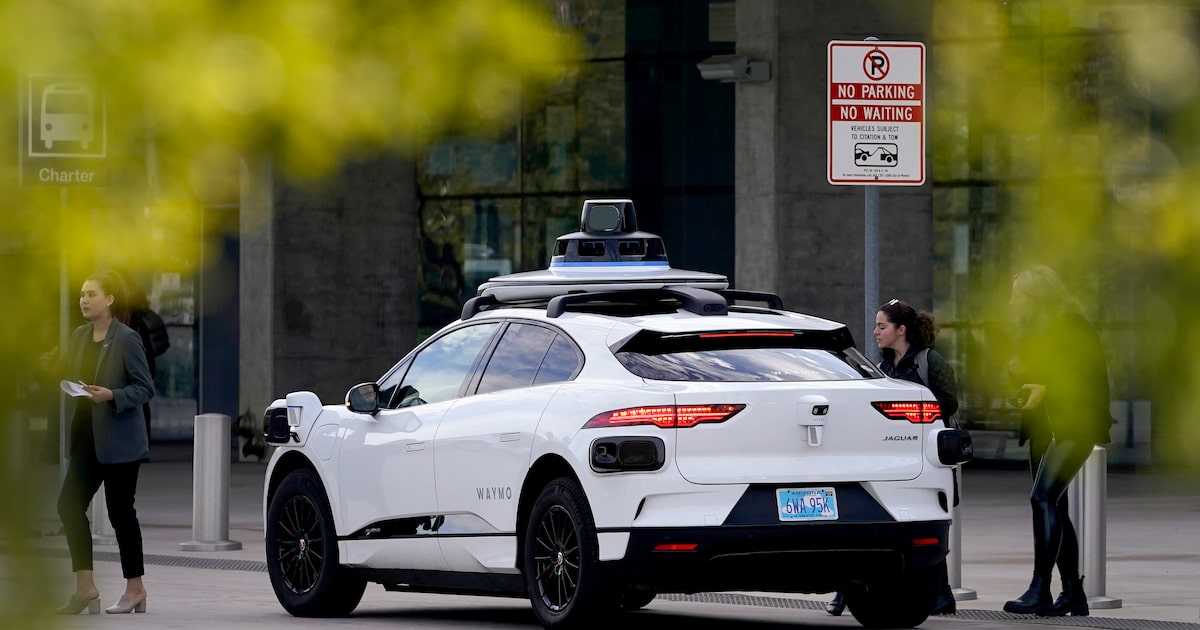
Dallas is preparing for the arrival of driverless taxis, with at least two companies currently testing vehicles on city streets and competitors expected to follow. Autonomous vehicles hold promise, but as they move closer to everyday use in Dallas, it’s reasonable for the public and policymakers to ask whether the technology and the rules governing it are ready.
Advocates of autonomous vehicles often point to their potential to reduce human error, expand mobility and improve safety. Those goals are worth pursuing. At the same time, autonomous driving remains a developing technology, and recent experiences in other cities suggest there are still open questions about how these vehicles perform in complex, real-world conditions.
In recent months, Waymo vehicles have been involved in incidents that illustrate these challenges. In Phoenix, a Waymo robotaxi turned onto a light rail track, like those operated by DART, in front of an approaching train. The Waymo passenger can be seen fleeing the vehicle as it sits on the tracks.
Waymo vehicles also have been reported driving into flooded roadways.
In Austin and Atlanta, public records and media reports document more than 30 cases of Waymo vehicles passing stopped school buses with flashing lights and extended stop arms, a basic traffic law designed to protect children. In San Francisco, Waymo vehicles stopped in the middle of city streets during a widespread blackout, disrupting traffic and requiring human assistance. The company has also suspended service during periods of anticipated bad weather, underscoring that the technology still has limits under common driving conditions. This is part of a series of widely seen incidents involving self-driving technology navigating complex urban environments underscoring both the promise and the challenges of truly driverless systems.
Opinion
Supporters often argue that autonomous vehicles are safer than human drivers. While companies cite millions of autonomous miles driven, that figure remains small compared to the trillions of miles driven by people each year. Autonomous vehicles also operate in limited geographic areas and under selected conditions, making broad safety comparisons difficult.
Regulation is still catching up. Congress is considering major autonomous vehicle legislation, including the Autonomous Vehicle Acceleration Act of 2025 and the AMERICA DRIVES Act, with hearings expected later this month. Texas has recently adopted new statewide requirements for autonomous vehicles, including a permitting process overseen by the Texas Department of Motor Vehicles, though many details are still being worked out. As these rules take shape, cities like Dallas will be subject to autonomous vehicle deployment during a period of regulatory transition.
This raises an important question for Dallas: Should cities have the authority to manage autonomous vehicles on their own streets? Dallas has its own traffic patterns, road designs, weather challenges, and pedestrian activity. Allowing local officials to respond to safety concerns does not oppose innovation; it recognizes that local conditions matter.
Dallas does not need to reject new technology to be responsible. But before driverless taxis become part of daily life here, it is fair to ask careful questions and to make sure innovation proceeds with public safety firmly in mind.
Amy Witherite is the founding attorney of Witherite Law Group and a nationally recognized traffic-safety advocate based in Texas. She has represented hundreds of families affected by trucking collisions.