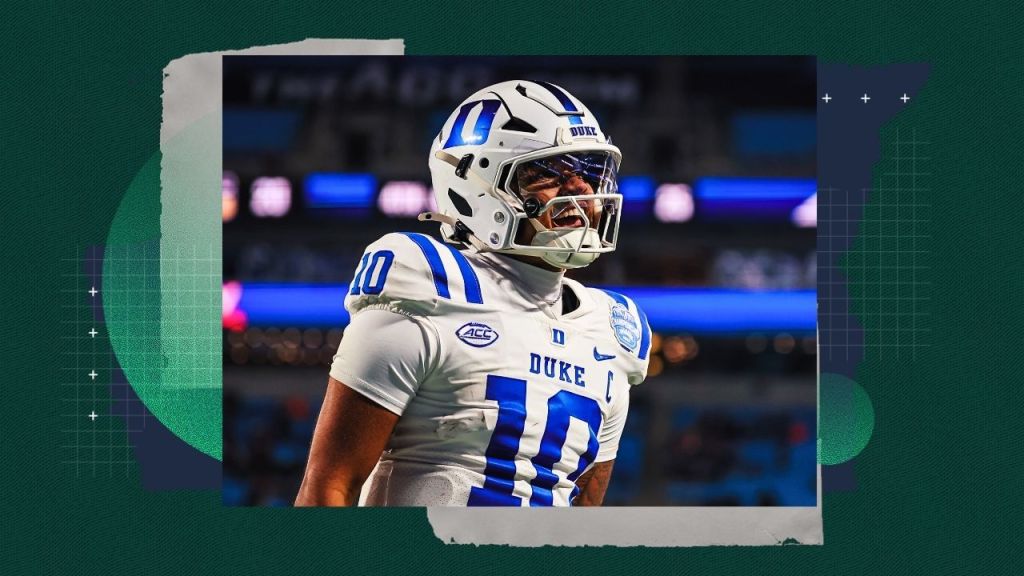
Duke University on Tuesday sued quarterback Darian Mensah—who, last Friday, entered the transfer portal—claiming he breached a multiyear NIL contract that ends on Dec. 31, 2026.
The school seeks an injunction and restraining order in Durham County (N.C.) Superior Court to effectively block Mensah from leaving the Blue Devils and joining another program. It is reported that Mensah could join the University of Miami, which lost to Indiana in Monday’s national championship game.
The case could have far-reaching implications for college sports in a new, post-House settlement world where schools can directly pay players through contracts, but those players remain non-employees whose relationship with schools is an unsettled mix of educational enrollment and intellectual property contract.
As described by Duke, the contract grants the school “exclusive rights” to Mensah’s NIL “with respect to higher education and football.” Duke says Mensah transferring would constitute him acting “as if his obligations” to the university “do not exist.”
The complaint references that the contract contains a mandatory arbitration provision, which Duke says it has followed, but the school insists that an emergency restraining order is needed to prevent Mensah from “ignoring his contractual obligations” to Duke and “transferring to another school to compete in football and license his NIL rights to that school.”
Duke says Mensah transferring would cause irreparable harm, meaning a kind of harm that monetary damages can’t fix. Mensah is a highly coveted player who would be difficult to replace, particularly since the transfer portal first opened on Jan. 2 and many quarterbacks have already chosen new homes. In 2025, Mensah led the ACC in passing yards and touchdowns and set a Duke single-season record for passing touchdowns, helping the Blue Devils win the conference championship game.
As Duke tells it, last July it agreed to pay him a series of “substantial payments” in exchange for granting the ACC school the exclusive license for his NIL in its use in higher ed and football. NIL is defined as including his persona, right of publicity, biographical information and jersey number. Attorney Darren Heitner negotiated Mensah’s contract with Duke.
To try to counter a potential argument that Mensah is being paid to play—which would be a violation of NCAA rules and, in terms of the law, evidence of possible employment—Duke stresses that the payments “did not and do not hinge on Mensah’s on-field performance.” Duke insists that if Mensah joins another school, he’ll “negotiate a license agreement for the rights that he has licensed to Duke.”
Further, Duke maintains that “enrollment at another school and commitment to play football at that school” would constitute a violation of his Duke NIL deal since he has contractually “agreed that no other school can use Mensah’s NIL.”
Duke is represented by Ripley Rand and other attorneys from Womble Bond Dickinson.
Mensah will have the chance to try to rebut Duke’s arguments. One argument the quarterback will raise is that a college can’t block a student from transferring to another college. Enrollment is a voluntary relationship between a university and a student that either can end, whether it’s a school dismissing a student for bad grades or a student leaving the school to pursue other opportunities. While he’s in contract with Duke for use of his NIL and is a famed college football player, Mensah is still a student at Duke. He can matriculate at another school that admits him.
Mensah can also argue that the parties agreed to arbitrate disputes and Duke is trying to evade that by filing a complaint in court. He could contend that an athlete using the transfer portal is foreseeable and that Duke should have anticipated that possibility in negotiating the NIL contract. Duke agreed to arbitration, Mensah can assert, and no court should intervene until arbitration plays out.
In addition, Mensah could maintain that his transfer to another college would not constitute irreparable harm. He could contend that a breach of contract involves monetary considerations, which money damages can fix, and that on the field the Blue Devils could replace him with another player.
Mensah could also try to delay the proceedings by trying to remove the dispute to federal court. He and his representatives might be concerned by whether he would get a fair shake with a state court and judge who are local to Duke, one of the largest employers in the area and where many people have connections to as a student, employee or have relatives who are connected to the school.
Employment is another potential defense argument by Mensah. While Duke goes out of its way to say that the QB is not being paid to play football and that his NIL deal doesn’t hinge on him playing football, Mensah could assert that by suing him over a potential transfer, Duke is contradicting its position. The school wants Mensah to stay because he is a talented quarterback and he could join a rival football program. Mensah could insist that while he is paid for NIL, NIL is more form than substance, and that the contractual relationship should be better understood as a work relationship where Mensah is under the control of Duke to play football and he’s rendering services on those lines. To that point, Mensah might say the Blue Devils could conceivably still pay him for NIL if he played at another school. As an employee, Mensah could maintain he has additional protections.
The litigation follows a recent dispute between University of Washington and quarterback Demond Williams Jr., who the school contemplated suing after he signaled he would renege on his deal with the Huskies. Williams ultimately stayed at Washington and thus averted litigation.
Duke v. Mensah could lead to more serious discussions about college athlete employment and unionization. If Mensah were an employee of Duke and signed a multiyear employment contract with the school, he would not be able to transfer. Instead, in the current environment, there is a murkier relationship between the two where while he is ostensibly being paid for NIL, the school wants him to stay as a student to play football—much like an NFL team doesn’t want to lose its star QB, except that QB is an employee and union member.