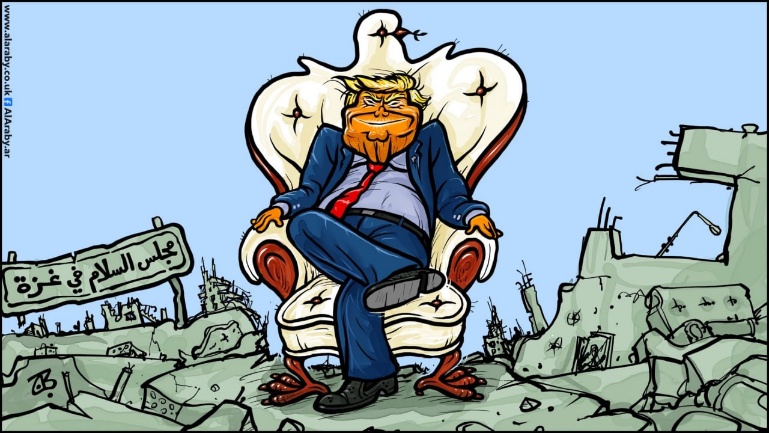
 A cartoon by Imad Hajjaj: the American president imitates the pose of Yahya al-Sinwar on an armchair shaped like a dove of peace with a sign reading “Peace Council in Gaza” (al-Araby al-Jadeed, January 15, 2026)
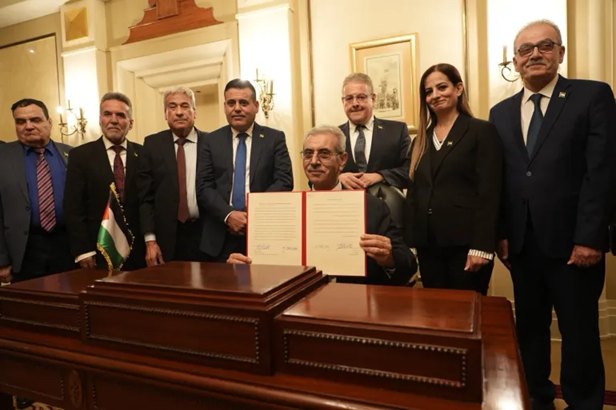
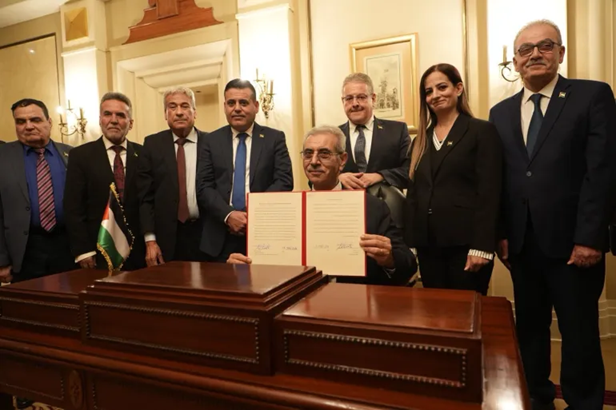 Shaath (seated) with members of the committee after signing the committee’s mandate of action (Al Jazeera, January 18, 2026)
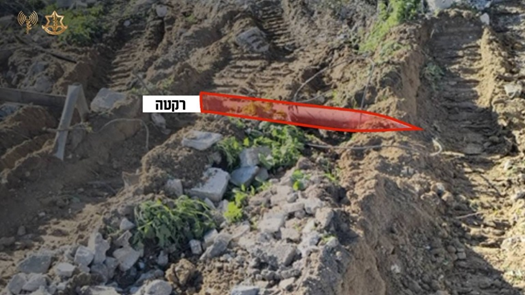 Rocket launchers in the southern Gaza Strip (IDF spokesperson, January 14, 2026)
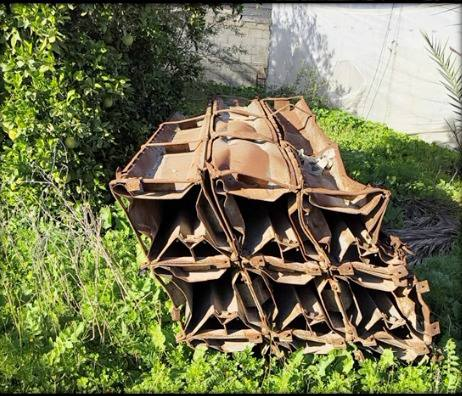 Rocket launchers in the southern Gaza Strip (IDF spokesperson, January 14, 2026)
- The president of the United States announced the launch of the second phase of the ceasefire agreement in the Gaza Strip and presented the bodies that will oversee implementation of the agreement and rehabilitation of the Strip, among them representatives of Qatar and Turkey.
- Dr. Ali Shaath, former deputy minister in the Palestinian Authority government, was appointed to head the committee of technocrats which will manage the Gaza Strip on a day-to-day basis and stated that the goal was “to support the Gazans and wipe away the children’s tears.”
- Hamas claimed it was willing to transfer management of the Strip to the committee, but remained adamantly opposed to the demand to disarm it and the other terrorist organizations operating in the Gaza Strip.
- IDF forces continued operating within the Yellow Line in the Gaza Strip, located and destroyed terrorist facilities and weapons, and eliminated terrorists who attempted to attack the forces. After exchanges of fire with a terrorist cell in Rafah, prominent terrorist operatives from Hamas and the Palestinian Islamic Jihad were attacked.
- Hamas security forces in the Strip accused the Palestinian Authority of supporting “collaborator gangs” operating in areas under Israeli control.
- Israeli security forces continued counterterrorism activity throughout Judea and Samaria and launched a wide-scale operation in southern Hebron.
- On January 14, 2026, American envoy Steve Witkoff announced the launch of the second phase of the ceasefire agreement in the Gaza Strip as part of the American 20-point plan. He noted that the United States expected Hamas to fulfill its commitments, including the return of the body of the murdered Israeli hostage. He said the second phase included the establishment of a temporary Palestinian technocratic government in the Strip, the beginning of the disarmament process and the start of comprehensive rehabilitation of the Strip (Steve Witkoff’s X account, January 14, 2026).
- The American president formally announced the start of the second phase of the peace plan and stated that since the beginning of the ceasefire, “record quantities” of humanitarian aid had entered the Strip (Truth Social, January 15, 2026). Subsequently, the president welcomed the establishment of the national committee for managing the Gaza Strip (the committee of technocrats), headed by Dr. Ali Shaath, which will oversee the reconstruction of basic services and civilian institutions, and the stabilization of daily life in the Strip. He also presented the members of the Peace Council which will oversee implementation of the peace plan and mobilization of resources for rehabilitation, and the members of the Gaza Executive Council, which will serve as an intermediary between the Peace Council and the committee of technocrats and will include representation from Turkey and Qatar as well. It was also announced that Nikolay Mladenov, former UN special coordinator for the Middle East peace process, would serve as the senior representative for the Gaza Strip and liaise between the Peace Council and the committee of technocrats. American General Jasper Jeffers was appointed commander of the international stabilization force which will be responsible for security activity in the Strip, assist with disarmament and enable safe transfer of humanitarian aid and construction materials (White House website, January 16, 2026).
A cartoon by Imad Hajjaj: the American president imitates the pose of Yahya al-Sinwar on an armchair shaped like a dove of peace with a sign reading “Peace Council in Gaza” (al-Araby al-Jadeed, January 15, 2026)
- The chairman of the committee of technocrats, Ali Shaath, formally announced the composition of the committee and said they had begun their work from Cairo but were preparing to move to the Gaza Strip. He said they would use the Egyptian March 2025 plan for reconstructing the Strip, which begins with the supply of temporary housing for Palestinians until homes are rebuilt. He also said opening the Rafah Crossing was a top committee priority, and would allow the entry of aid and essential supplies and ease the passage of Gazans to and from the Strip. Shaath said the committee met often to develop a plan to “support the citizens, wipe away the children’s tears, feed every mouth and repair every home in the Gaza Strip” (al-Qahira al-Ekhbariya, January 17, 2026). The committee members are the following:
- Chairman of the committee and holder of the energy and transportation portfolio, Ali Shaath (former deputy minister of transportation in the Palestinian Authority and head of the Palestinian Industrial Zones Authority).
- Economy, trade and industry portfolio, Aaed Abu Ramadan (head of the Gaza Strip Chamber of Commerce).
- Agriculture portfolio, Abd al-Karim Ashour (director of the Agricultural Relief Association).
- Health portfolio, Aaed Yaghi (director of the Medical Relief Association).
- Housing and lands portfolio, Osama al-Saadawi (former minister of entrepreneurship and empowerment in the Palestinian Authority government).
- Justice portfolio, Adnan Abu Warda (former judge in the Palestinian Authority).
- Security and interior portfolio, Sami Nasman (former senior official in the Palestinian Authority Preventive Security, accused by Hamas of attempts to undermine public order).
- Local authorities and water portfolio, Ali Barhoum (engineer and consultant in the Rafah municipality).
- Finance portfolio, Bashir al-Rais (engineering and financial consultant).
- Welfare and social affairs portfolio, Hanaa al-Tarazi (lawyer and community activist).
- Education portfolio, Jabr al-Daur (president of Palestine University).
Shaath (seated) with members of the committee after signing the committee’s mandate of action (Al Jazeera, January 18, 2026)
- Following the announcement of the start of the second phase and the establishment of the new bodies to manage the committee and implement the ceasefire agreement, Palestinian reactions were the following:
- Hamas spokesperson Hazem Qassem said Hamas demanded the American administration compel Israel to complete its commitments to the first phase of the ceasefire agreement and move forward to the second phase. He called Witkoff’s announcement regarding the beginning of the second phase a positive and important development, adding that Hamas was fully prepared to transfer management of the Gaza Strip to an independent committee of technocrats and to assist in facilitating its work (al-Jazeera Mubasher, January 14, 2026).
- The following was written on a Hamas-affiliated channel in response to the declaration of the Peace Council: “The American president officially declares an American mandate over Gaza! We fought the British Mandate; afterward we smashed the head of the Israeli occupation; and we will turn the president’s dreams into a nightmare. Gaza is a cemetery for invaders” (al-Siyad Telegram channel, January 17, 2026).
- The Palestinian Islamic Jihad claimed it had expressed readiness to move to the second phase despite Israel’s “delays and violations” and it had also allowed [sic] the announcement of the technocrats committee. However, it added that it was “surprised” by the composition of the Peace Council, claiming that its members “serve Israel’s interests,” and there were negative signs regarding Israel’s willingness to implement the agreement (PIJ media information office Telegram channel, January 17, 2026).
- Fatah spokesperson Iyad Abu Znait said the “national committee for managing Gaza” reflected a specific framework for managing the Strip, consistent with the demand that the committee be subordinate to the Palestinian Authority and operate in coordination with it. He further claimed that the committee was not a body parallel to the Palestinian Authority, but rather a designated committee for managing the Strip, and its success depended on a future relationship based on cooperation between Palestinian Authority institutions in the Gaza Strip and its institutions in Ramallah (Radio Alam, January 15, 2026).
- Despite the announcement of progress to the second phase, one of the key issues which remains unresolved is disarming Hamas and the other terrorist organizations. “Two senior American officials” claimed that Hamas had privately signaled it was prepared to accept the United States military disarmament plan and begin to lay down its weapons. They reported that the United States and the other mediators had been in contact with Hamas in recent weeks regarding disarmament, and further talks would take place in the coming weeks with the start of implementing the second phase. They added that the American administration’s disarmament plan for the Gaza Strip was gradual, and in the immediate future focused on destroying “terrorist infrastructure” such as tunnels and weapons factories and relinquishing heavy weapons such as RPGs, rockets and missiles, which would be placed in a location “where they will not be used for attacks against Israel” (Axios website, January 15, 2026).
- However, “a senior Hamas official” in Cairo denied reports that the movement had expressed willingness to disarm in exchange for amnesty for its members. He said there were “many errors” prevalent regarding Hamas’ position on disarmament, adding that Hamas had emphasized its readiness to discuss any vision or outlook regarding the weapons issue, except for the vision of Israeli Prime Minister Netanyahu, who insists on disarmament and the elimination of all weapons in the Gaza Strip. The “official,” who was said to be involved in discussions between the Hamas delegation and senior Egyptian officials regarding the second phase of the ceasefire agreement, revealed understandings and an agreement between Hamas and the Egyptian mediators regarding a vision of the “removal of weapons” from the arena and enabling rehabilitation efforts in the Gaza Strip. He emphasized that the military wings of Hamas and the other factions were absolutely opposed to any agreement which would lead to disarmament or the denial of the option of “resistance” as long as the “occupation” continued, and their positions linked disarming to the establishment of an independent Palestinian state (al-Araby al-Jadeed, January 15, 2026).
The IDF
- IDF forces continued operating within the Yellow Line (the area under IDF control) in the Gaza Strip, destroyed terrorist infrastructure above and below ground and eliminated terrorists who approached the line or attempted to cross it to attack the forces. In the northern Strip the forces located a loaded launcher with a rocket aimed at Israeli territory, and in the southern Strip a launcher was located alongside a rocket (IDF spokesperson, January 13-19, 2026).
Rocket launchers in the southern Gaza Strip (IDF spokesperson, January 14, 2026)
- On January 13, 2026, six armed terrorists were eliminated after being identified in western Rafah shooting at the forces and at one of the tanks. In response, the IDF attacked prominent terrorist operatives from Hamas and the Palestinian Islamic Jihad in various areas of the Gaza Strip (IDF spokesperson, January 13-17, 2026). Palestinian media reported that ten people were killed in the strikes, including Muhammad al-Houli, a senior figure in Hamas’ military wing in the central camps (Reuters Arabic, January 15, 2026; Ultra Palestine website, January 15, 2026). Senior Hamas figure in Lebanon, Osama Hamdan, said that the killing of al-Houli was a “serious escalation” and exposed Israel’s intentions to sabotage the ceasefire agreement (aljazeera.net, January 15, 2026).
The Situation in the Gaza Strip
- According to reports, for the first time since the start of the war, a cement truck entered the Gaza Strip through Kerem Shalom, alongside reports of additional trucks bearing with fruits and vegetables, food products for children, clothing and shoes, beverages and frozen products (Akhbar al-Musaadat Gaza Telegram channel, January 14, 2026). The entry of 1,000 fiberglass tents was approved through the UN Development Programme (UNDP), while the actual need is estimated at around 40,000 tents (Sahm Unit 103 Telegram channel, January 16, 2026).
- During a visit to Gaza, the executive director of the UN Office for Project Services (UNOPS), Jorge de Silva, said there were more than 60 million tons of rubble in the Strip, and clearing it would take more than seven years. He said the problem was not only the quantity of the rubble, but also what it contained, namely unexploded ordnance, hazardous waste and human remains (Jorge de Silva’s X account, January 16, 2026).
- According to reports, in recent days and weeks there has been an obvious decline in the clearing of rubble and waste from the streets and roads of the Gaza Strip, in contrast to the activity after the ceasefire went into effect on October 10, 2025. A significant decline was also observed in the activity of bulldozers and cranes. As a result, many streets and roads that had been opened were blocked again, as residents turned them into dumping grounds for rubble from their homes (al-Ayyam, January 18, 2026).
- Economic analyst Ahmed Abu Qamar claimed that the Gaza Strip’s economy was in one of the most dangerous periods in its history, characterized by almost complete paralysis. He said that during 2025 the unemployment rate crossed the 77% threshold, while the labor force participation rate remained particularly low and did not exceed 38%. He added not transitioning to the second phase of the ceasefire agreement meant continued Israeli control over about 60% of the Strip’s territory, including key agricultural and industrial areas, a situation that intensified the collapse of economic sectors and led to the shutdown of most factories and the exclusion of most productive activity from the labor market (alresala.net, January 19, 2026).
Civilian Governance
- The spokesperson of the Hamas police, Lt. Col. Muhammad al-Zarqa, said that a campaign had been launched in cooperation with the Gaza Municipality to regulate facilities and main roads in Gaza City during the current week. He said the objective was to regulate the traffic situation, deal with unregulated stalls and remove waste and obstacles from roads and main intersections to improve the flow of traffic and improve the city’s appearance. He said the program would include the Gaza municipality, Gaza District police, Gaza City police and traffic and emergency police (Hamas police Telegram channel, January 17, 2026).
- The traffic department of the Hamas police announced a campaign to monitor and supervise trucks throughout the Strip in cooperation with the ministry of transportation and the Hamas ministry of national security. The campaign will focus on drivers and trucks complying with legal instructions, including checking the validity of the driver’s license, its suitability for the truck category and verification of the technical and legal licensing of the vehicles. The traffic department also announced that its teams would begin instructing drivers on “the dangers of noncompliance with traffic regulations and instructions,” after which they would begin using stricter measures, including issuing fines and confiscating vehicles which did not meet the conditions (Hamas Police Telegram channel, January 18, 2026).
Security Governance
- “A senior figure in the Raad force” of “resistance security” accused the Palestinian Authority (PA) of supporting “gangs of collaborators” operating in areas under Israeli control in the Gaza Strip. He claimed interrogations had exposed the existence of direct communication channels between militia leaders and political and security figures in the PA. He also claimed that the PA provided the gangs with political backing and continued to pay monthly salaries to the leaders and members of the gangs on its payroll (al-Siyad Telegram channel, January 14, 2026).
- Three Hamas police operatives were reportedly eliminated in an Israeli airstrike near al-Nabulsi Square in Gaza City. “Palestinian sources” said the strike was carried out during a police attempt to arrest several members of “militias supported by Israel” in the eastern part of the city (al-Siyad Telegram channel, January 15, 2026).
- Hussam al-Astal, leader of an anti-Hamas militia operating in the Qizan al-Najjar area in the Khan Yunis district, claimed that the militia’s security apparatus exposed individuals who admitted that they had been sent by senior Hamas figures in Khan Yunis to infiltrate the militia and get close to al-Astal in order to assassinate him. He promised that they would receive a fair trial (Hussam al-Astal’s Facebook page, January 13, 2026).
- Subsequently, al-Astal published a video of himself with Hamza Ramadan Arab Mahra, an operative in the Izz al-Din al-Qassam Brigades from Jabalia al-Balad in the northern Gaza Strip, who announced he was joining the militia. He is reportedly the grandson of Arab Mahra, one of the founders of the Hamas movement. Al-Astal said in the video that he welcomed all Hamas members whose hands were not stained with blood to join his forces (Hussam al-Astal’s Facebook page, January 17, 2026). In response, the Mahra clan stated that it condemned Hamza Ramadan Muhammad Arab Mahra for joining al-Astal’s “gang” and noted that “his shameful behavior is a complete deviation from the family’s customs and its national and moral values.” The clan also announced that it disowned him and firmly rejected any form of cooperation with the IDF and “treason” (Telegram channel of journalist Ayman Hunaidek, January 17, 2026).
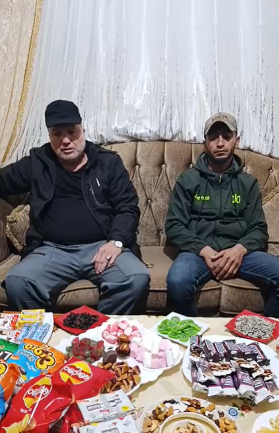
Al-Astal (left) with Mahra (al-Astal’s Facebook page, January 17, 2026)
- The militia of the Popular Army in the Northern Strip District, commanded by Ashraf al-Mansi, threatened a senior figure in Hamas’ Emergency Committee because he tried to forcibly evacuate displaced persons staying in the building of the ministry of public works and housing in western Gaza City. The militia called it a moral and national crime which could not be ignored, and said that anyone who participated in or justified such an injustice would be held accountable (Facebook page of the Popular Army in the Northern Strip District, January 14, 2026).
Counterterrorist Activity
- This past week Israeli security forces continued counterterrorist activity throughout Judea and Samaria, and on January 19, 2026, launched a wide-scale operation in the southern part of the city of Hebron. They eliminated Palestinians who threw explosive devices, Molotov cocktails and rocks, and detained others. In addition, a terrorist who planned to deal arms was detained in Nablus, and at the Allenby Crossing 12 million shekels in cash (about $3,800,000) were seized on suspicion of being intended to finance terrorist activity. The forces also demolished the homes of two terrorists who carried out attacks in which Israeli civilians were murdered (IDF spokesperson and Israel Police spokesperson, January 13-19, 2026).
- The PA minister of finance and planning, Estaphan Salameh, held a series of meetings with senior officials in the Spanish government in Madrid. From the meetings it emerged that Spain and its partners were trying to renew the international grants fund for the PA, while affirming that Spanish support for “Palestine” did not depend on prior conditions. According to the announcement, countries of the International Alliance to Promote the Two-State Solution, led by France and Saudi Arabia, had donated $200 million to the fund, of which $90 million came from Saudi Arabia. Salameh noted that the money helped the PA ministry of finance meet part of its recent commitments. He also welcomed Spain’s commitment to increase assistance to “Palestine” to €75 million over the next two years, to allocate a new payment for budgetary support and to expand support for UNRWA and humanitarian responses in the Gaza Strip and Judea and Samaria, and thanked Spain for its political backing of Palestinian rights and its activity in the European arena to mobilize broad support (Wafa, January 18, 2026).
Campaign for the Release of Palestinian Prisoners
- On January 15, 2026, pro-Palestinian activists led a digital campaign calling for the release of Palestinian prisoners still held in Israeli prisons, while attempting to draw a comparison to the Israeli campaign for the release of civilians and security personnel abducted to the Gaza Strip in the Hamas terrorist attack and massacre on October 7, 2023. The campaign, initiated by the Palestinian Forum in London, presented red ribbons, a paraphrase of the yellow ribbon in the Israeli campaign, combined with the call “Demand freedom for Palestinian hostages [sic].” The organizers said their goal was to mobilize international support ahead of an International Day of Action planned for January 31, 2026 (Al Jazeera, January 15, 2026).
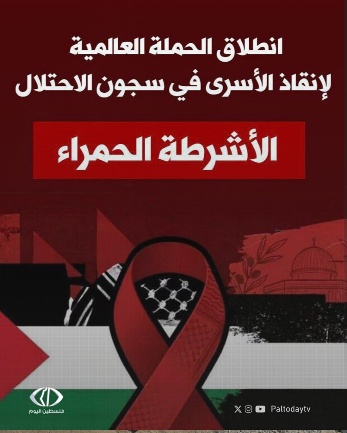
The Palestinian campaign for the release of prisoners
(Palestine Today network, January 15, 2026)
[1] Click https://www.terrorism-info.org.il/en to subscribe and receive the ITIC’s daily updates as well as its other publications.
Related Articles