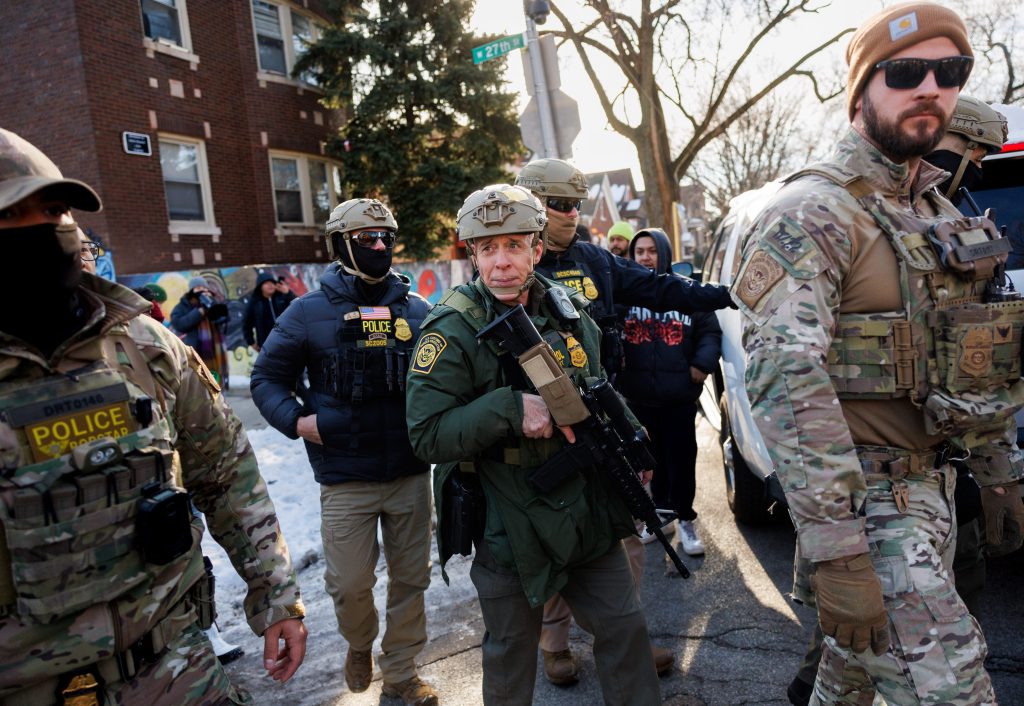
After a daylong process that took place partially out of public earshot, a jury was selected Tuesday in the trial of a Chicago man accused of passing along a gang bounty allegedly placed on the head of controversial Border Patrol Cmdr. Gregory Bovino.
The jury of six men and six women, plus two alternates, was sworn in about 3:30 p.m. to hear the case against Juan Martinez Espinoza, then promptly excused until opening statements Wednesday morning. The trial is expected to end by Friday.
Few details on each of the jurors were discussed in open court. One is a man who said he works as a contracted truck driver. Another man takes care of an elderly family member. One juror, a woman, said she once served on a jury in California. Another male juror told the judge he’d just landed a second interview for a new job.
At least three members of the panel have Hispanic surnames.
Espinoza Martinez, who has lived in Chicago for years but is not a U.S. citizen, is charged in an indictment with a single count of solicitation of murder for hire, which carries up to 10 years in prison.
According to prosecutors, Espinoza Martinez told a law enforcement source after an immigration agent shot a woman in Chicago’s Brighton Park neighborhood on Oct. 4 “that he had dispatched members of the Latin Kings” to the area of 39th Street and Kedzie Avenue in response to the shooting.
The law enforcement source shared Snapchat messages that Espinoza Martinez had sent him saying, “2k on information when you get him” and “10k if u take him down,” according to the complaint.
A message also stated, “LK on him,” which was a reference to the Latin Kings, the complaint alleged. Included in the message was a photo of Bovino.
Espinoza Martinez’s trial is the first criminal case stemming from Operation Midway Blitz to go to a jury, and is sure to attract national attention.
Though limited in scope, the case is expected to offer an important litmus test as immigration-enforcement operations continue to roil Chicago and other Democrat-led cities long targeted by President Donald Trump, including Minneapolis, where the killing of a U.S. citizen by an immigration agent earlier this month has sparked nationwide protests.
The jurors were empaneled Tuesday after filling out questionnaires about their backgrounds and ability to serve, including any opinions they might have about the Trump administration’s immigration enforcement policies.
Bovino’s name didn’t come up in court on Tuesday until after a lunch break, when U.S. District Judge Joan Lefkow told the pool of prospective jurors she wanted to “just give you a little bit more information about the case before we go further.”
“The case is called United States v. Juan Espinoza Martinez, and the defendant is charged with committing acts in furtherance of a murder-for-hire plot against Gregory Bovino,” the judge said.
Bovino was not mentioned again in open court. However, during a discussion about “for cause” challenges, it became clear that at least a few jurors had revealed they had strong feelings about Operation Midway Blitz, the aggressive deportation push in the Chicago area that began in early September.
One woman was dismissed for cause after she said she had strong opinions on immigration enforcement but also said she thought she could put those feelings aside and be fair.
Another juror, also a woman, said she didn’t agree with the current immigration enforcement policies and knows people who live near the Brighton Park shooting incident. Prosecutors successfully argued she should be dismissed, telling the judge she’s “going to have trouble putting that aside to assess the evidence in this case.”
“These issues hit close to home for her,” First Assistant U.S. Attorney Jason Yonan said. “She is going to have trouble putting that aside to assess the evidence in this case.”
The judge also dismissed a male prospective juror who said he didn’t agree with the current immigration policies and had friends who’d been tear-gassed by agents.
Espinoza Martinez’s attorney, Jonathan Bedi, noted that the juror eventually said he could be fair and impartial, despite his opinions on immigration. “We are not asking people to check their feelings and emotions at the door,” Bedi said. “Nobody is asking them to be a blank slate.”
Before jury selection began Tuesday, Lefkow made a series of last-minute rulings on evidentiary issues that further limited what the jury will hear about Chicago street gangs during testimony.
Espinoza Martinez was initially charged in a criminal complaint alleging he was a high-ranking member of the Latin Kings street gang with “authority to order other members to carry out violent acts, including murder.”
The case was held up by top Department of Homeland Security officials as an example of the violence and threats immigration agents were facing from gang members and even international drug cartels.
In the months since, however, evidence of Espinoza Martinez’s supposed gang affiliations has not materialized. Prosecutors vastly toned down that aspect of the case, first dropping mention of gang affiliation in the indictment handed up by a grand jury, then saying in a pretrial hearing they only intended to prove Espinoza Martinez had an “affinity” for the Latin Kings.
On Tuesday, the defense objected to prosecutors introducing a text string where Espinoza Martinez told an unidentified contact: “It’s going down bro my guys are ready in the vill (Little Village). Saints sd and 2Six being bitches. Kings on they ass n they scared.”
Prosecutors argued the conversation showed Espinoza Martinez was disappointed other gangs weren’t fighting back.
But Lefkow sided partially with the defense, saying the comments on Little Village can be shown to the jury, but not the references to the Latin Saints or Two-Six gangs.
She also excluded later text by Espinoza Martinez about “Chapo” having the Latin Kings’ back — a reference to former Sinaloa Cartel boss Joaquín “El Chapo” Guzmán.
Prosecutors also wanted to play a short video clip that Espinoza Martinez forwarded after he was asked by the cooperator what his text about the bounty on Bovino meant.
The video, which was played for Lefkow on Tuesday, showed an unidentified man standing out at 26th Street and Spauling Avenue asking where all the gangbangers were.
“Now that ICE is out here there nobody out here … it’s a (expletive) ghost town,” the person said on the video, which Espinoza Martinez was not a part of.
Prosecutors said it showed Espinoza Martinez’s motivation for sending along the Latin Kings’ bounty offer.
But Lefkow ruled the video cannot be used because prosecutors cannot show it was a statement adopted by the defendant.