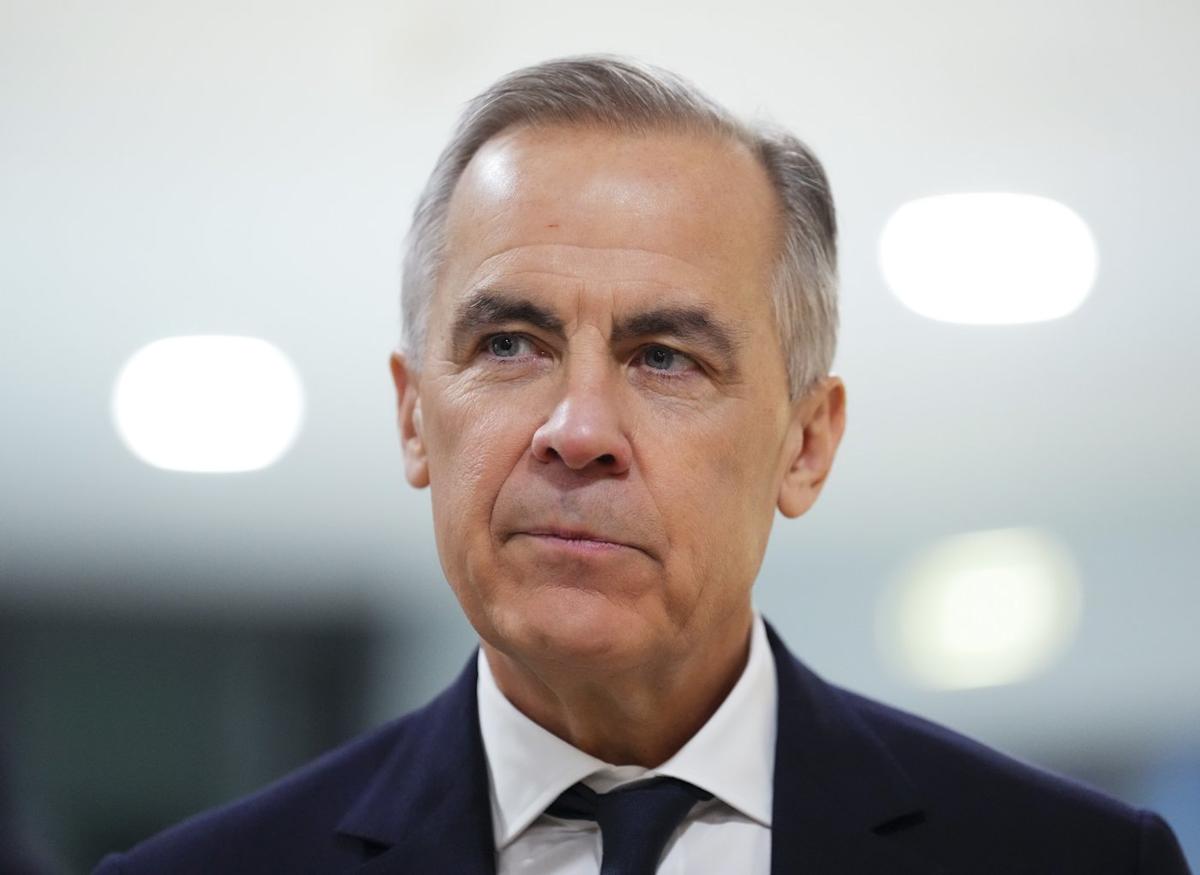
DAVOS — The world has entered a risky new age of great power rivalries and middle powers need to join forces to survive, Prime Minister Mark Carney told the World Economic Forum in Davos, Switzerland, Tuesday.
As President Donald Trump prepares to bring his case for U.S. control of Greenland to the elite annual international forum on Wednesday, the prime minister warned leaders assembled there that giving in to coercion and economic threats will not protect them.
“Great powers have begun using economic integration as weapons, tariffs as leverage, financial infrastructure as coercion, supply chains as vulnerabilities to be exploited,” Carney said in his speech.
“You cannot live within the lie of mutual benefit through integration when integration becomes the source of your subordination.”
The prime minister said countries like Canada prospered under the former rules-based international order — but the “old order is not coming back.”
“Middle powers must act together because if you are not at the table, you are on the menu,” he said, bringing a familiar talking point from last year’s election campaign to a global audience.
Big powers can go it alone, said Carney. Middle powers like Canada cannot.
“But when we only negotiate bilaterally with a hegemony, we negotiate from weakness,” Carney said. “We accept what’s offered. We compete with each other to be the most accommodating. This is not sovereignty. It’s the performance of sovereignty while accepting subordination.”
His speech comes as Trump nears the one-year anniversary of his second term as president, a year marked by him using tariffs as both political and economic power moves, against virtually every country in the world.
His most recent threats include tariffs against eight European nations strongly opposing his desire to take over Greenland, and a 200 per cent tariff on French wine after French President Emmanuel Macron turned down an invitation to join Trump’s “Board of Peace” for Gaza.
The Greenland crisis dominated much of the discussion in Davos, with world leaders calling out the U.S. over its threats.
Macron called the situation “crazy,” while Belgian Prime Minister Bart De Wever warned that America is not behaving like an ally.
Carney met with Macron on Tuesday. A readout from the Prime Minister’s Office said the two “reaffirmed their mutual commitment” to Denmark’s sovereignty, including Greenland.
Carney told the Davos crowd the past year has shown the world is moving toward a system of economic coercion, with great powers pursuing their own interests above all else.
Story Continues
The prime minister said middle powers like Canada must adapt to this new reality — which why Canada is looking to expand non-U.S. trade through deals such as those signed recently with China and Qatar.
Colin Robertson, former Canadian diplomat and fellow at the Canadian Global Affairs Institute, told The Canadian Press he thought Carney’s speech was “pragmatic.”
“Multilateralism is how we level the playing field and, if we don’t do it, then the big ones are going to pick us off one by one, as the prime minister pointed out,” he said. “I thought it laid out what I think is probably going to become the Carney doctrine.”
“I think it’s very positive,” he added. “I think it’s probably going to also be looked at by other countries and particularly middle powers within Europe.”
Adam Chapnick, professor of defence studies at the Royal Military College of Canada, said while Carney’s speech is being positioned as a departure, in some ways it’s consistent with what Canada’s national interests have always been.
“When you aren’t a great power, there was always strength in numbers, whether the great powers are confrontational and aggressive or less belligerent,” Chapnick said. “You never want to be put in a situation where you’re dealing one-on-one with someone either more militarily or economically powerful than you are, because it’s really hard to win in those negotiations.”
Chapnick said while it’s been rare for Canada in recent years to speak in such “clear, pragmatic terms,” the content of Carney’s speech was not new.
“It’s a realistic assessment of what Canada can and cannot do alone in the world,” he said. “For Canada to pursue its interests in the world, it has to work with others, no matter the international environment.”
Chapnick said the speech worked to explain what Carney’s been doing as much as what he is going to do next.
“It explains why the constant travel, why the different trade agreements, why the different military partnerships, purchasing agreements, a reset of relations with all these different countries,” he said.
Carney has been criticized for not speaking out more forcefully on human rights while meeting with dictators as he seeks to attract new investment from abroad.
Less than a year ago, Carney publicly identified China as the greatest threat to Canadian national security.
In his Davos speech, the prime minister talked about how Canada is focusing on broad international engagement to “maximize” its influence on a turbulent world stage.
“We actively take on the world as it is, not wait around for a world we wish to be,” Carney said.
Carney said Canada was among the first to hear the “wake-up call” of the new great-power era — a reference to the U.S. imposing tariffs last year and threatening to make Canada the 51st state.
Trump, who is attending the World Economic Forum along with a core cadre of cabinet members and White House advisers, is scheduled to address the forum on Wednesday.
World leaders can walk around the town freely and may even bump into each other by chance, but it’s not clear if Trump and Carney will cross paths at all.
Carney is scheduled to leave for home late Wednesday. The Prime Minister’s Office said there is currently no meeting scheduled between Carney and Trump, though that could change.
The office does not routinely disclose when the two leaders communicate.
This report by The Canadian Press was first published on Jan. 20, 2026.
—With files from Catherine Morrison in Ottawa.
Kyle Duggan, The Canadian Press