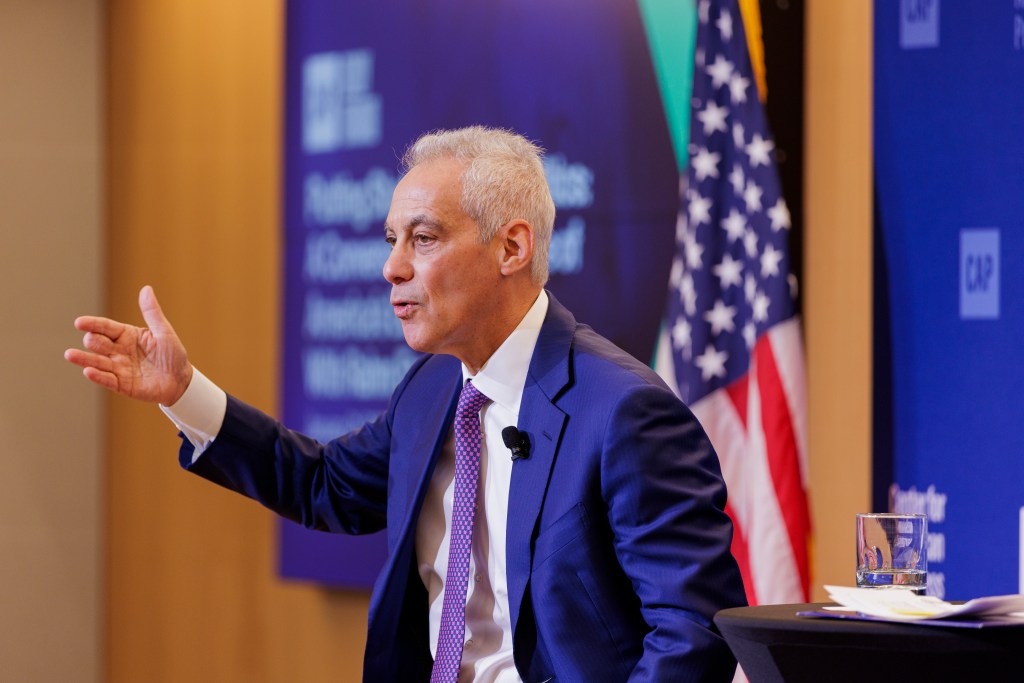
WASHINGTON — As he explores a potential White House bid, former Chicago Mayor Rahm Emanuel told a Washington crowd Wednesday the changes he oversaw in the city’s school system could be a model for the rest of the country, despite the significant blowback they caused.
Emanuel, a Democrat who left City Hall after two terms in 2019 and later served as President Joe Biden’s ambassador to Japan, said everyday Americans he spoke with in places like Iowa and Mississippi were eager to hear about his ideas to improve their schools.
He blamed both national parties for losing focus on public schools, saying Republicans are too eager to adopt vouchers for private schools while Democrats have lost their appetite for holding teachers and administrators accountable for student performance.
“The answer isn’t: vouchers over here, no standards over there,” he said. “Don’t abandon public schools and don’t abandon accountability.”
Emanuel spoke at the Center for American Progress, a liberal think tank, emphasizing the need to stress phonics in early childhood education, to better prepare high school students for life after graduation and to expand ways for students to participate in their communities, whether through the arts, academics or their jobs.
Many of his ideas, which he has been touting in stump speeches and in national media interviews and op-eds, are rooted in his experience overseeing Chicago Public Schools, which was under direct mayoral control during his eight years in office.
He pointed to his efforts to offer universal pre-K, make kindergarten full day, lengthen school days and the school year, bring back recess, offer free summer tutoring and free community college admission to students with grades averaging at least a B.
But, of course, schools were a frequent flash point during Emanuel’s mayoral tenure. In 2012, the Chicago Teachers Union went on strike for the first time in 25 years, a seven-day stoppage that emboldened labor unions nationwide. Then in 2013, the Chicago Board of Education announced it would close 49 elementary schools and one high school program, most of them on the South and West sides, leaving a disproportionate impact on Black communities.
On Wednesday, Emanuel chafed at the idea that those experiences would dampen enthusiasm for his future educational plans.
“Come walk the streets with me in Chicago,” Emanuel said. “See how things are going and how they think about the past versus the present.”
“On the 50 schools, my life would have been easier if I had never touched that. Totally easier! I wouldn’t have had teachers (holding signs) outside my kids’ classroom,” he said. “My life would have been easier. But those kids in schools that people were fleeing, that were failing year in and year out, their lives were going to be miserable.”
And he said that improving Chicago Public Schools’ finances helped him in Springfield, where Republican Gov. Bruce Rauner signed off on favorable legislation for the school system.
“I ran so I could fix this public school system. And after I did that, the state gave the city of Chicago what no mayor had ever gotten in all seven of my predecessors’ requests: equal funding for the first time ever,” Emanuel said. “And our reading scores, our math scores, our graduation rates and our community college attendance all went up.”
“Was it easy? You find me a day where you do a big thing and everybody sings ‘Kumbaya,’” he added. “It was hard. It was harder leaving those kids in failure and walking away. So if you’re looking for someone to husband political capital, I’m not your guy.”
Emanuel also noted that the end of mayoral control over the Chicago schools came after he left office, following a longer CTU strike while Lori Lightfoot was mayor. Mayor Brandon Johnson, who succeeded Lightfoot, is a former CTU organizer. Illinois lawmakers in 2024 changed the selection process for Chicago Board of Education members from mayoral appointments to direct election. Half the board was elected in 2024, and the remaining seats will be on the ballot later this year.
Emanuel said the test of a good public official is to compare how things are when an official walks into office with how they are when they leave. In his case, he said Chicago schools were the “single worst public school system in America” when he came into office in 2011, but by the time he left, a Stanford education professor found they were the “single best of the top 100.”
When asked how he would compare American and Japanese school systems, Emanuel said the most striking differences were outside the classroom. He said that Japan’s family structure provided students with the support they needed to excel in their studies. In American society, that structure would most likely have to come from mentorships and other outside activities, he said.
“You want to know what’s beautiful, makes you want to cry with joy? Watching a 5-year-old walk eight blocks to school all alone,” the former ambassador added. “What I would have done as the mayor of Chicago to give a child back their childhood, thinking of their studies, not their safety … That to me is sublimely beautiful.”
Emanuel also reiterated his support for keeping kids under 16 completely off of social media, as Australia has done. He said the federal government needs to come to the aid of parents who want to keep their kids off of mobile devices, likening social media companies to the tobacco industry.
“It’s an addiction,” he said. “Our kids don’t have the moral foundation to handle that addiction. Either you’re going to stand up for parents, or you’re going to let Facebook raise kids.”
In Washington, Emanuel is well-known as a political strategist. He was a fundraiser for Bill Clinton’s 1992 presidential campaign, chief of staff to President Barack Obama, and as a U.S. House member, the architect of the Democrats’ 2006 effort to retake the chamber from Republicans during President George W. Bush’s second term.
On Wednesday, he advised Democrats in this year’s midterms to embrace the “change” theme that was central to both Bill Clinton’s and Obama’s messaging.
Emanuel said he agreed with Democratic leaders’ emphasis on “affordability,” but suggested it should be tied to a broader focus. The party should push to raise the federal minimum wage from $7.25 an hour, which hasn’t been increased since 2009, as a contrast to billionaires accruing more rights. With electric bills rising due to demand from tech companies, he suggested Democrats propose a “ratepayers bill of rights.”
Emanuel said Democrats should also strengthen ethics laws to fight corruption among public officials.
Perhaps his most ambitious proposal — one that could require a constitutional amendment — was to impose a mandatory retirement age of 75 for all branches of government, including people serving as president, in the Cabinet, in Congress or as a judge.
“That screams change,” Emanuel said. The Democrats’ agenda can’t be disparate policies about grocery prices or other affordability concerns, he said. “It has to be under the rubric of: ‘We’re going to change Washington, and we’re going to focus on our priorities, not theirs.’ That’s what the Democrats have to talk about.”