Historical research done right — that is, honestly — is a lot like science itself. Conclusions are not predetermined, often unsettling assumptions rather than confirming them. And discovery arrives unexpectedly.
Simply ask author and historian Harold Rich, a “late bloomer” academic who has returned to book stores — and you, too, Amazon — with a third comprehensive account of Fort Worth history.
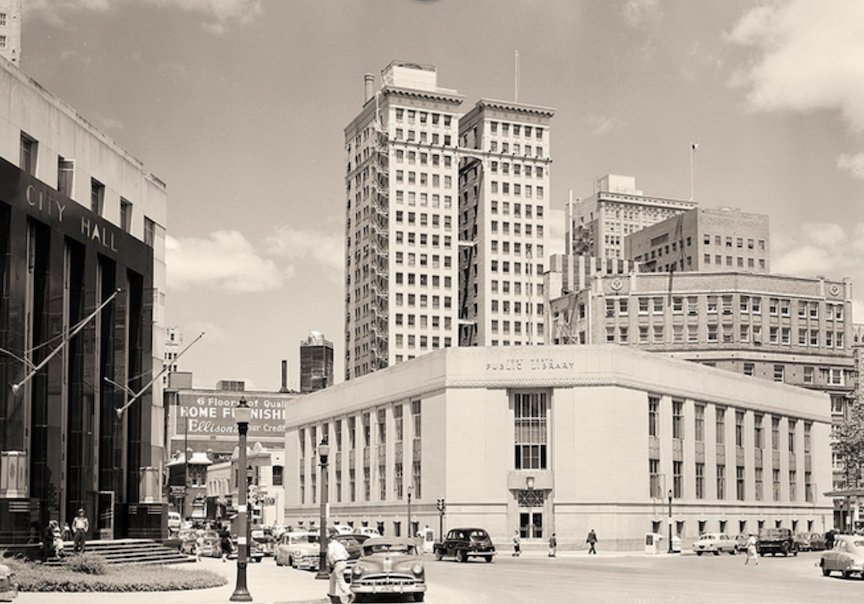
Fort Worth From World War II to 1960, published by the University of North Texas Press, examines everything from economic development — the “bomber plant” the most prominent initiative — to policing, where gangs and corruption played a leading role, and race relations, a history that is far from something to be proud of.
“Fort Worth in 1944 was a Southern segregated city, and by 1960 it still was, with very few changes or advances,” said Rich, who grew up in Fort Worth and graduated from Paschal High School. “Fort Worth was the last major city in Texas to hire Black police officers. Fort Worth schools remained segregated throughout all that time, even though the Brown decision came out in ’54. I graduated in 1966, and I tell people that the first time I ever sat in a classroom with a Black person was my first college class.”
Most everybody from here already knows — or should know — generally about all of that. Rich, however, adds many details and anecdotes to complete the story.
What Rich had no idea about before researching this book was the jaw-dropping matter of sterilizing young people in a largely forgotten episode in 1943–44. There are some stories communities want to forget. Families do that. Cities and societies do that. This is one of them.
What began as a military and public-health campaign to control venereal disease among soldiers expanded into something far more consequential: the sanctioning of forced sterilizations of young people deemed mentally or morally unfit.
“That really shocked me — that during World War II, that happened here in Fort Worth,” Rich said. “It was really just a form of eugenics because sterilizing those kids didn’t do anything to change their behavior. It didn’t make them not ‘feeble-minded’ or make them less sexually active. All it did was keep them from reproducing. So, it was a form of eugenics.”
Between May 1943 and early 1944, at least five sterilizations were performed on juveniles and young adults — four girls and one boy — with 11 more planned. These procedures were carried out under the approval of county officials and physicians, with consent obtained from parents or guardians in most cases, and without the consent of the individuals themselves. One exception was a 20-year-old woman, the wife of a serviceman, who signed for her own sterilization.
Those sterilized were consistently labeled “feeble-minded,” a designation applied broadly to teenagers and young adults whose circumstances included illegitimate children, alleged sexual promiscuity, or institutionalization.
The legality of the procedures came under scrutiny in April 1944, when Tarrant County District Attorney Marvin Brown requested a special grand jury to investigate them. Brown publicly maintained that no criminal laws had been violated, citing the 1927 U.S. Supreme Court decision Buck v. Bell, which upheld forced sterilization statutes.
Some judges agreed, arguing that sterilization was legal if conducted carefully and in the interest of public welfare. Others condemned the practice as cruel and inhumane.
Testimony before the grand jury revealed deep internal conflict and finger-pointing among county officials. Two deputy probation officers from the Juvenile Office strongly defended sterilization, describing it as a necessary response to what they viewed as a growing social menace.
They asserted that all candidates were examined by physicians and approved by county authorities, and that sterilization was justified for individuals with “revolting sex habits” or an inability to control their behavior. At the same time, Brown, the district attorney, attempted to distance himself from direct involvement, while the probation officers insisted he had been aware of and instrumental in the process — an accusation Brown denied.
As public scrutiny intensified, officials tried to scatter.
“Once it was made open to the public and revealed, just about everybody tried to run from it,” said Rich, who earned a bachelor’s degree in history from UT Arlington in 1972 and returned to school later — in the early 2000s — to earn a master’s degree and a Ph.D. from TCU. “There were a few people who openly supported it, particularly the Tarrant County judge, a guy named Clarence Kraft, and a couple of agents with the county juvenile office. Everybody else tried to run from it. Once it was exposed to the public, it ended.”
Clarence Kraft arrived in Fort Worth to play minor-league baseball for the Fort Worth Panthers in 1918. He had had the proverbial cup of coffee — three plate appearances — in the big leagues with the Boston Braves in 1914, the same Braves who would surge from last place on July 4 to a World Series title that season. (Kraft wasn’t on the World Series roster.) Before there was “The Miracle Mets,” there was “The Miracle Braves.”
As a ballplayer, Kraft thrived in Fort Worth, becoming the offensive engine of one of the greatest dynasties in minor-league history, helping lead the club to six consecutive Texas League championships in the 1920s. His 1924 season remains legendary: 55 home runs and 196 runs batted in, a Texas League record. That
As the story goes, Amon Carter offered Kraft $10,000 if he could break Babe Ruth’s single-season home run record. Kraft stalled at 54 for weeks and finally hit his 55th on the last day of the season — falling just short of Ruth, as well as Mr. Amon’s cash. That team, along with Amon Carter, paid a visit to Calvin Coolidge at the White House.
By the time Kraft retired, he was a celebrity in Fort Worth, a status he leveraged into business and then politics. After running a downtown Ford dealership and briefly rescuing the Panthers as a club executive during the Depression, Kraft was elected Tarrant County judge in 1942.
As county judge, he wielded broad authority over juvenile and mental-status cases. He strongly supported sterilization as a solution to what he viewed as an unmanageable social problem. According to Rich’s research, records showed that Kraft conducted hundreds of lunacy hearings in 1943 alone and played a central role in committing individuals to state institutions.
The Juvenile Board ordered an immediate halt to further sterilizations and suspended scheduled procedures.
Moreover, Kraft, who declined to run for reelection in 1948, continued to wield authority over those already sterilized, including ordering the institutionalization of the 20-year-old woman who had consented to her procedure, committing her to the same state facility as her husband.
“They never identified any of those [young people] involved — they were 16 to 20,” said Rich, soon to be 78, who for a brief time taught history at Tarrant County College. “I wish we had their names. I’d be interested to see what happened to them.”