Why this matters
Last year’s point-in-time count showed decreases in most North County cities after an upward trend in recent years.
Help us help you understand how things work in San Diego County.
Chip in
San Diego County service providers are seeking hundreds of volunteers to help conduct the region’s annual count of people experiencing homelessness next week. They especially need volunteers in North County.
The so-called “Point-in-Time Count” is organized by the Regional Task Force on Homelessness to count the thousands of people sleeping outside or in shelters on one night in January. The data can be imprecise, but it also helps inform homelessness plans in each city in the region and across it as a whole.
The task force’s goal is to collect data on the needs of people experiencing homelessness – it breaks down the county’s homeless population by geography, age and veteran status, for example – and also to increase people’s awareness of homelessness.
Last year, the count of people experiencing homelessness in shelters or on the street totaled at least 9,905. That was down from at least 10,605 the year before. Some 1,700 volunteers compile the count by spending several hours on the streets, starting in the early hours of the morning.
“The Point-in-Time Count is a vital tool that helps us understand homelessness in our community and shape how we approach solutions,” Dijana Beck, director of the county’s Office of Homeless Solutions, said in a press release. “Every volunteer plays a critical role in ensuring we have accurate data to secure resources and create programs that make a real difference.”
This year’s count will be on Thursday, Jan. 29. The regional task force is still looking for nearly 400 volunteers. It had signed up 1,313 of the desired 1,7000 volunteers as of Wednesday.
The task force was short 24 people in Oceanside, 17 in Encinitas, three in Fallbrook, and 15 each in San Marcos, Ramona and Escondido.
Interested people can sign up for shifts at dozens of spots around the county. Most shifts are from 4 a.m. to 8 a.m., but there are a few evening roles from 6:30 p.m. to 9 p.m. later that day. People can also donate to help fund the count.
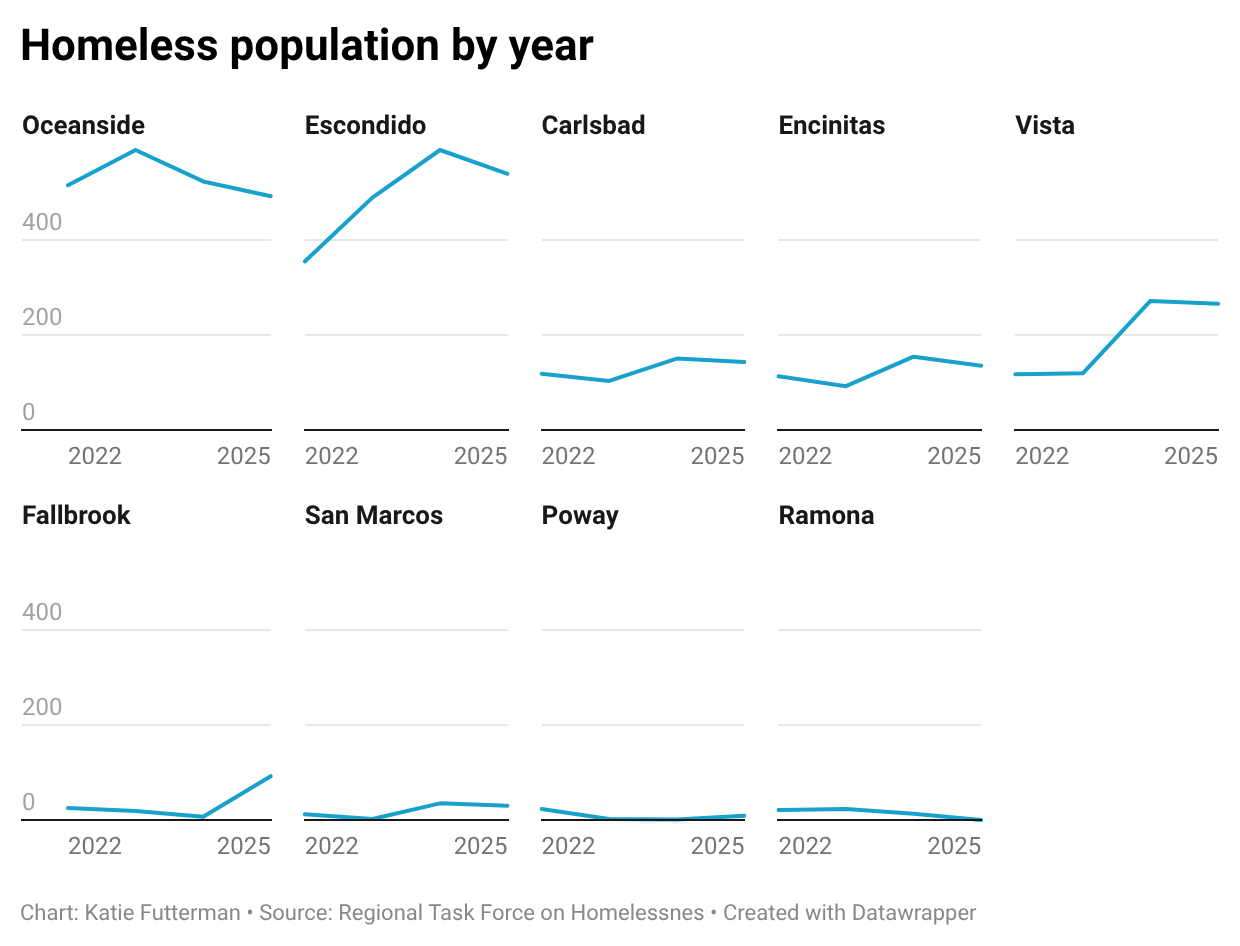
Nearly all of the North County cities counted fewer homeless people in 2025 than the year before. That bucked a recent trend: Between 2020 and 2025, North County’s entire homeless population increased by about 20%.
Together, North County’s coast and inland areas make up about one-sixth of the homeless population in San Diego County in 2025.
While the point-in-time count is often cited and used when making decisions about homelessness, research shows there are also significant limitations.
A 2017 report from the National Law Center on Homelessness and Poverty said the count often undercounts the number of homeless people.
“Despite all the community effort and goodwill that goes into them, and due to no fault of the professionals and volunteers who carry them out, the counts are severely flawed,” the report said.
That’s because the count takes place on one night only, and can miss many people for a wide array of reasons: People may be experiencing homelessness but on that night staying with friends, in a hospital or incarcerated.
The Regional Task Force on Homelessness works with the San Diego County Sheriff’s Office to collect data on people who were incarcerated the night of the count.
Typically, it takes several months to release the data. In past years, it’s been made public in May.