Berenjak, the fourth-and-counting global location of a London-based Iranian kebab house, opened in the SoHo Warehouse complex in downtown’s Arts District in late September. My interest in its arrival boiled down to a question: What might this import contribute to the Persian culinary culture in Southern California, where the largest Iranian population outside of Iran resides?
The answer in one word: vibes.
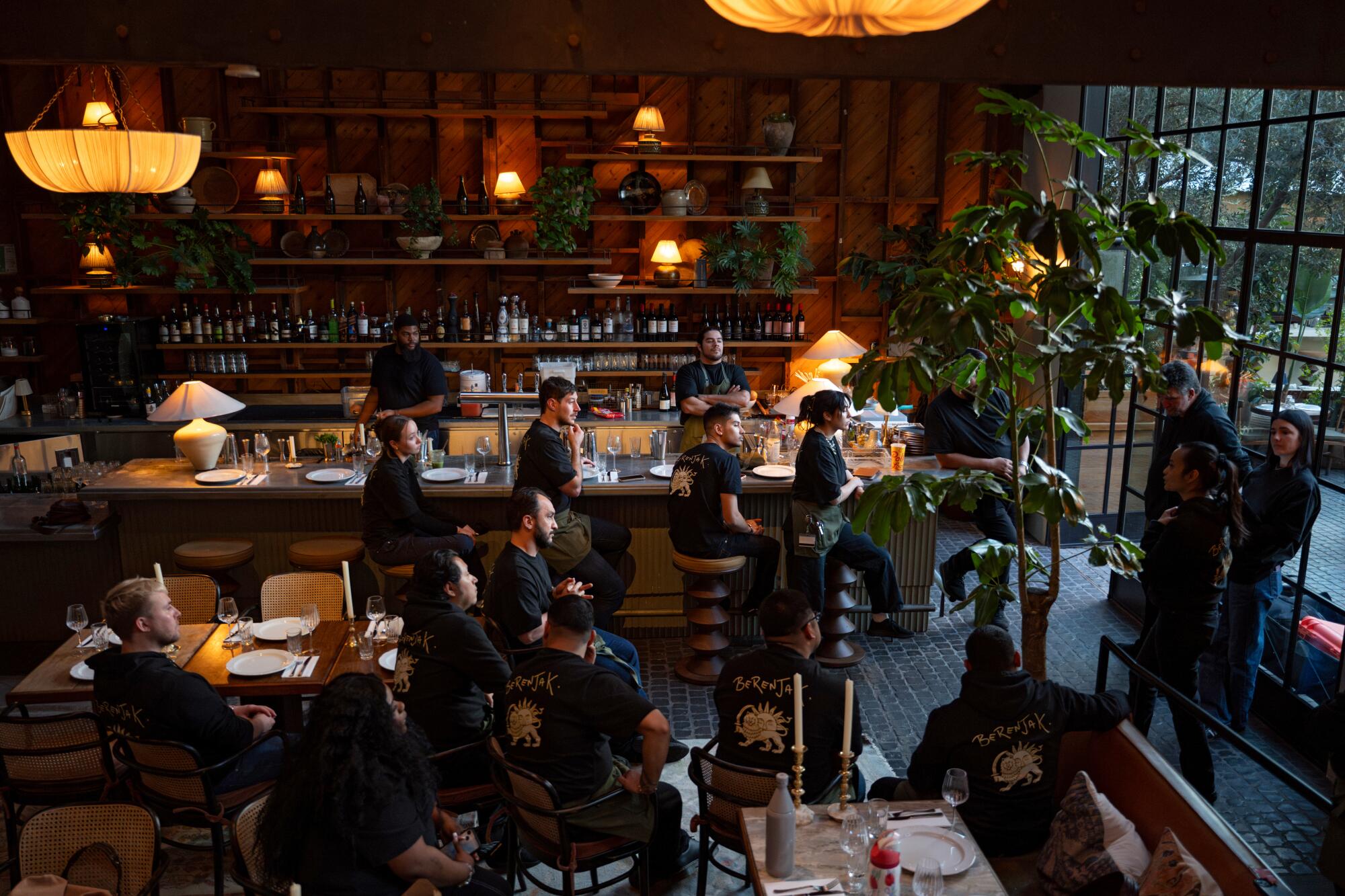
Staff gather for a pre-shift meeting in Berenjak’s interior dining room, which leads to a lush courtyard.
(Ron De Angelis)
Most of Berenjak’s menu will look familiar to anyone who has dined at Persian restaurants in Southern California: various cuts of meat threaded on skewers, mounds of rice and crackly bread, a crucial platter of feathery herbs hiding cubes of briny cheese, and starters of creamy dips and pickles that extend other flavors as dishes continue to arrive, helping to define a meal’s soul.
The similarity of options from one place to the next could generally be expected. Iranian American food writers Andy Baraghani and Naz Deravian shared their parallel childhood experiences with me years ago. Khoresht, or stews, are the foundation of Iranian home cooking, with infinite regional and seasonal variations that vary by household. Families or groups tend to go out for kebabs, and the standard repertoires available at these restaurants appeal broadly by design. Azizam, the Silver Lake cafe embracing homier-style cooking (where specials like autumnal short rib simmer with quince, prunes, carrots and potatoes) represents a rare, wonderful exception.
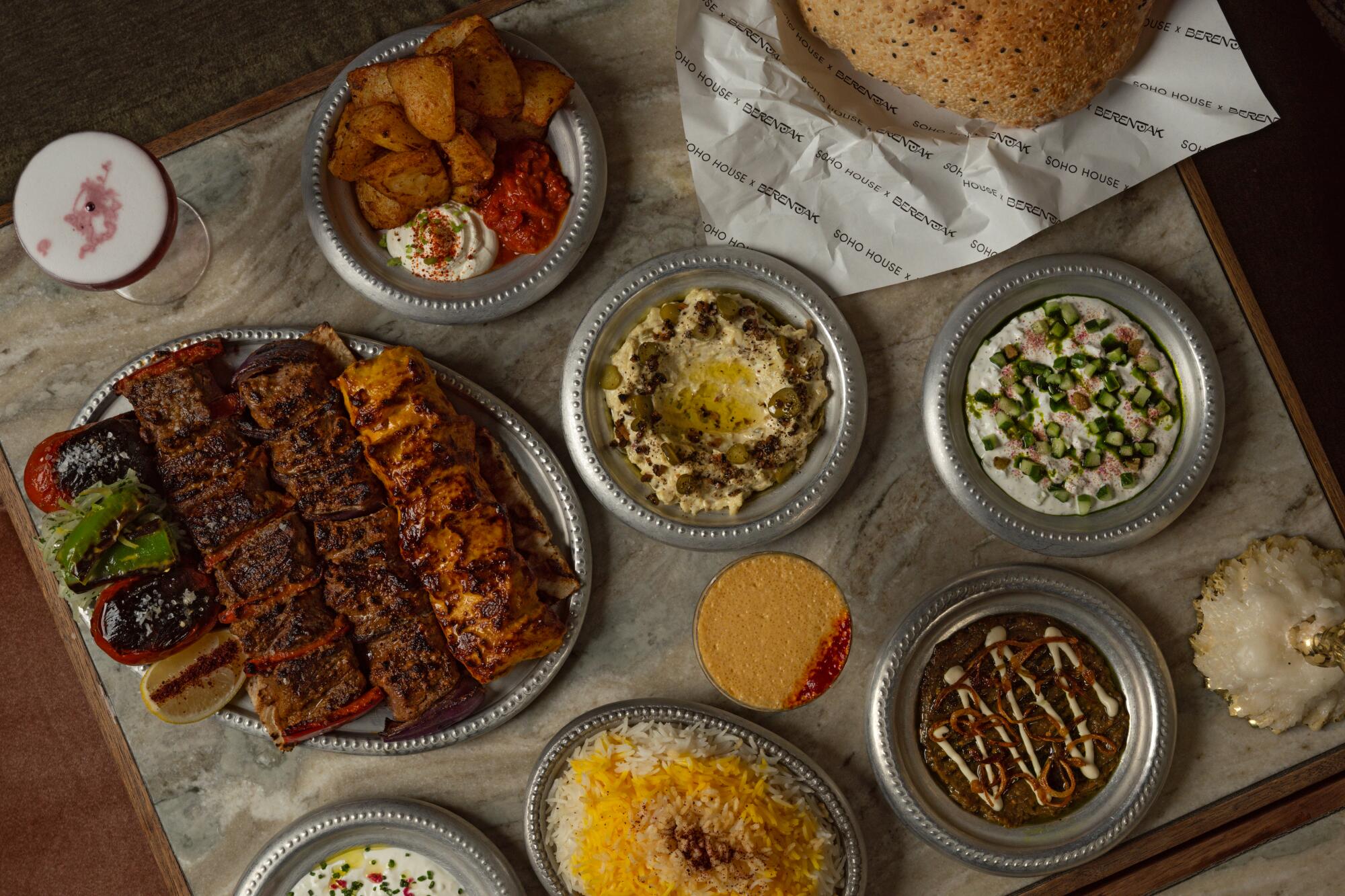
The menu at Iranian restaurants can be a ritualized mix of kebabs, breads, rice and side dishes. Berenjak serves the standards.
(Ron De Angelis)
Berenjak hangs its individuality instead on an unusually luxe setting. The interior dining room, divided into two levels and connected by a slowly sloping ramp, could at first cynical glance register as backdrop. Staggered shelves, arranged just-so with short lamps and pottery and plants, nearly rise to the tall ceiling behind the six-seat bar. Framed prints of Persian art and geometric patterns fill one wall. On the second tier, diners can peer into the large, well-staffed kitchen through paneled windows. By sundown, the mood locks in. The lighting goes dim and flickering, engineered to flatter. Darkness falls around tables like draperies.
I might never even walk inside the building again, though. I’ll be outside in the courtyard garden, one of the most seductive patio spaces I’ve seen in the city. The foliage has a cultivated wildness: olive and citrus trees, young palms and other plants and shrubs twining together in dozens of shapes and shades of green. Seating is arranged along the stone walkways, with a few pockets almost engulfed in vegetation for extra privacy. Warmed with fire towers, it’s the place to be even in wintertime — a good thing to know, since right now prime reservations for inside tend to book out weeks ahead.
Wherever you land, start dinner with a few mazeh.
Between two choices for breads, lean toward taftoon, a puffed balloon tanged with sourdough and thin enough to rip easily into pieces. Swipe them through any of three classic dips, all worth ordering: mast-o-musir, yogurt with dried Persian shallots and an unconventional, winning addition of fresh goat’s cheese; mast-o-khiar, yogurt with diced cucumber, slender green raisins and a fleeting scent of rose petals; and kashk-e-bademjoon, eggplant cooked over coals, combined with whey into a thick spread and sprinkled with dusky-bright dried mint. Ask for the basket of dill, basil and other herbs, with cubes of the feta-adjacent Bulgarian cheese called sirene, to build more textured, complex bites wrapped around hunks of taftoon.
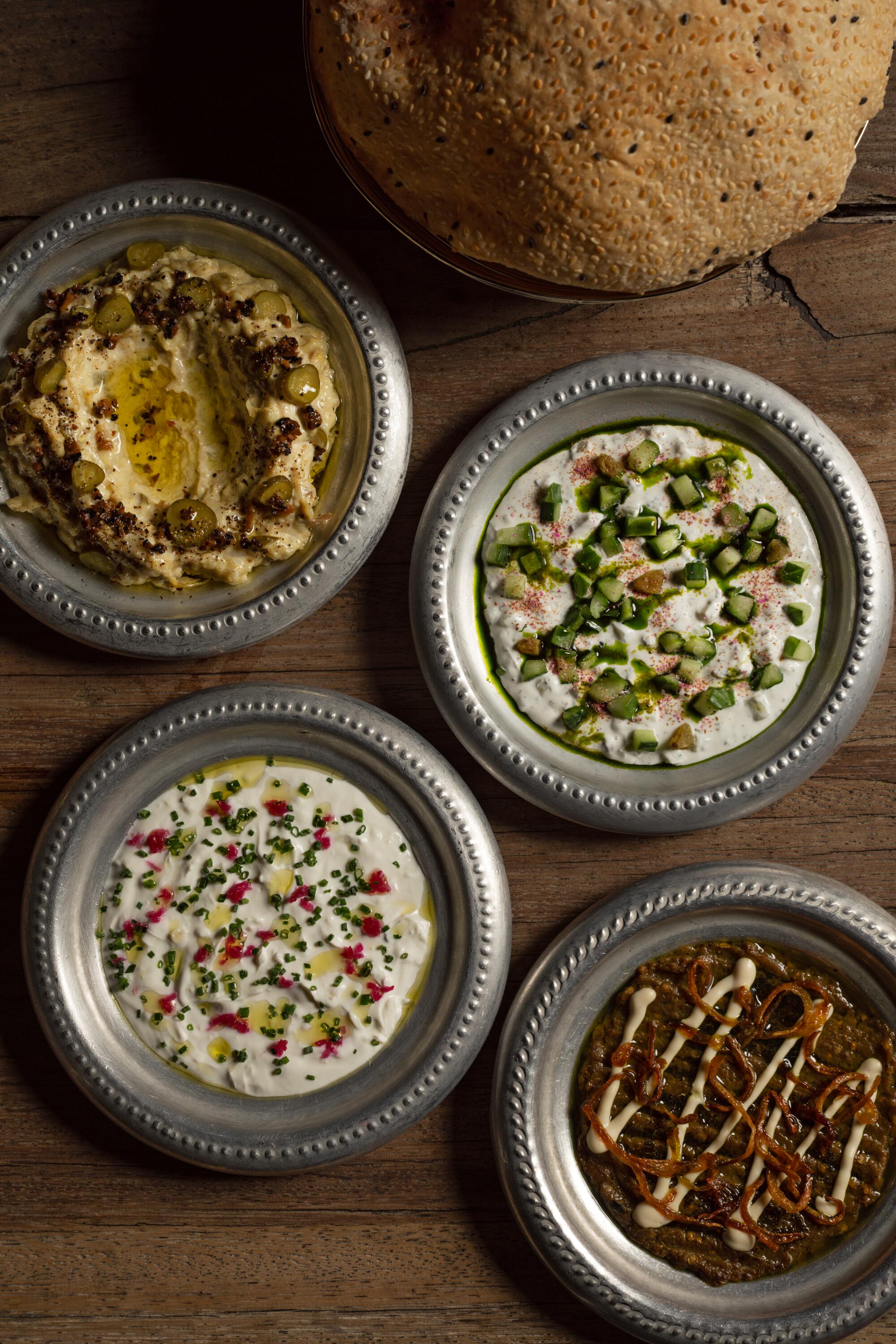
A spread of mazeh includes; kashk-e-bademjoon, eggplant cooked over coals, mixed with whey and sprinkled with dried mint; black truffle olivieh; mast-o-khiar, yogurt with diced cucumber, green raisins and rose petals; and mast-o-musir, yogurt with dried Persian shallots and fresh goat’s cheese. Order them with taftoon bread.
(Ron De Angelis)
This is an ideal setup of what for me has ended up feeling like overall competent dinners: safe, middle-of-the-road seasonings, a few true highlights, a handful of odd letdowns.
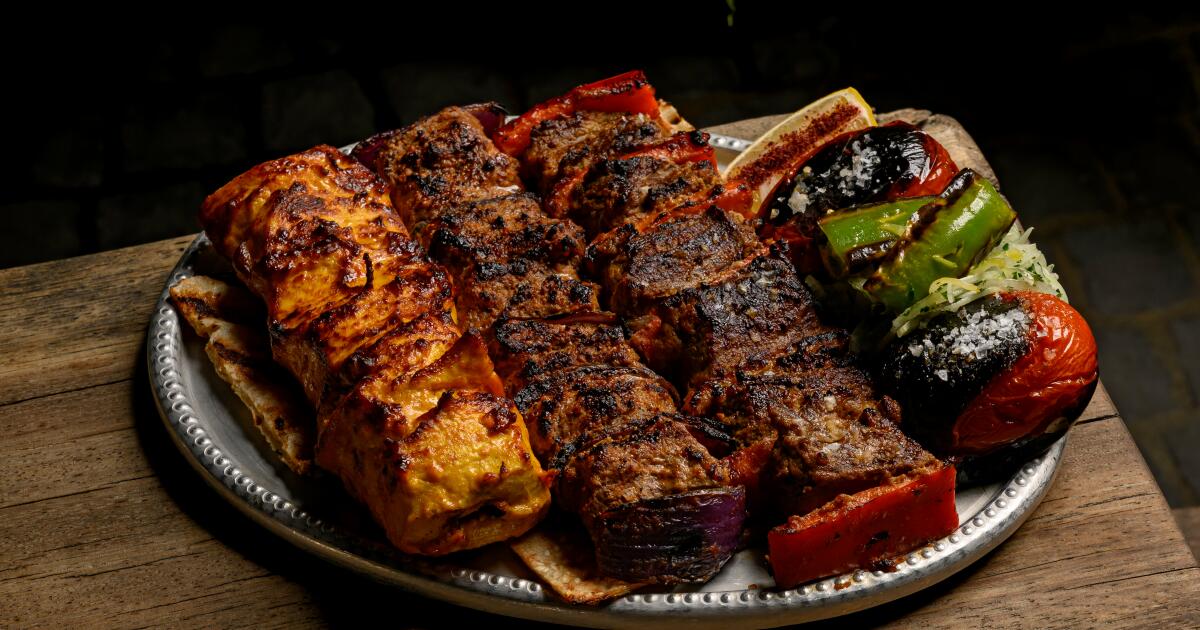
Presentations are immaculate. Order two or three kebabs and they appear as pictures of uniformity: tidy rectangles of meat, evenly blackened over smoke and fire, with a charred tomato to smash into rice, an important side order. A few crisped grains arrive on top of the heap, hinting at the pleasures of tahdig (the coveted layer of crunchy rice that takes skill to cook correctly on the bottom of a pot) without quite investing in the effort. Sangak — the other, flatter bread, traditionally cooked by spreading the dough over stones — line the plates under the kebabs, deliciously collecting their juices.
Chenjeh, lamb bathed in a peppery marinade with the merest suggestion of saffron, is my favorite kebab, the one that yields to a fork but hits as boldest in flavor. Jujeh (chicken breast) does its job as empty canvas, best for painting with leftover yogurt and pairing with pristinely cut torshi (pickled vegetables). Poussin, smeared with garlic, sumac and red pepper paste, was unappealingly mealy. Koobideh, always the popular kid of kebabs, is made at Berenjak in a style using lamb shoulder so finely ground that the meat resembles tiny, distinct sausages, rather than an unbroken shape formed in undulating patterns over the skewer. The taste came off as livery, which I could appreciate, but the consistency bounced against the teeth, which I didn’t enjoy. I hungered afterward for the koobideh at Mini Kabob in Glendale.
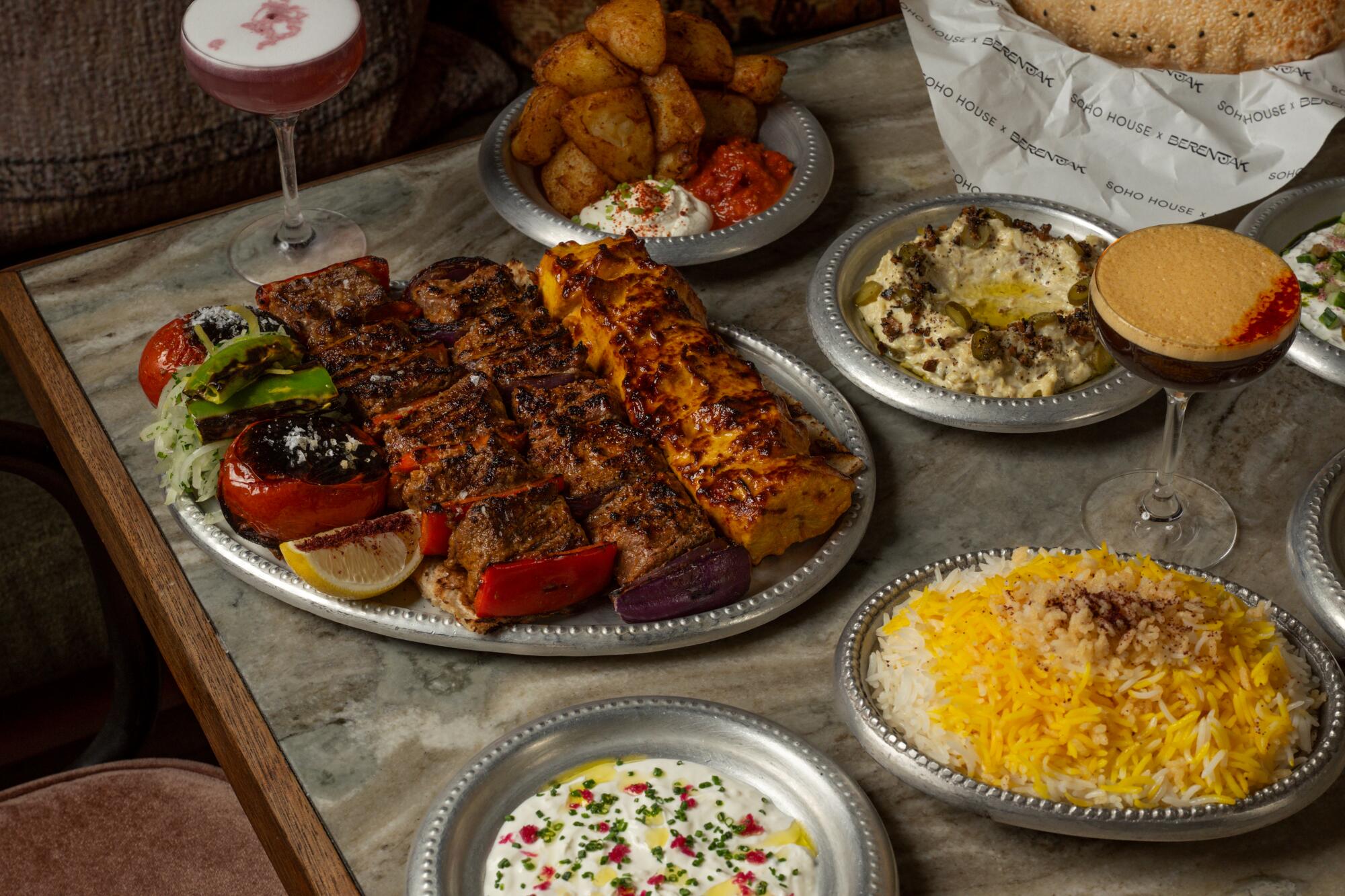
Chenjeh, lamb in a peppery marinade with saffron, is a favorite kebab, the boldest in flavor.
(Ron De Angelis)
And to spring back to mazeh for a moment, the menu’s weirdest disappointment was the hummus, a dish that isn’t a longstanding part of Iranian cuisine, but, as with so many of us in the world who love blitzed garbanzos, has been adopted from its Eastern Mediterranean origins. Berenjak’s version tries too hard, using black chickpeas and a “tahini” fashioned from sunflower seeds, resulting in a whip of ingredients that resembles grainy chocolate mousse and clangs with flat, sour earthiness.
Cocktails touch down on the other side of the spectrum. They’re unrelentingly sweet. A carbonated version of doogh, the ubiquitous Persian salted yogurt drink, is frothy and refreshing on its own here. But as the base for an alcoholic drink, it’s mixed with vanilla and gin and tastes like a post-adolescent experiment. Name-checking coconut butter, fig leaf, marigold-infused tequila and saffron-tinted mezcal, the cocktails read and sip as condescending, a British restaurant group’s misguided idea that Californians want silly, busy beverages.
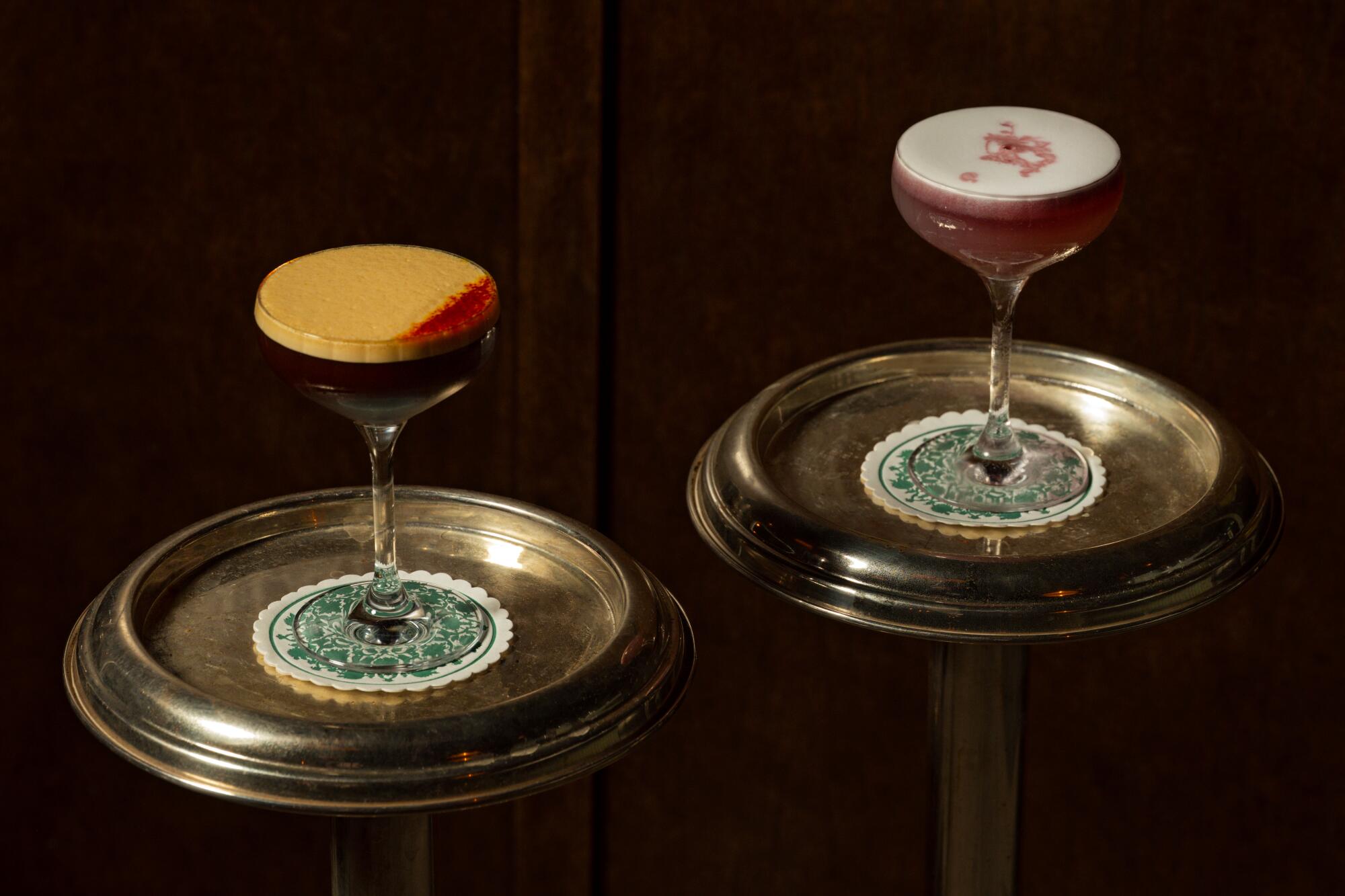
Saffron Carajillo and Grape Sour cocktails at Berenjak.
(Ron De Angelis)
I have to remind myself in these examples that there is a person behind the conception of Berenjak. In 2016, Kian Samyani was a chef in London looking for a new gig. He’d begun in restaurants as a teenager, working at his father’s Tex-Mex cantina in a suburban district with the fantastic name of Twickenham. By the mid-2010s, he had wrapped up working at Barbecoa, a massive and now-closed steakhouse that was part of Jamie Oliver’s portfolio, and had taken some time off to regroup, traveling through Spain.
Samyani wound up answering an ad in search of a grill master for a planned spinoff of Gymkhana, the fine-dining Indian centerpiece of JKS Restaurants, one of London’s largest restaurant groups. Knowing the principals were brainstorming new restaurant themes, Samyani threw one out: How about a kebab house channeling the food he remembered from boyhood trips to Tehran with his family?
The first Berenjak opened in London’s Soho district in 2018, in a space handsomely scruffy in the spirit of Samyani’s memories. A partnership with Soho House — the international members’ club founded in London in 1995 and acquired by MCR Hotels in 2015 — brought Berenjak expansions (not all of them, as in Los Angeles, open to the public) to Oxfordshire, Dubai, Doha and Brooklyn before the Arts District outpost.
I think about this as I spoon more ghormeh sabzi onto my plate. It’s my favorite dish at Berenjak, one of the few khoresht that show up routinely on kebab house menus, a reduction of lamb, kidney beans and herbs cooked to alluring mulch and braced with black lime. This one maneuvers through exciting polarities: long-simmered while exuding fragrance and freshness, meaty yet sharply herbaceous, at once homey and refined. Its excellence implies greater possibilities.
Here’s my far-flung wish: When Samyani cashes out of the JKS Restaurant life, he sets off for L.A., eats through our Persian dining scene and sticks around to open a truly personal expression of Iranian cuisine that none of us have ever quite seen or tasted before. In the meanwhile, what we have are mostly pleasant renditions of kebab house basics, served amid subtropical glamour.
Berenjak
1010 S. Santa Fe Ave, Los Angeles, berenjak.com
Prices: mazeh $5 to $20, kebabs $28 to $42, side dishes $5 to $14, desserts $8 to $12
Details: Dinner Tuesday to Saturday, 5:30 to 11 p.m. Full bar. Street and valet parking. The outdoor garden seating is unusually beautiful.
Recommended dishes: mast-o-khiar, mast-o-musir, kashk-e-bademjoon, taftoon, chenjeh kabab, ghormeh sabzi, house rice, torshi