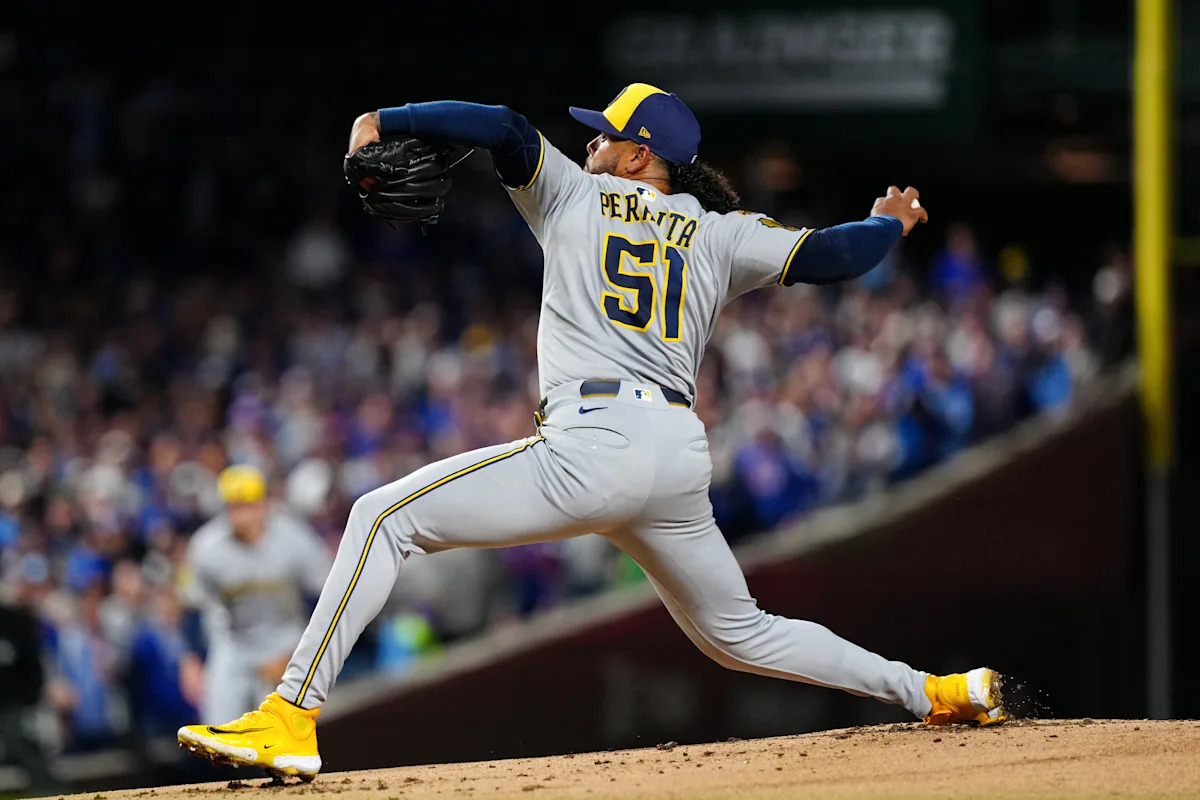
During his postmortem news conference at Citi Field in September, New York Mets president of baseball operations David Stearns used the words “run prevention” at least 10 times.
The sting of New York’s brutal, season-ending loss the day before in Miami — a loss that completed a late-summer implosion of epic proportions — was still extremely raw. The playoffs were set to start in a few days. The Mets would not be in them. It was a shocking outcome for a team with supersonic expectations and a payroll north of $300 million.
Advertisement
So there was Stearns, less than 24 hours after a most unsavory season finale, tasked with trying to explain the inexplicable failures of his well-paid ballclub. But the end-of-season debrief also served as a roadmap to the future. Asked about manager Carlos Mendoza’s status for 2026, Stearns unflinchingly backed his skipper. And when a reporter inquired about potential roster changes, the Mets’ head honcho was, by his standards, incredibly revealing.
“We’re going to have to be open-minded on our position-player grouping so that we can improve our run prevention,” he replied.
Four months later, that so-called open-mindedness has evolved into what can only be described as an era-delineating roster overhaul. Gone are Pete Alonso, Jeff McNeil, Brandon Nimmo and Edwin Díaz, all long-time Queens cornerstones. And while their early winter-departures peeved much of the Mets’ fan base, it’s clear now that Stearns, ever patient, had something of a grand plan.
Advertisement
In just the past week, the Mets agreed to terms with prized free agent Bo Bichette, acquired center fielder Luis Robert Jr. in a deal with the Chicago White Sox and swung a trade to add frontline hurler Freddy Peralta from the Milwaukee Brewers. That trio will join second baseman Marcus Semien (traded for Nimmo), infielder Jorge Polanco (free-agent signing from Seattle) and relievers Devin Williams and Luke Weaver (both free agents from the Yankees) as newcomers.
It’s a jarring amount of change, particularly for a franchise that previously relied on so many stalwarts. Mendoza’s coaching staff, too, has been almost entirely reconstructed.
[Get more New York news: Mets team feed]
Without a doubt, the Mets will enter 2026 as a different version of themselves, but is this team actually better than the group that just underachieved itself into oblivion? Do these moves really fit with Stearns’ stated goal of improving the club’s pitching and defense?
Advertisement
It’s complicated, but mostly yes.
Peralta’s arrival is the most straightforward and the easiest to evaluate, so let’s start there. The 29-year-old is probably one of the top 10 pitchers in the world, top 20 at worst. A free agent at season’s end, Peralta will lead New York’s staff in 2026. He’s now the favorite to start on Opening Day and get the ball in Game 1 of a playoff series. The Mets paid a pretty prospect penny to gain his services — infielder Jett Williams and pitcher Brandon Sproat are both consensus top-100 types — but Peralta is a phenomenal addition to a rotation that desperately needed an ace. He’ll push someone (David Peterson, Kodai Senga, Sean Manaea or Clay Holmes) to the bullpen or the trade block, but that’s a first-world problem.
The additions of Semien and Robert, two players with sensational defensive track records, might be even more impactful. Neither represents a significant offensive upgrade — though that could change if Robert rediscovers his 2023 form — but that’s clearly not priority No. 1 for the Mets.
Advertisement
“We really like what our defense looks like up the middle right now,” Stearns said during a media session Thursday. “I think we’re clearly better in some key defensive positions.”
The jump to Semien, a 2025 Gold Glover, from a Luisangel Acuña-Jeff McNeil combo at second base is particularly big.
Bichette and Polanco, however, create an interesting dynamic, as both seem primed to start on Opening Day at positions they’ve never played in the big leagues. Bichette, before this past World Series, had only ever started at shortstop in the Show and moved to second for the Fall Classic only because of a leg injury; he’s expected to slide to third in Queens. Polanco spent most of his 20s as a shortstop as well but has played mostly second base since 2022; he’ll man first base with New York.
Advertisement
The Mets are trusting that athletic intelligence, tailored drill work and good coaching can help this duo overcome their unfamiliarity. Crucially, Bichette’s and Polanco’s experience at up-the-middle positions should allow them to work downhill, so to speak. Third base is an easier position to handle than shortstop; the same is true with second and first. Certain aspects of their new roles might require an adjustment period — particularly when it comes to positioning and in-play responsibilities — but when speaking to media on Thursday, Stearns was certain the two would figure it out in the long run.
“There’s no question we’re asking two guys to learn some new positions. We’re also asking two guys with very high baseball aptitude who are good athletes, who have spent the majority of their careers at the shortstop position, to learn new positions on the dirt,” he said. “There’s going to be learning curves. We’re going to make mistakes. I also have a high degree of confidence that both of those players are going to figure it out and play their positions at a very high level.”
Thankfully for Bichette and Polanco, the defensive bar is pretty low. Brett Baty was an average defender at the hot corner last year, while Mark Vientos, with whom he split time, was abysmal. So, too, was Pete Alonso across the diamond.
Offensively, this team still has some questions, chief among them how to replace Alonso’s consistent production. How youngsters such as Baty, Vientos, Francisco Alvarez and Carson Benge perform will dictate whether this lineup is good or great. And of course, employing Francisco Lindor and Juan Soto — as Stearns pointed out Thursday — is a pretty good place to start.
Advertisement
But what’s certain at this point in the offseason is that, unorthodox as their path to that endpoint might have been, the Mets have indeed accomplished their stated goal of upgrading their run prevention unit.