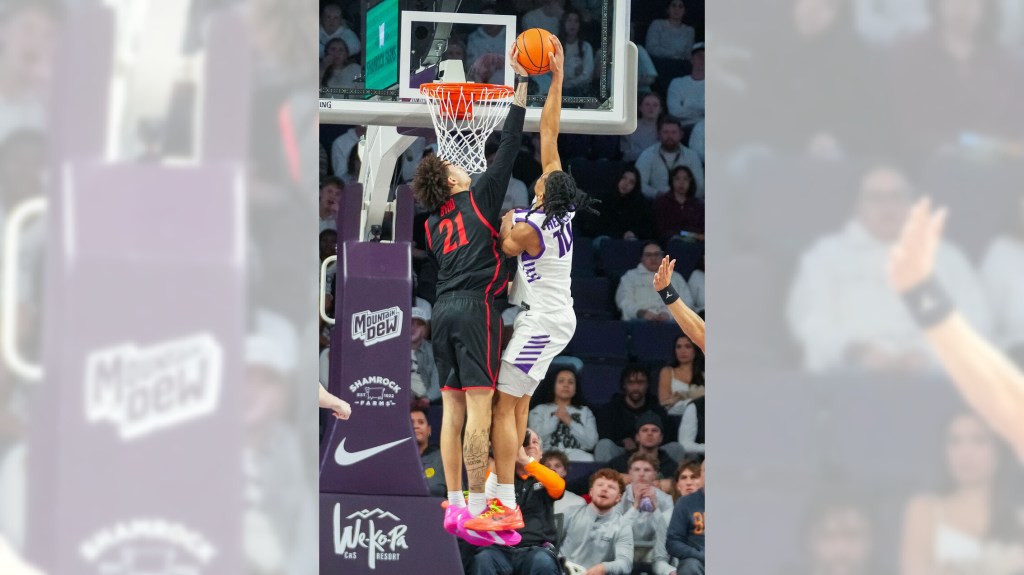
PHOENIX – Three thoughts on San Diego State’s 70-69 loss at Grand Canyon on Wednesday night:
1. The call
Some thoughts within a thought about the foul call that sent Antelopes guard Makaih Williams to the line down one with 1.8 seconds left:
• Jeffrey Anderson made the call. Anderson did not miss 15 of 18 attempts behind the 3-point line, or miss the front end of a 1-and-1 with 7.7 seconds left. The Aztecs did.
• Labeling Anderson a bad official is unfair and flat wrong. He’s among the most respected in Division I, two years ago ranking No. 1 in the Kenpom ref ratings and working the national championship game between UConn and Purdue. He has ranked in the top 25 in 11 of the past 12 years and is currently No. 11, regularly working the Big Ten’s most important games.
• There’s a difference between whether Tae Simmons hit Williams on the shoulder on his frenetic drive to the basket and whether Anderson should have blown his whistle.
College basketball officials, according to those in the business, are taught not to make calls from the baseline through a tangle of bodies, instead deferring to one of your partners trailing the play. In this case, that was Brian Dorsey, who is ranked No. 5 and was well-positioned to get a good view of Williams slicing through Simmons and teammate BJ Davis — and whether any contact was incidental or deserving of free throws.
Dorsey opted not to blow his whistle.
• This is a classic case of cognitive bias and emotional investment among sports fans. Grand Canyon supporters see a clear foul; SDSU supporters see minimal, if any, contact.
“We’re 100% sure we see the world the way it is, but the human mind is not a camera,” Dr. Itiel Dror, a cognitive neuroscientist, told BBC in an interview about the subject. “The brain has limited capacity. It cannot compute and process all the information coming in. It always has to prioritize some information and ignore other information.
“It doesn’t do it randomly. What the brain pays attention to or not depends on who you are, what you are, what you want to see, what you expect to see. So two (soccer) fans can look at the same event – for example, the same foul – and honestly see two different things at the same time.”
• Four years ago, the almost identical sequence happened to the Aztecs in a conference game at Boise State. Up one, Matt Bradley missed two free throws with, yes, 7.7 seconds left. Then Broncos wing Abu Kigab was the beneficiary of a questionable call with 1.7 seconds left and made both free throws for a one-point win.
But these things also have a way of evening out.
The following season, SDSU guard Darrion Trammell got a friendly whistle with 1.2 seconds left in a tie game for a subtle bump on his hip by Creighton’s Ryan Nembhard, who to this day insists it wasn’t a foul. Trammell made one of two free throws for a 57-56 victory, and the Aztecs advanced to the Final Four.
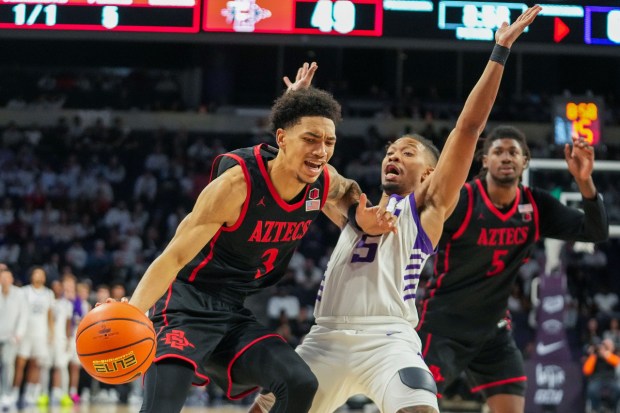 San Diego State’s Elzie Harrington pushes past Grand Canyon’s Brian Moore Jr. during Wednesday’s 70-69 Grand Canyon win at GCU Arena in Phoenix, Ariz. (Darryl Webb, for The San Diego Union-Tribune)
2. Future series
The first two times SDSU went to GCU Arena and lost, it was their choice, part of nonconference home-and-home series they agreed to schedule.
This time, it wasn’t, part of the conference schedule after the Mountain West admitted Grand Canyon a year early shortly after SDSU and the four other “Pac-stabbers” gave formal notification of their departure and forfeited voting rights.
So that’s it? They’ll never play again in cauldron of GCU Arena once they go their separate conference ways next season?
Maybe, maybe not.
SDSU coach Brian Dutcher left the door open earlier this week, hinting he may consider another nonconference home-and-home series, perhaps as soon as next season.
“A year from now, when they’re not in our conference, it’s a good game to get to,” Dutcher said Monday. “I’m always looking at travel and distance. It’s only an hour flight to Phoenix. It’s an easy home-and-home. We’ve played them in the past and we’d probably be interested in looking at that again because we know their metrics are always going to be high.”
The last part carries some validity. Grand Canyon is poised to become a regional basketball power, combining the playbooks of BYU and Gonzaga. They are the nation’s largest Christian university and view basketball as a means of promoting their mission and elevating their profile. And, like the Zags, they don’t have football to drain athletic department resources.
The one thing they didn’t have was conference legitimacy being in the WAC, which made it harder to attract players and schedule nonconference opponents. That’s solved now that they’re in the Mountain West.
And the Aztecs will need games. With only nine members, the Pac-12 will play a 16-game conference schedule, leaving up to 16 in the nonconference when the NCAA expands to a maximum of 32 next year.
This season, they had six one-off “buy” games at Viejas Arena. They played three in the Players Era Festival in Las Vegas, plus the neutral-court game against Arizona in Phoenix.
That still leaves a half-dozen dates. They’ll look for more neutral-court events, which usually come with a payday that would allow more home buy games. The other option is home-and-home series, where no money changes hands.
They’ve already agreed to a two-year series with UNLV, starting next fall at Viejas Arena. Programs like UCLA, Arizona and Oregon historically haven’t been interested in scheduling home-and-homes. Add BYU to that list since joining the Big 12.
Dutcher has said he won’t play any former Mountain West schools at altitude, which rules out Nevada, New Mexico and Wyoming.
Hello, Antelopes.
“It’s one of the elite programs in the country,” Grand Canyon coach Bryce Drew said of the Aztecs, “so we would love to be able to play them in the future.”
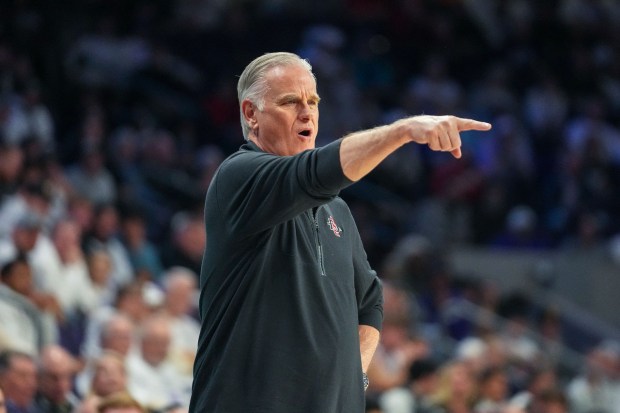 San Diego State coach Brian Dutcher instructs his team during Wednesday’s 70-69 Grand Canyon win at GCU Arena in Phoenix, Ariz. (Darryl Webb, for The San Diego Union-Tribune)
3. Pretty ridiculous
Three years ago, SDSU played against Alabama and 7-foot center Charles Bediako in the Sweet 16. Bediako, then a sophomore, started for the No.1-ranked Crimson Tide and had 10 points and seven rebounds in the 71-64 Aztecs win.
Then he entered the draft, wasn’t picked and was signed to a two-way contract with the San Antonio Spurs, spending the entire season with their G League affiliate and not appearing in any NBA games. He played for two other G League teams the last two seasons.
On Saturday, he’ll likely suit up again for the Crimson Tide.
On Wednesday morning in Alabama, a Tuscaloosa County Circuit Court judge granted Bediako a temporary restraining order against the NCAA, which had denied his request for eligibility.
Three weeks ago, the NCAA cleared another 7-0 pro center, James Nnaji, to play for Baylor despite being selected No. 31 overall by the Detroit Pistons in the 2023 NBA Draft. The difference, the NCAA said, was that Nnaji never played in college (he grew up in Europe) and never signed an NBA contract, and Bediako did both.
That line in the sand was wiped out by the next incoming tide.
The TRO lasts for 10 days or until a hearing can be held, and one is scheduled for Tuesday. That leaves just Saturday’s game against Tennessee, and Crimson Tide coach Nate Oats has indicated Bediako will play.
The crazy twist: The judge who granted the TRO, James H. Roberts, isn’t an Alabama alum but is listed as an active donor to the university with lifetime contributions between $100,000 and $249,999.
It leaves the sport in a vulnerable spot, with NCAA rules now at the whim of local judges who may or may not be fans of the program that stands to benefit – and coaches willing to push that envelope.
“We need to get one set of rules,” Grand Canyon’s Drew said, “and you shouldn’t be able to go state to state, judge to judge, and get things overturned. We should have set rules that everybody plays by, because does that mean he wouldn’t have been cleared at San Diego State or us because a judge here maybe doesn’t clear him?
“Coaches are smart. They want to get the best players out there and find legal ways to get them. If it’s legal, you try to put the best roster together that you can.”
Dutcher had a more cynical take, almost welcoming the Bediako news in a backhanded sort of way.
“I think the more this happens,” Dutcher said, “the better it is for us all in the long run because people will see how ridiculous the lengths that people are going to in the courts and different programs. People will eventually get fed up to the point where something will happen to change the direction that college athletics is going.
“The only way it gets fixed is to reach the level of ridiculousness, and I think this is pretty ridiculous.”