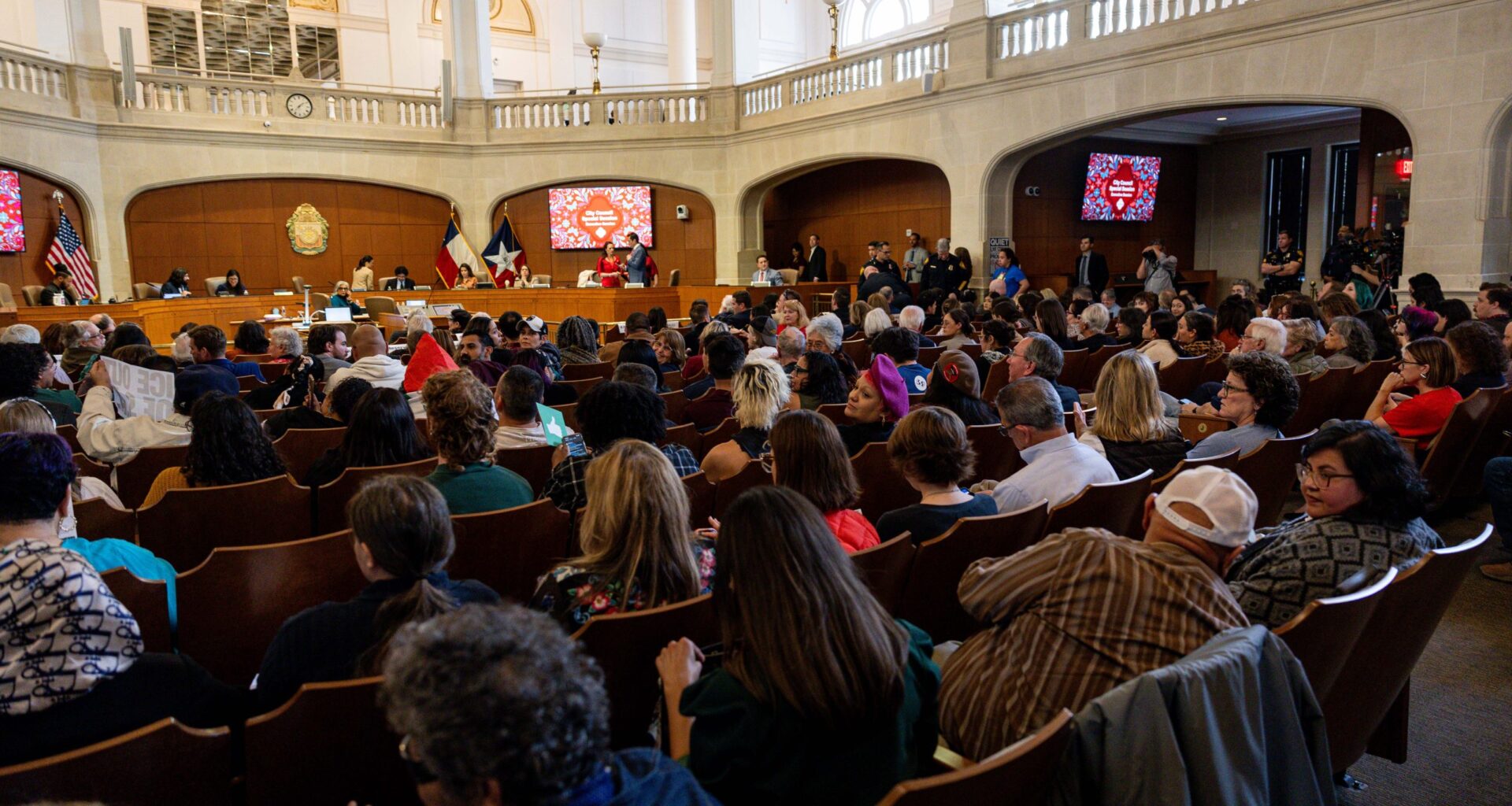
San Antonio officials held a special meeting Thursday to clarify how the San Antonio Police Department cooperates with federal agencies — including U.S. Immigration and Customs Enforcement — as anxiety grows nationwide over immigration enforcement.
Mayor Gina Ortiz Jones said she called the session to offer residents “a transparent dialogue” about the legal guidelines shaping the city’s collaboration with federal and state law enforcement agencies. She framed the meeting as an opportunity for the public to share concerns and learn about their rights during what she described as a “challenging time.”
Over 180 people signed up for a public comment session marked by frequent interruptions, chants, heckling and name calling that led council to call for multiple recesses throughout the meeting.
Texas Senate Bill 4 was at the center of the briefing that was provided by SAPD, a 2017 law that is commonly referred to as the state’s anti-sanctuary city law. City officials emphasized that SB4 places restrictions on what local governments can do, and that SAPD is required to cooperate with federal immigration enforcement in certain circumstances.
SAPD Chief William McManus kicked off the presentation, he emphasized that the department must cooperate by law but officers do not and are explicitly instructed that they are not authorized to enforce immigration law itself.
“We understand the concerns and fears in our community and we are very sensitive to them. SAPD follows Texas state law to assist federal agencies when requested,” McManus said. “I want to be clear on this and I can’t overstate this enough, SAPD is not enforcing immigration laws, we cannot do that by law we will continue to protect San Antonio with fairness, integrity and respect.”
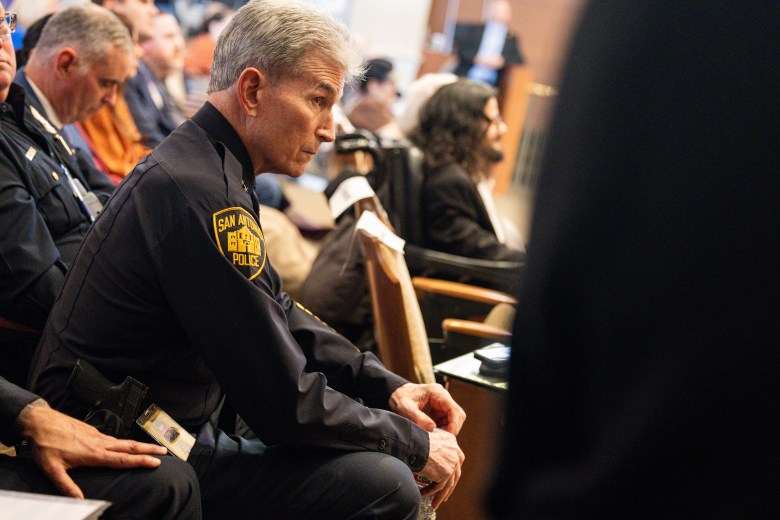 San Antonio Police Department’s Chief of Police William McManus waits to present to the council during a special session to discuss SAPD’s cooperation with federal agents on immigration enforcement on Jan. 22, 2026. Credit: Amber Esparza / San Antonio Report
What SB 4 requires — and what it limits
City Attorney Andy Segovia told council members SB 4 prohibits cities from adopting any policies that “interfere” with federal immigration enforcement. It also bars policies that would prevent police officers from asking someone about their immigration status. McManus noted that there had previously been internal policy that prevented officers from inquiring about immigration status but it was repealed when SB 4 went into effect.
That legal framework is one reason the city has limited room to adjust police policy in response to public demands, officials said. Non-elected officials and city employees are required by law to enforce SB 4.
A separate 2023 law, also known as SB 4, expanded obligations on local government law enforcement agencies, which include assisting with transportation or removal actions when requested. It would also allow state police to arrest people suspected of having entered the country illegally by crossing the border.
That law remains paused after a federal appellate court blocked it from taking effect with the Fifth Circuit Court of Appeals began hearing oral arguments on Thursday. Segovia noted that San Antonio was the only city sued under SB 4.
City officials emphasized SB 4 2017 continues to shape how city departments interact with federal immigration agencies because of the legal requirements under state law. The presentation noted that while the city complies with state law they also support “Know Your Rights” education campaigns.
Know Your Rights campaigns are educational initiatives, often run by nonprofits or government bodies, that inform vulnerable populations about their legal rights and how to assert them during interactions with authorities, like law enforcement or immigration officials.
Jones posed the question to Segovia on whether or not, SAPD officers could potentially provide Know Your Rights information to individuals when they are stopped. Segovia confirmed that such actions would be in violation of state law.
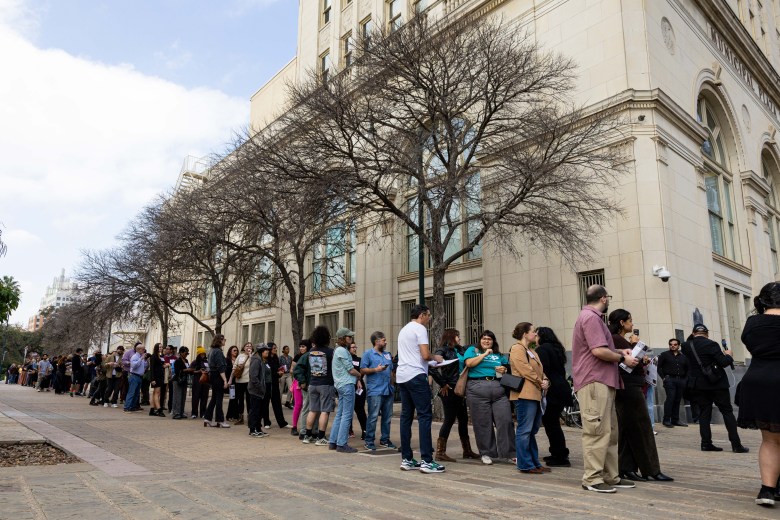 Citizens wrap around the San Antonio Municipal Plaza Building waiting to get in to participate in a city council special session to discuss SAPD’s cooperation with federal agents on immigration enforcement on Jan. 22, 2026. Credit: Amber Esparza / San Antonio Report
Limited roles when cooperating
McManus addressed recent community concerts around enforcement activity tied to immigration — including the raid that led to the detention of 140 individuals at a food truck park on San Pedro Avenue, which he said raised questions about the extent of SAPD cooperation with immigration enforcement.
McManus said the federal agency leading that operation was the FBI, and the case remains under investigation, but SAPD’s participation was limited to scene security and “task force assistance” describing the department’s role as “support,” not enforcement.
He confirmed SAPD works with multiple federal agencies through task forces, but described the department’s involvement as cooperative, once again citing requirements under state law.
Deputy City Manager, María Villagómez presented data meant to quantify how often immigration issues have surfaced in daily policing.
In 2025, SAPD received approximately 2.1 million calls and dispatched officers on about 1.8 million of them, she said. Of those only 258 reports referenced the word “immigration.” Villagómez noted that the department does not directly track the amount of immigration related calls they respond to, instead police reports were queried to identify the use of the keyword.
They found that 161 of those reports involved no federal immigration enforcement at all. Most of those cases involved stolen immigration documents, scams or fraud, threats where someone claimed they would report another person for being in the country illegally, criminal reports where a suspect was alleged to be in violation of immigration law or First Amendment-related immigration demonstrations.
Forty three reports were related to ongoing criminal investigations — including narcotics and gang related activities that were concurrent with federal criminal investigations; 30 reports involved an arrest for a state charge or city ordinance violation where the individual already had an active administrative immigration warrant.
And 15 reports indicated the person was wanted on a federal criminal warrant. The remaining nine reports were connected to human smuggling or trafficking investigations.
The data, officials say, shows immigration-related situations often appear in policing as secondary issues — not as primary enforcement targets.
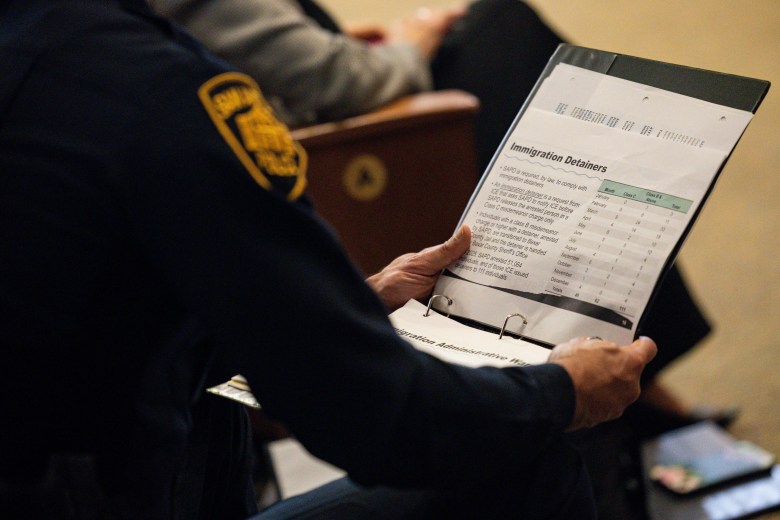 SAPD officials review a presentation on their patrolling over the last year during a special session to discuss SAPD’s cooperation with federal agents on immigration enforcement on Jan. 22, 2026. Credit: Amber Esparza / San Antonio Report
ICE detainers and administrative warrants
A major part of the briefing focused on ICE detainers and administrative immigration warrants — Villagómez said SAPD handled 111 ICE detainers in 2025.
An ICE detainer is a request from ICE asking local law enforcement to hold a potentially removable immigrant for up to 48 hours beyond their scheduled release from criminal custody.
An ICE administrative warrant is an internal document authorizing an agent to arrest a non-citizen for an immigration violation; it’s signed by an immigration officer, not a judge, and generally does not give agents permission to enter a home or private space without consent, unlike a judicial warrant.
SAPD officials said they are required to notify ICE before the release of an individual tied to a detainer. But officials also emphasized that an administrative immigration warrant is not a criminal warrant and does not automatically give SAPD authority to arrest someone.
McManus said officers are trained to distinguish administrative immigration warrants from other types of warrants. SAPD policy, officials said, is that officers do not have authority to arrest someone solely based on an administrative immigration warrant. Instead, if officers encounter such a situation, they are instructed to contact ICE.
Segovia also raised concerns about ICE’s use of administrative warrants more broadly. Referencing a report by the Associated Press, he said ICE has indicated — including through what he described as an internal memo — that it may be relying on administrative warrants in enforcement actions, including for entry. Segovia said the city does not have independent verification of that practice, but expects it could face constitutional challenges.
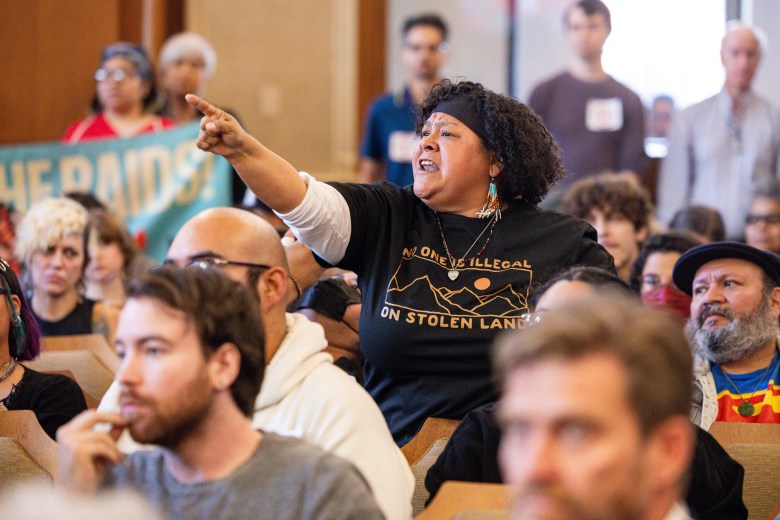 Cheryl Gonzales was among dozens of citizens who shouted, cheered and booed other speakers during the special council meeting to discuss SAPD’s cooperation with federal agents on immigration enforcement on Thursday. Credit: Amber Esparza / San Antonio Report
Public sentiment
On Tuesday, protestors took to San Antonio’s streets to call for an end to ICE’s aggressive enforcement efforts that have marked the first year of Donald Trump’s second presidency.
And on Thursday, public comments stretched into disorder at times, marked by frequent recesses and repeated interruptions. Bexar County Precinct 3 Commissioner Grant Moody opened comments expressing his support for cooperation with federal agencies, before being interrupted by hecklers leading to a 15 minute recess.
Members of the public frequently cited fear in the community and concern over expanding 287(g) agreements across the state, including with Balcones Heights Police Department and the state’s Department of Public Safety. The agreements allow local law enforcement agencies increased immigration enforcement in the field or in jails depending on the model they select.
Former mayor and democratic candidate for county judge, Ron Nirenberg spoke on the importance of unity in the community.
“These are moments that define ourselves as a community, I believe that the soul of San Antonio lives in the trust we built as a community, that trust is founded in the compassion we have for our neighbors and its maintained by the dignity in which we act and is tested by our ability to know right from wrong,” he said, adding that the president’s actions over immigration are eroding that public trust.
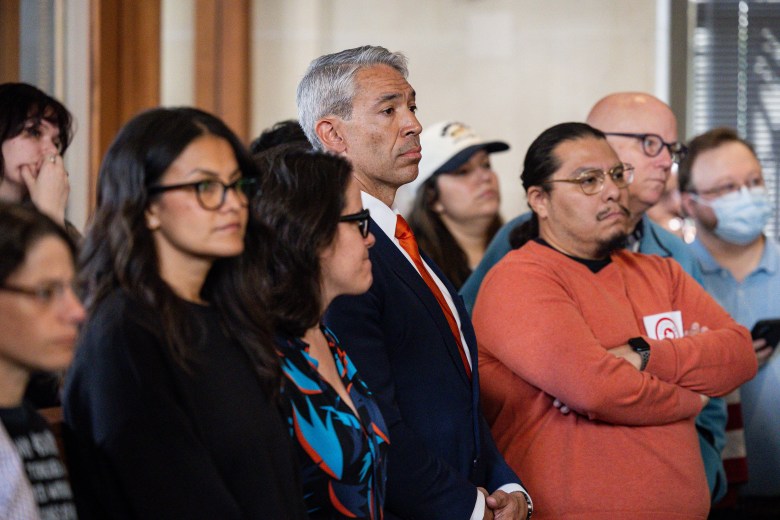 Former San Antonio mayor Ron Nirenberg waits with other citizens to address the council during a special session to discuss SAPD’s cooperation with federal agents on immigration enforcement on Jan. 22, 2026. Credit: Amber Esparza / San Antonio Report
“But immigration isn’t a threat to us, it’s a strength and what really threatens our safety is unchecked power,” he said. “What we are seeing play out across the country is aberrant and we have an obligation to stand up for our neighbors.”
During public comment Jones requested city officials confirm whether or not all cooperation efforts had been initiated by federal agencies. City Manager Erik Walsh confirmed all requests had been made by federal authorities.
The meeting was aimed at clarifying currency legal constraints and providing residents with a clearer understanding of where SAPD’s cooperation begins — and where it ends. No actions were listed on the agenda.