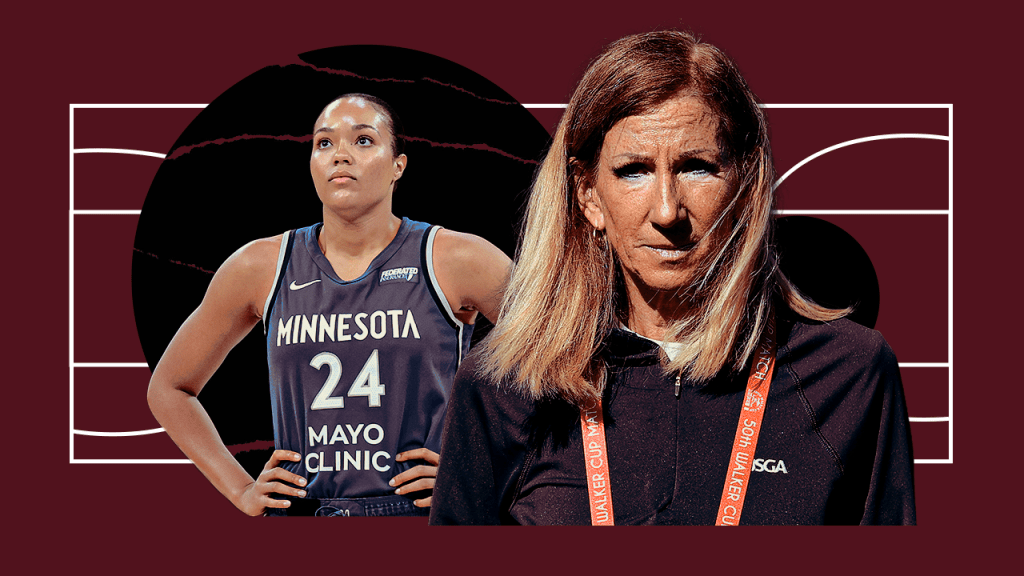
Months into CBA negotiations, WNBA team and athlete union representatives agree on this: For the first time, women’s basketball players’ pay should be directly tied to the money their league earns.
Then come the details. In them, the devils. From there, the debate.
A month after the most recent proposal was shared, the sides disagree over both the type of formula that should be used to set compensation and the exact numbers to plug into it, according to multiple sources familiar with the talks.
The latest offers have been framed as using (a) the teams’ and league’s gross revenue in the union’s proposal or (b) their net revenue after expenses in the league’s version, as the underlying measure, but in reality the proposals are more complicated than those labels suggest. And further details around how the money would be divided across everyone from maximum-salary stars to minimum-deal vets remain largely unsettled.
At this point, it’s no longer hyperbole to say that the league’s future hangs in the balance of those discussions. If discussions happen at all.
How to Slice a Growing Pie
Each league pays its players slightly differently. In the NFL, players get roughly half of “All Revenues,” which isn’t exactly all revenues. In the NBA, the process of determining what qualifies as Basketball Related Income (BRI) and the players’ share of it takes up 38 pages of the league’s collective bargaining agreement.
The WNBA has now created its own proposed model. While its latest offer would give players the equivalent of 70% of net revenue based on current projections (rising from 65% to 80% over the course of the deal), that ratio isn’t explicitly guaranteed. The league’s formula doesn’t ensure that owners make a profit, and teams would bear the brunt of revenue shortfalls or increased spending—including costs outside of their control—according to a source familiar with the proposal. The deal would seemingly account for expenses as a percent of revenue, with the WNBA keeping roughly 70% of money earned to cover team and league operational costs and the other 30ish percent being split between players and owners.
“Our priority is a deal that significantly increases player salaries, enhances the overall player experience, and supports the long-term growth of the league for current and future generations of players and fans,” the league said in a statement earlier this month.
Alternatively, the union has proposed players receiving roughly 30% of all team and league revenues, which would be simpler to administer if less sophisticated than other leagues’ systems. Rather than deducting expenses, the 70% split remaining with the league would be used to cover costs. The union has also opened the possibility of non-salary benefits, such as travel and medical expenses, coming out of that 30% tabbed for athletes.
Players are wary of a formula that is directly determined by expenses because of the possibility that expenses could be overstated without union oversight, according to a source familiar with the union’s thinking, though the NBA does factor some costs into its formula. They are also likely to push back against any proposal that looks to them more like profit-sharing rather than revenue-sharing, without the upside that an equity stake confers. WNBPA executive director Terri Carmichael Jackson specifically spoke out against an earlier proposal that she said “pays [the league] back first.”
The two offers remain far apart in projected salary figures—though not as far apart as earlier suggestions. Over the course of the potential CBA, the union’s proposal would likely see more than $700 million extra dollars flow to players compared to the league’s latest offer.
In response to reporting that the WNBPA’s proposal would lead to significant losses for the league, union president Nneka Ogwumike pointed ESPN to the expansion-fee payments the league has received (which it does not count as typical revenue) as well as growing franchise valuations, though owners would have to sell at least part of their teams to realize those gains.
“The league and teams saying that they’re losing money is like saying their pockets are empty while you’re also holding the keys to a brand-new Ferrari,” Ogwumike said.
The league sees those team values as contingent on building a sustainable business model, especially given franchises folding in the past. Players say the W is in a different place now; just look at its ratings and attendance figures. And around and around the debate goes.
In year one, the league’s latest proposal would pay players an average of more than $530,000, assuming revenue-sharing payouts above the guaranteed salary cap figures meet expectations, while max-salary stars would see more than $1.3 million per year. That average is up from roughly $120,000 in 2025, when the max was near $250,000. Prior league salary levels were pre-set in the CBA. The union proposal would have an expected mean salary of roughly $840,000 in 2026, with the percentage of league revenue going to players growing over the course of the deal.
Beyond those initial numbers, both sides also have their eyes on the future. Whatever formula is agreed to this time around will become the starting point for the next set of negotiations. Hence the stakes. And the hesitancy to budge.
Hoping for the Best, Preparing for Worse
The final CBA negotiation deadline came and went on Jan. 9. The league is currently operating under a “status-quo” setup. Business efforts are ongoing, including some coordination with the union. But either side is now able to initiate a work stoppage. And with the calendar flipped to 2026, the potential of missed games has appeared on the horizon.
League sources feel that their side has made significant concessions, leading to a strong proposal sent to players in December. While the league awaits movement from the union rather than directly counter the union’s most recent proposal, also sent in December, those on the players’ side have accused the WNBA of stalling, essentially using the possibility of missed games to get a better deal at the negotiating table.
From the beginning of the process, union leaders have advised players on contingencies should talks drag on. They expected negotiations to be lengthy, and told players that the league’s “playbook” would be to delay negotiations to pressure the players, a source familiar with the union’s perspective said, but have still been disappointed by the progress made to this point.
New York Liberty guard Natasha Cloud recently discussed the possibility of Unrivaled playing an additional season “if need be”, though the 3-on-3 league has not publicly shared its potential responses to a work stoppage affecting the WNBA. Currently, it features more than 50 players, but many more WNBA athletes would be left without somewhere to play if the existing Unrivaled teams were the only option this summer.
Alongside frustration, some optimism still emanates from both camps. But even if a framework was agreed to today, a source familiar with the situation said, free agency—which is set to include most of the league’s top veterans—likely wouldn’t begin until March.
Last year, the draft was held April 14, training camp started April 27, and the season began on May 16. Do the math, and it appears that another month of back-and-forth could imperil the start of the 2026 season.
A work stoppage has never led to the cancellation of WNBA games, but the league did near that brink in 2003. Then-NBA commissioner David Stern threatened to cancel the season if a deal was not reached by April 18 of that year. A CBA introducing free agency was hammered out around 3 a.m. on April 25 ahead of a rescheduled collegiate draft that same day. Games began just over a month later. With league, team and player cooperation, an extremely condensed offseason could be put together once again.
On Wednesday, the WNBA released its 2026 schedule. All 15 teams—including expansion franchises in Portland and Toronto—are slated to play opening weekend games May 8-10 to tipoff the league’s 30th season. But just because there are now dates on the calendar doesn’t guarantee there will be players on the floor.
The WNBA is nearing the point at which it would need to actively address the ramifications of missed games, according to someone familiar with the situation. As one person put it, the league is getting very close to that point. Meanwhile, the negotiating sides remain far apart.