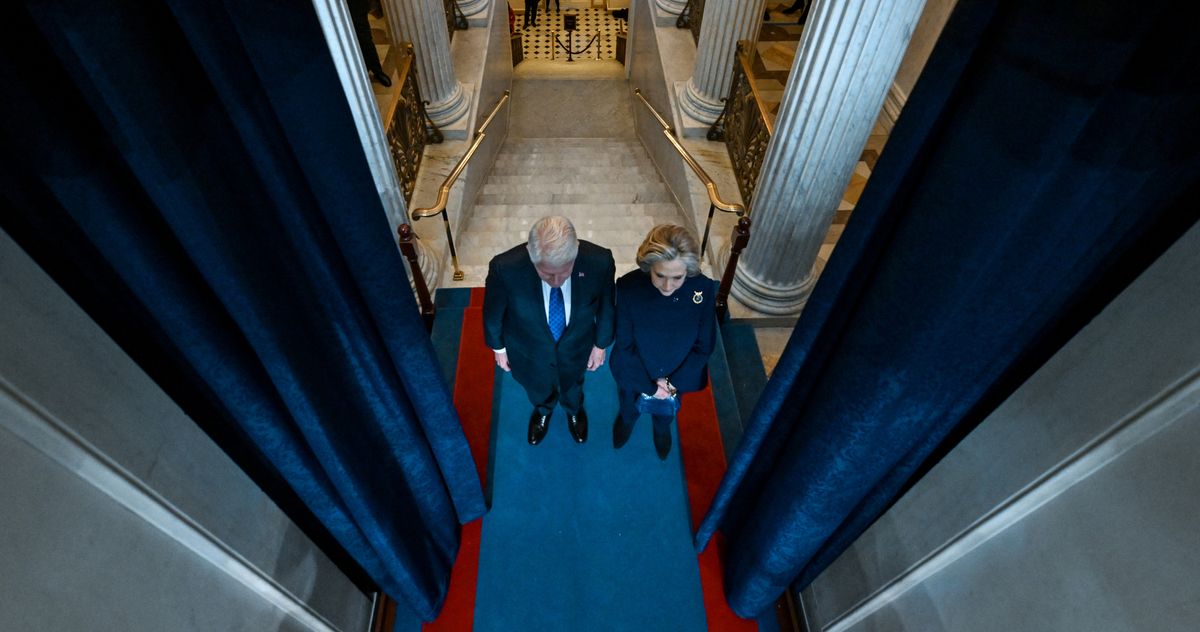
Photo: Kenny Holston/Getty Images
Republicans have thirsted for a criminal prosecution of a Clinton — Bill, Hillary, any Clinton will do — since the 1990s. Thirty years and several near-misses later, they may finally get their wish.
The Clintons almost certainly aren’t going to prison, or even getting convicted. But with characteristic hubris, Bill and Hillary have walked themselves to the brink of federal charges by defying bipartisan congressional subpoenas on the Jeffrey Epstein investigation. And it’s a good bet that our current Justice Department — which apparently makes critical decisions by a sophisticated litmus test that asks, “Do we like you, or not?” — will pursue criminal contempt charges.
The Clintons have, of course, had previous brushes with the law. We all remember the impeachment (and acquittal) of Bill Clinton over his false testimony about his relationship with Monica Lewinsky. But nearly lost to history is that Clinton barely avoided a federal indictment. On his final day in office in January 2001, Clinton agreed to a deal with prosecutors that spared him criminal charges for perjury and obstruction in exchange for a five-year suspension of his Arkansas law license, a $25,000 fine, and a public statement acknowledging that he had testified falsely. For my latest book, I asked Robert Ray, who replaced Ken Starr as Independent Prosecutor in late 1999, whether he would have indicted Clinton had he not agreed to the deal. Ray responded, “We were more than prepared to pull the trigger, if necessary.”
A decade and a half later, Hillary Clinton narrowly dodged an indictment for her use of a private email server while secretary of state. Shortly before the 2016 election, FBI Director James Comey unilaterally announced that Clinton had been “extremely careless” but that the Justice Department would not pursue criminal charges; he then announced the case’s re-opening, eleven days before the election. Clinton was spared an indictment, but Comey’s public comments probably cost her the presidency.
Yet for all the political drama and close prosecutorial calls, the Clintons could soon find themselves sitting at the defense table over a pair of comparatively mundane subpoenas.
In August 2025, the House Oversight Committee — led by Republican James Comer, a serial over-promiser who habitually teases shocking revelations about prominent Democrats but never delivers — subpoenaed both Clintons for in-person testimony over their connections to Epstein and Ghislaine Maxwell. Both subpoenas were approved unanimously by all Republicans and Democrats on the Committee.
Through their lawyers, the Clintons engaged in a monthslong pushback campaign. They argued to the Committee that the subpoenas were unrelated to any legitimate legislative purpose; were intended to harass and embarrass; and were overbroad and unduly burdensome. Indeed, it’s not clear Hillary would know anything of substance about the details of Epstein’s criminal enterprise. And while Bill Clinton would have a hellacious time explaining newly-revealed photographs of his nighttime frolic in a pool with Maxwell and an unidentified female, it’s difficult to articulate how testimony about his dealings with Epstein thirty years ago might somehow inform the drafting of anti-human-trafficking legislation now, as the Committee disingenuously claims.
But the Committee holds broad subpoena power, and Comer was unswayed by these legal arguments. Comer declined the Clintons’ offer to provide written statements in lieu of live testimony and, ultimately, the parties reached no resolution.
Listen to The Counsel podcast
Subscribe on:
Last week, the Clintons launched a self-important, last-ditch public relations campaign. In a letter signed personally by both Bill and Hillary (not their lawyers), the Clintons wrapped themselves in all manner of high-minded irrelevancy. They cited “[p]eople [who] have been seized from their homes by masked federal agents,” the mass pardons of January 6 rioters, Donald Trump’s targeting of universities and law firms, and the recent fatal shooting of Renee Good in Minneapolis. “Every person has to decide when they have seen or heard enough, and are ready to fight for this country, its principles, and its people, no matter the consequences,” the Clintons wrote with a self-important flourish. “For us, now is that time.” Yet the Clintons conspicuously failed to explain how their cited examples had anything to do with whether Bill Clinton should tell Congress what he knows about Jeffrey Epstein’s child sex trafficking network.
Now the Clintons have worked themselves into a jam. They made a curious tactical decision not to file a lawsuit in advance to “quash” (invalidate, essentially) the subpoenas; while they still might formally challenge the subpoenas in court, it’s likely too late. When the designated days arrived last week for the Clintons to testify, they both failed to appear. At that point, the Committee had all it needed to pursue contempt: presumptively valid subpoenas (and no court order invalidating them); two dates for testimony; and no-shows by both Bill and Hillary.
On Wednesday, the Oversight Committee voted to hold both Clintons in contempt of Congress. Notably, nine Democrats joined their Republican colleagues to vote for contempt for Bill Clinton, while three Democrats voted for contempt against Hillary. The matter will next move to the full House for a vote. If it passes — Republicans hold a slim majority, and several Democrats on the Committee voted for the subpoenas and contempt — then the matter will be formally referred to the Justice Department for potential prosecution.
That’ll leave the final call to DOJ leadership. Both attorney general Pam Bondi and deputy attorney general Todd Blanche have made clear that political retribution is their highest aspiration. Witness, for example, the spectacularly failed payback prosecutions of James Comey and Letitia James, and the recent full-bore investigations of seemingly every prominent Democrat in Minnesota — but not the ICE officer who fatally shot Good.
And consider that, during the Biden administration, lightning-rod Trump confidantes Peter Navarro and Steve Bannon were prosecuted, convicted, and imprisoned for four months each for contempt after they, too, defied Congressional subpoenas. Navarro and Bannon made less of an effort than the Clintons have to engage with the Committee, and were more defiant in general, but those are thin distinctions. At bottom, the Clintons did the same thing as the two Trump loyalists.
If the Justice Department does indict the Clintons for contempt, don’t count on the cases getting anywhere. The cases would have to be charged in Washington D.C., which is overwhelmingly pro-Democratic and anti-Trump. Trump received less than 7 percent of the vote in D.C. in all three of his presidential runs; Bill Clinton topped 84 percent in both of his campaigns, and Hillary topped 90 percent in hers. A grand jury might well refuse to indict, even under the low “probable cause” standard, and it’s almost impossible to conceive of a D.C. trial jury unanimously voting to convict Bill or Hillary.
But it’s not clear the Justice Department, or Comer, or Trump would care about the ultimate outcome. After more than three decades of futile yearning for a Clinton indictment, Republicans have never seen an opportunity quite like the one the Clintons have handed them now. The prospect of a Clinton criminal charge — even if unlikely to succeed — might just be too much to resist.
Sign Up for the Intelligencer Newsletter
Daily news about the politics, business, and technology shaping our world.
Vox Media, LLC Terms and Privacy Notice