Sign up for the Slatest to get the most insightful analysis, criticism, and advice out there, delivered to your inbox daily.
It’s remarkable how many times Donald Trump acts like Donald Trump, and people come away dazed and stupefied, as if they haven’t witnessed the spectacle over and over before.
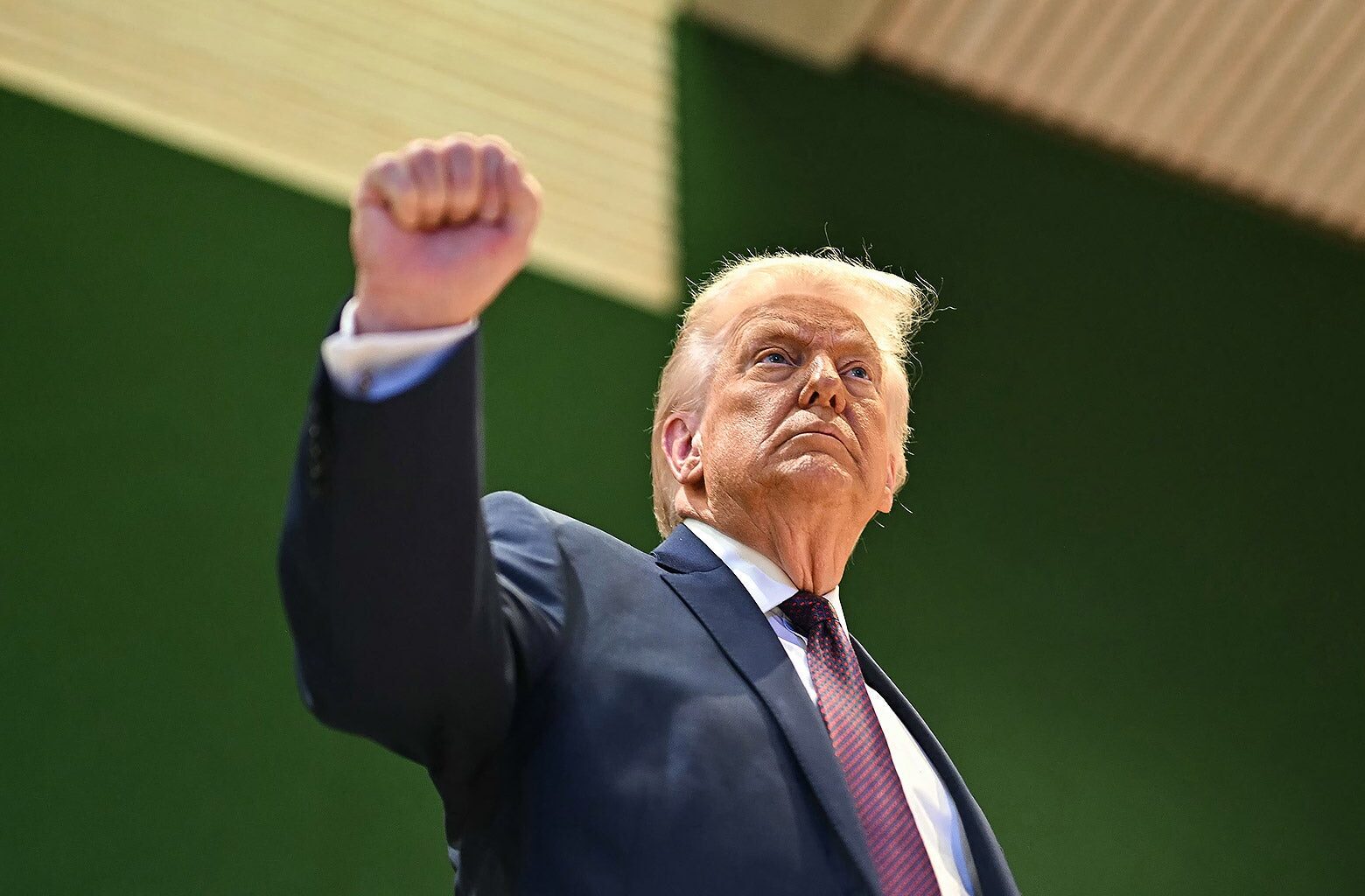
It happened again this week at the World Economic Forum in Davos, Switzerland. In his speech on Wednesday, our president doubled down on his odd obsession over Greenland, demanding U.S. ownership of the icy island, insisting that he needs it for national security, and telling European leaders, in the pose of a Mafia don, “You can say yes and we will be very appreciative, or you can say no and we will remember.”
Trump had threatened, a few days earlier, to impose 100 percent tariffs on European nations that opposed his takeover plans. It seemed, this time, he wasn’t going to back down from his own ruinous demands.
And then he backed down. Just a few hours after his speech, which was unusually hostile by even his standards, he emerged from a meeting with NATO Secretary General Mark Rutte, announced that they’d worked out the “framework of a future deal” on Greenland, so there’d be no need for an invasion or for any punitive tariffs. Asked about the details of this framework, Trump said, “We’ll have something in two weeks”—his usual timetable for putting off important decisions, or sometimes evading them altogether.
In other words, Trump the Godfather had once again transformed into the TACO Man—the derisive acronym for “Trump Always Chickens Out,” coined after the first couple of times he threatened tariffs, then backed off, early on in his second term as president.
But this time, the syndrome played out differently. The targets of the threat, in this case the leaders of European nations, were in the same room, watching in real time. They’d gathered earlier, to work out a unified stance, and they were energized by one of their own, Canadian Prime Minister Mark Carney, whose speech, the day before Trump’s, laid out a clear path for how medium-sized countries, working together, can outmaneuver the dictates of large powers that abuse the rules they created for their own benefit. (Carney is no starry-eyed idealist, having once been the head of the Bank of England and the Bank of Canada.)
In short, the Europeans did something that Trump, with some reason, thought they would never do—they held firm. They threatened to invoke the Anti-Coercion Instrument (nicknamed “the Bazooka”), which allows the European Union to counter economic pressure from third nations with tariffs and penalties of its own. The bazooka was designed as a deterrent—and it seems to have deterred. It was a major reason why Trump backed down. The financial markets’ response to Trump’s speech probably also played a role; the S&P 500 plunged 2.5 percent, some bankers worried about a run on the dollar and a sell-off of Treasury notes. (The stock market recovered its losses, and financiers’ panic abated, after the president chickened out.)
Many European leaders—and probably some of Trump’s aides too—heaved a huge sigh of relief. For all the wishful talk of “strategic autonomy,” at least by some EU members, they prefer mutually productive relations with the United States. The dollar still reigns supreme in global transactions, and a reliable U.S. military presence is crucial to Europe’s security, at least for the next decade.

Fred Kaplan
It Might Have Seemed as if Trump Couldn’t Get More Irrational. Greenland Proves He’s Just Getting Started.
Read More
Yet under Trump, relations with the U.S.—for not just the Europeans but all of America’s traditional allies—are neither productive nor reliable. And his backpedaling on Greenland, while welcome, doesn’t alter this clear reality. In fact, in some ways, it intensifies the pervasive aura of insecurity. Trump came to Davos so insistent in his belligerence, so determined to pursue U.S. interests as he saw them (however misguided he was about what those interests really were)—then, within hours, shifted 180 degrees with no explanation and only the vaguest outline of an alternative plan. How, from now on, can anyone take seriously any threat or promise Trump makes? He is still, by default, the leader of the free world and, by constitutional powers, the commander in chief of the world’s most lethal military establishment—yet how can anyone rely on anything he says?
We have been creeping, for some time now, toward this crisis (crisis is not too strong a word for what we’re facing), but the summit in Davos dramatized it. It did so in two ways. First, Trump’s speech was so hostile and his subsequent retreat was so airheaded. (No one could convincingly claim, as some have in the wake of previous reversals, that Trump was playing some wizard’s game of four-dimensional chess.) Second, and more important, the leading allies publicly talked about his behavior and found in Carney’s speech—which they greeted with (a rarity at Davos) a roused standing ovation—a way of moving out of the old order’s grip.
-
ICE Agents Detained Me for Eight Hours for Legally Observing Them. I Saw Exactly What They’re Up To.
-
ICE Will Come to Your City, Suburb, or Town. Here’s How to Prepare.
-
This Content is Available for Slate Plus members onlyHe’d Been Life-Expectancy Maxxing and Testosterone Optimizing. He Ended Up Burning Down a Synagogue. How Did He Get There?
It’s unclear whether they’ll be able to sustain this pivot toward a “third way.” The United States still has, as Trump likes to put it, lots of “cards” to play in tit-for-tat games of leverage. Still, the landscape is changing. China is exploiting the trans-Atlantic transition (or, as Carney described it, the “rupture”), moving into markets that had previously been closed; even before his Davos speech, Carney signed a high-profile trade deal with Beijing. The EU negotiated a similar deal with South American nations, similarly designed to bypass Washington’s control. Denmark announced that it would sell its stockpile of U.S. Treasury notes, valued at $100 million, at the end of the month. This isn’t as much as it may seem; the EU holds about $10 trillion in U.S. assets. Still, it’s an unusual gesture fraught with at least symbolic significance.
Trump has responded to the growing discontent with dismissive contempt. In his Davos speech, he bellowed that, without the United States, much of the world “wouldn’t be making anything”; that without his own efforts, “you wouldn’t have NATO,” which gives us “absolutely nothing” in return; and that if America hadn’t entered World War II, “you’d all be speaking German”—a bizarrely crude thing to say in Switzerland, where the most commonly spoken official language is German.
Yes, the U.S. holds a lot of cards. But Trump doesn’t realize that the game is changing and that, under the emerging set of new rules, his cards are slowly but steadily declining in value.
Sign up for Slate’s evening newsletter.