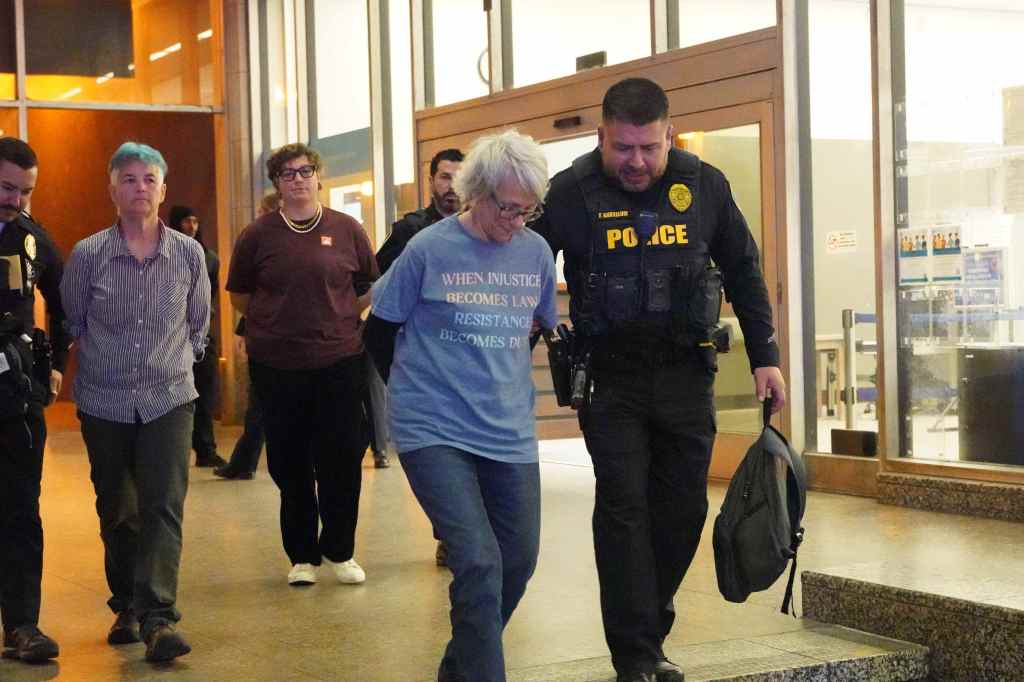
Six activists barricaded themselves in the City Hall offices of Mayor Todd Gloria on Friday, a stand-off that continued until they were arrested.
The protesters, who were in the waiting area outside of the office, were arrested on suspicion of misdemeanor trespassing, said San Diego police Capt. Ryan Hallahan.
According to local activist Tasha Williamson, the group had gone to the office to discuss with Gloria policies and concerns related to San Diego police interactions with Immigration and Customs Enforcement agents.
“These are six non-violent people who just want a meeting,” she said. “They are simply saying they want a redress of grievances.”
“This is civil disobedience,” she said.
A San Diego police spokesperson said the mayor was not in his office when the barricade started, and staffers left the area.
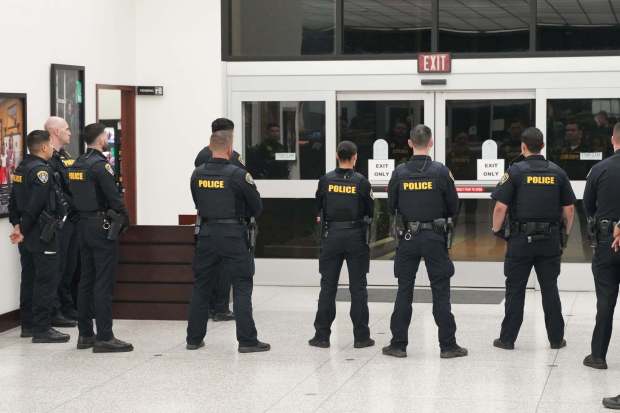 San Diego police officers stand inside City Hall on Friday after the arrest of six protestors who barricaded themselves in the waiting room of Mayor Todd Gloria’s office. (Michael Ho / For The San Diego Union-Tribune)
Gloria issued a statement Friday afternoon, saying that the group demanded to meet with him and staged a sit-in. “What transpired later went beyond peaceful protest.”
“These individuals chose to raid the front desk to my office, bang on the doors in ways that intended to force entry, and then barricaded the doors, creating a public safety hazard,” the mayor said.
“That conduct is unacceptable — full stop,” he said.
Williamson said she was with the group when they arrived about 9:30 a.m. in an attempt to meet with Gloria. She did not join the group when they barricaded themselves inside the office at roughly 2:30 p.m. Williamson posted videos of some of the incident to her Facebook page.
Her videos showed the group behind the glass, with an object wedged into the door handles to prevent it from being opened.
Hallahan, who said police were watching the incident on video, said the group “secured the doors with what they found in the janitorial closet, sticks, furniture, anything they could pick up.”
About 5 p.m., police entered the office from a back entrance and arrested the activists. When the six were brought in handcuffs to a waiting van outside City Hall, other protestors chanted. “Hey Todd listen to your people.” Some of those in handcuffs joined in the chant.
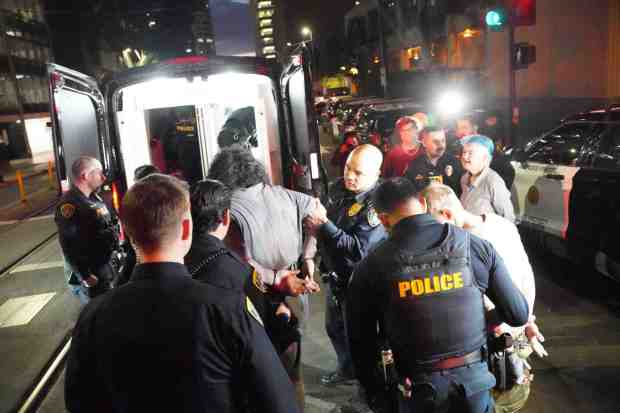 an Diego police officers place handcuffed protestors in a police van outside City Hall on Friday. Six people were arrested after barricading themselves in the waiting room of Mayor Todd Gloria’s office. (Michael Ho / For The San Diego Union-Tribune)
While the officers secured the detainees in the van, Arturo Gonzalez, 23, shouted into a megaphone promising that this would not be the last time protestors take such actions.
“We do not need to get arrested to have a conversation with our mayor,” Gonzalez said.
Police said they would also look into whether there was any vandalism inside the offices. Protestors who were not arrested denied that any vandalism took place. They said those who barricaded themselves inside banged on empty 5-gallon water jugs and placed sticky notes on the glass doors but did not cause any damage.
Gonzalez told the Union-Tribune that at least some of the people who were arrested are part of the San Diego Bike Brigade, a collective of cyclists and ebike riders who monitor the neighborhoods around local schools in the mornings for signs of immigration enforcement.
According to a list of demands posted at the front doors of the mayor’s office, the activists were demanding clarification of the city’s policies regarding police interaction with immigration authorities.
Local police are generally barred from cooperating with immigration enforcement under state law. However, police are sometimes called by community members or federal agents to respond to immigration enforcement scenes to ensure the safety of the public or agents, police say.
Several such instances have created controversy, with some community advocates saying the mere presence of city police alongside immigration agents erodes trust with migrant communities.
In their list of demands, the activists asked, among other things, that if police do continue to respond to such incidents, then the officers should “protect unharmed civilians from harm or unlawful use of force by armed agents.”
And if police are “unwilling or unable” to do that, then the ask is for the department to “refrain from responding to or positioning itself alongside federal immigration enforcement” and “cease providing cover.”
Gloria said his staff, including his deputy chief of staff, had met with the group last week. “My staff listened directly to their concerns about ICE activity and the role of local law enforcement, and those concerns were shared with me.”
“I have been unequivocal and public about where I stand on their issue. In my State of the City address last week, and through the executive order I signed in July, I made it clear that the San Diego Police Department does not participate in federal immigration enforcement. That policy is in writing, it is enforced, and it is exactly what these protestors are asking for.”
Gloria’s executive order, in response to the Trump administration’s aggressive immigration enforcement tactics, calls for measures that include know-your-rights outreach, interagency planning for response to “disruptive” enforcement actions and requests to the federal government for data on immigration operations in the city.
In October, the San Diego City Council unanimously approved an ordinance to ensure that city resources are not used to facilitate federal enforcement activities, including immigration enforcement operations.
Among the ordinance’s many provisions is a measure that would require the chief of police to issue a “publicly available incident report” within three business days of instances in which officers are called to respond to an incident involving immigration enforcement.