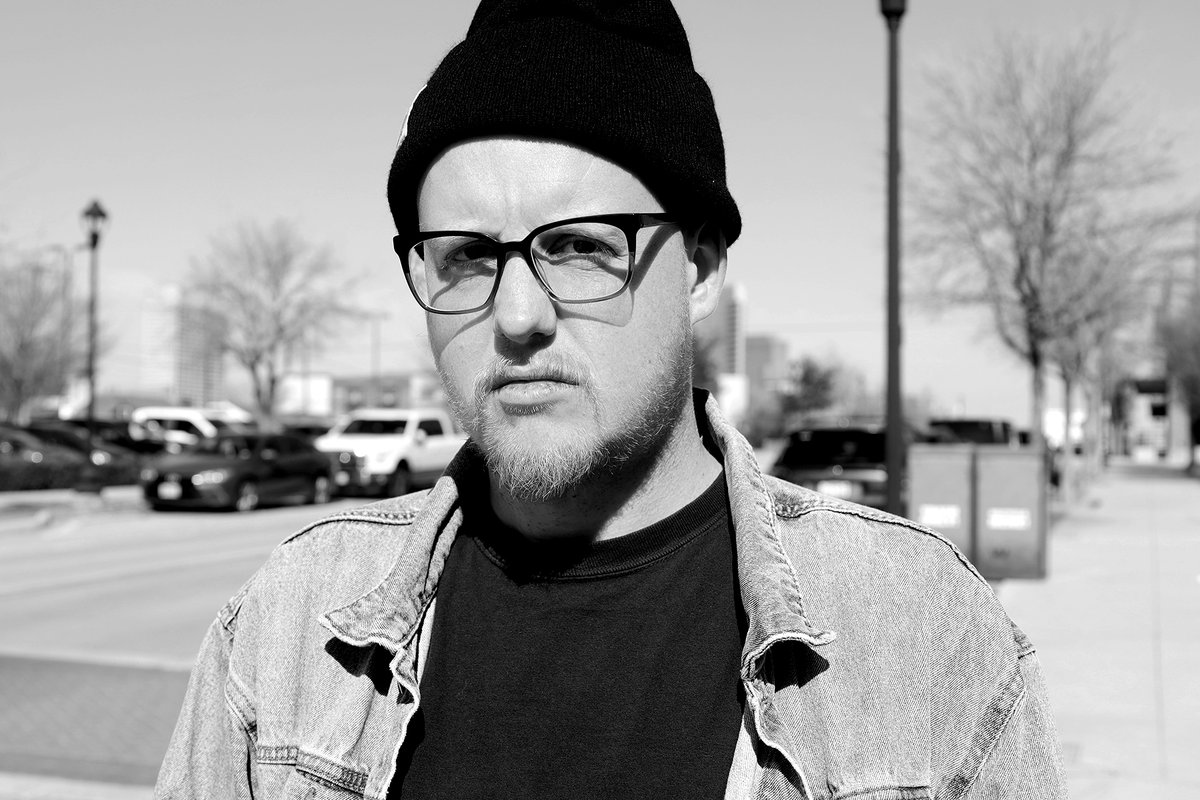
If you’ve been plugged into the Fort Worth music scene over the last decade, chances are you’ve heard the name Ryker Hall. His devil-may-care attitude and songwriting instincts are anything but cliché. Hall’s music — a self-described hybrid he calls “Texas Emo” — lands as an outlier in a city that proudly clings to Americana and Red Dirt musical styles. But fitting in has never been the goal. Hall is stubborn about originality, relentless about authenticity, and rarely filters himself when asked for his true opinion. That’s how I found him one morning at a South Main coffee shop, right on time, black coffee in hand, ready to explain exactly how he became who he is.
Hall didn’t come to music through ambition so much as obsession. He was ten years old when he first felt drawn to it, watching a worship band at a church he attended. He decided he wanted to be on that side of the stage. The guitar that started everything was a battered Sigma his stepdad had bought for fifty bucks while stationed in Korea. A deal followed — stick with lessons for a year, and a new electric guitar was his. Hall kept his end of the deal, practicing for hours a day, becoming more proficient during a brief stint in homeschool.
“[Music has] been the thing that’s been in my life for the longest, and I’ve stuck with it, and I’ve never let go,” he says.
By 13, Hall was already playing in bands around Keller, learning songs in garages and bedrooms, chasing volume and connection wherever he could find it. His childhood was defined by movement — East Texas, the Florida panhandle, North Texas, back to Florida — the result of growing up in a military family. Music became the one constant thread, something portable enough to survive every relocation.
After high school, Hall landed in Shreveport, where music took a backseat to radio — at least professionally. He worked on-air, wrote and produced commercials, engineered audio, and learned the mechanics behind sound. The experience gave him technical confidence and creative control, but little else. “Radio really, though — it’s a shitty industry,” he says without hesitation. When the money dried up, radio disappeared. Music didn’t.
By 2016, Hall was back in North Texas, stepping into Fort Worth’s music ecosystem one open mic at a time. His first show came at Lola’s, and from there he started meeting people, playing regularly, and developing a reputation not just as a songwriter, but as someone deeply invested in how scenes actually work. Open mics eventually lost their appeal. Songwriter nights didn’t.
To Hall, songwriter nights are meant to be workshops, not showcases. They’re places for unfinished ideas and bad verses, not recycled crowd-pleasers. “That’s what songwriter nights are for, man — mingling and meeting people and growing together, not just showing off,” he says. Growth, to Hall, happens in rooms where ego stays checked and songs are allowed to be incomplete.
Since 2018, Hall has released three EPs and four singles, with more projects already in motion. His approach to recording mirrors his approach to songwriting — intentional and disciplined. He never walks into a studio without a plan. “I never go into a studio blind,” he says. “It costs you a lot of money that way, and it’s just unprofessional.” If he’s there, it’s to work. “If you’re serious about it, you’re going to go in there and knock it out and make a badass product and not just fool around.”
Texas Emo, as Hall defines it, isn’t a branding exercise. It’s descriptive. “I’m heavily influenced by all the emo stuff in the mid 2000s with a little bit of twang,” he explains. “So I call it ‘Texas Emo.’” His listening habits stretch far beyond that — Conor Oberst, Max Bemis, Patrick Stump, John Moreland, Turnpike Troubadours, The Notorious B.I.G., Wu-Tang Clan — not as sounds to imitate, but as proof that having a clear point of view matters more than genre purity.
Live, Hall splits his identity. Solo shows are acoustic and intimate, emotionally direct. With a full band, everything sharpens — electric guitars, louder dynamics, occasional pedal steel when logistics allow. Lately, his focus has shifted outward. Oklahoma. West Texas. San Antonio. Austin. More road. More rooms. More chances to be heard outside Fort Worth.
Ask Hall what “making it” actually looks like, and he shrugs off the fantasy. For him, it’s not fame or excess. “Honestly, just having everything you need and not having to stress about
money — that’s making it,” he says. Stability matters more than spectacle. That mindset extends into his personal life as well. Over the last several years, Hall has stripped away distractions, stepped away from harder substances, and built routines rooted in discipline. “Patience is the hardest part,” he admits. “You can’t book a tour in a day. You can’t make a thirteen-track album in a day. You have to take your time to make something of substance.”
Rejection, he says, is unavoidable. The business is transactional, taste is subjective, and none of it is personal. “If you can’t deal with rejection, then you shouldn’t be a musician,” he says. “It’s like getting a hundred tequila shots thrown in your face all the time.” The only way forward is persistence — and self-advocacy. “If you’re not advocating for you, no one’s going to advocate for you.”
When pressed to define himself, Hall hesitates. He doesn’t love the exercise. Eventually, he lands somewhere simple. “I like to be good to people as much as I can, although I can be kind of an asshole sometimes,” he says, laughing. “But I just like to help my friends and see people win.” Music, for Hall, remains the outlet — a way to perform, to purge, to stay honest. Or, as he puts it more plainly, “You’ve got to look in the mirror and fix that person before you can do anything.”