Some of my fondest memories of growing up in Dallas center on downtown. I remember my father bringing me to a vibrant, bustling place with people everywhere — shopping at Titche’s or Neiman’s, coming in and out of office towers, getting something to eat at great diners.
The place had an energy of success and prosperity that we lost at some point in the late 20th century, then began to regain in the 2010s and now are at risk of losing again. I don’t want that to happen. Dallas is too great a city not to have a great downtown.
I’ve invested heavily in downtown property because, first, I know our downtown can be a huge financial success, but also because I believe it’s possible to restore and build on the sort of memories I have of this place and to make those same memories for kids growing up in Dallas today.
That’s why, in recent weeks, I’ve been having conversations with leaders throughout the city about a vision I propose for downtown. Do I want to be successful with my investments? Of course. Every investor does.
Opinion
But this is about something more. It’s about trying to get people to think about a vision for downtown that can get us moving forward again. This offers us a place to start to believe in our downtown again and to use that belief to make Dallas even greater than it is now. That’s why I’m sharing this vision with you here.
City Hall and a crossroads
All cities that strive for greatness encounter crossroads to determine their future and direction. Dallas is at one now. But we also have a once-in-a-generation opportunity to remake downtown, the largest property tax base for a primary residential city, into one that is welcoming, inspiring, exciting and livable. The potential to redevelop the 40 acres that is currently occupied by the Dallas City Hall (the opening of which I attended as a 17-year-old in 1978) is that opportunity.
Let’s imagine how a $2 billion Dallas Mavericks arena, entertainment and residential district could turn the City Hall site, which doesn’t produce property or sales tax, into a space generating millions of dollars for the city. We know the Mavericks have narrowed their search to two Dallas sites, including this one. The time to take this opportunity is now.
Converting this site into an arena would be great news for downtown and for the broader city. If you live in Lake Highlands, Oak Cliff or West Dallas, you know we need additional tax revenue flowing from downtown to support services in your community.
This reimagined space on the City Hall site would complement and spur additional development coming to downtown. That includes the $4 billion Convention Center, 3,000 new hotel rooms, an arena and necessary surrounding restaurants, shops and other amenities.
By my estimate, this would be upwards of $10 billion in new development in our core.
Connecting downtown
But just adding new development isn’t where we should stop thinking about downtown. Historically, Dallas has created disconnected islands in the central business district. Victory Park, the Arts District, West End, Farmers Market … where is the connective tissue?
Imagine if the American Airlines Center was where the House of Blues is. The West End would be alive, not dead, because people would walk into downtown, moving from one activity to another.
If the planning for this new area doesn’t take such things into account, then another island will again keep the core’s assets isolated from one another.
One thing that exacerbates this problem is downtown’s lack of any grand streets or boulevards. What if we took Griffin Street from Young Street up to the new Goldman Sachs near Victory Park and made it a truly great street with wide sidewalks, great tree cover, beautiful lighting and excellent pedestrian amenities. What if we did the same thing with Young Street from Union Station to the Farmers Market, both with trolley cars to connect all four major points?
This would enhance mobility between major islands, linking the Farmers Market to the Mavs arena and connecting to Uptown and Victory Park. It could also connect to the Bishop Arts District with the existing streetcar.
Then, we could create a true civic district with the Federal Courthouse, county buildings, and a reimagined City Hall. In the middle of this civic district will be the new Dallas College campus — an 800,000-square-foot state-of-the-art college training facility that will ready Dallasites for the modern workforce. (I’m an investor in property I hope will become that new Dallas College site, and I truly believe the college and its students will be anchors of an enlivened central city.)
Next, we should remove the East and West end DART Transfer Stations and replace them with restaurants and nightlife spots that downtown is missing right now. Because downtown is built on linear streets, there is currently no area large enough to provide adequate square footage for such an entertainment district. But with this plan, we could have an entertainment district around the new arena and restaurants and nightlife clusters on the East and West ends.
A big part of making this work would need to focus on a new pedestrian plan for downtown streets. Too many places are uncomfortable for walking. We need to tighten downtown streets like we did on Lower Greenville Avenue and make all streets two way, ending the one-way mess that contributed to a less walkable downtown. Yes, traffic will move more slowly, but we have to recognize that downtown’s days as an office center for suburban commuters are over.
As we focus on converting under-utilized office towers into housing, the city needs to come up with innovative tax strategies, and building owners need to focus on innovative redesigns to make these buildings unrecognizable from what they look like today.
Downtown should become a grand living community with parks, tree-lined streets and cafes. But we need to be realistic. Apart from bringing people in for Mavs games and other activities at the new arena, it’s unlikely we can make downtown a destination in itself.
Downtown has to become its own neighborhood with its own ecosystem. The catalyst to this exciting future begins, first, with the Mavericks agreeing to a new arena. But just as crucial is proper urban planning for an entertainment district that is open and accessible to the core of downtown.
Some pieces are already in place, with Dallas College planning its new campus and the new convention center moving forward. But we need to focus on the whole of downtown, not just the pieces.
A new City Hall and a renewed downtown
A new Dallas City Hall is the most important statement to the world that Dallas is forward thinking, committed to its core, and, unlike the existing building, welcoming to the public, an exciting workspace, and a gathering point for the southwest part of downtown.
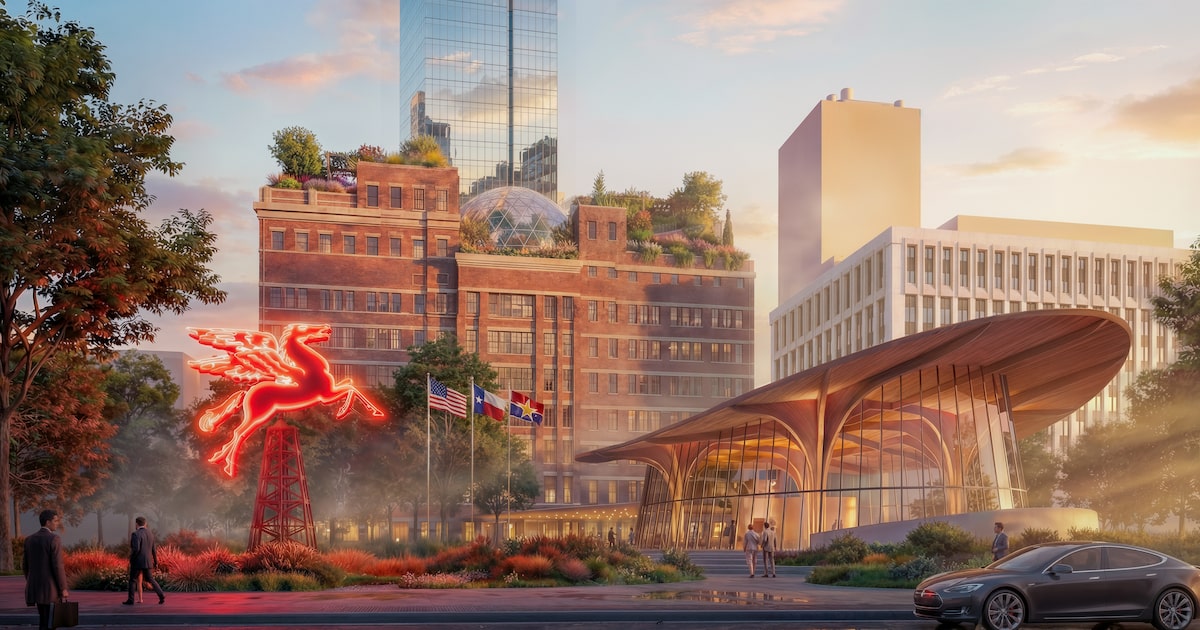
I’m hoping that my vision for a new City Hall will be selected. And since it’s the big question everyone is asking, here is what I have proposed.
It begins with a nod to our history with the 1915 Founders Square building, a classic red brick structure I own in the center of downtown. To that building, and at a reasonable cost, we could attach a beautiful jewel box City Council chamber.
We could add a park that can be the Klyde Warren Park of the south end of downtown.
This building would be very near a new Dallas College campus that would include student and workforce housing, restaurants. We could have a true 24-hour city of daily civic workers and guests, students, hotel guests (with some 5,000 new rooms), convention goers, game and event attendees at the new arena and even people who just come downtown because it is again a place to be.
The cattle drive statues in Pioneer Plaza just across the street would be an anchor space for conventions, marathons and victory celebrations with the two grand boulevards, Griffin and Young streets, radiating out. This would be Dallas’ true central intersection, something we’ve never really had.
We need a vision for our city. The time is here and now. This spring, if the decision is made for the future of City Hall to be decommissioned, a new location will be selected quickly, Dallas College could begin construction this fall, and the Mavs starts planning an arena
I believe in this vision because I believe in Dallas. We can make our city beautiful, prosperous and an envy of the world. We just need to see what it can be and make it happen.
Ray Washburne is vice chairman of Gillon Property Group and co-founder of the M Crowd Restaurant Group.
We welcome your thoughts in a letter to the editor. See the guidelines and submit your letter here.
If you have problems with the form, you can submit via email at letters@dallasnews.com