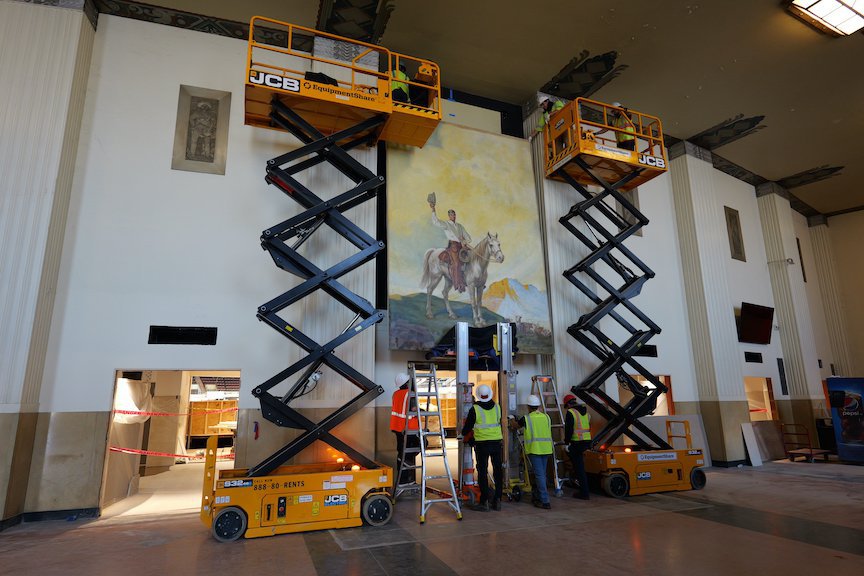
Greeting visitors to Will Rogers Coliseum for nearly 80 years came at a price for the iconic art piece of Will Rogers and Soapsuds, which has hung in the foyer since 1947.
Exposure to the elements over nine decades left visible wear on the renowned work by Seymour Stone. After all, it sits in an arena designed for horse events — though, yes, they’ve hosted everything from war bond rallies to hockey games, boxing, and Billy Graham — and built to honor the rugged individualism of the West embodied by Will Rogers. That can be dirty.
Then there were the Marlboros — tens of thousands of Marlboros from those days when one could smoke inside buildings and just about everybody did. It was like a San Francisco morning in there, the smog refusing to lift.
“I don’t think I have ever seen a painting so dusty,” says Cristiana Acerbi Ginatta, who got to know Will Rogers and Soapsuds unlike anyone since Stone last put down his brushes.
Ginatta is an art conservator working with Dallas-based Crozier Fine Arts who was charged with restoring the environmental portrait commissioned in 1940 by Amon Carter. The work was part of the renovation of Will Rogers Coliseum in advance of the Fort Worth Stock Show and Rodeo.
The painting is over 15 feet high and almost 12 feet wide, and its vibrant golden skies and beautiful colors again pop just like the day it was unveiled by Dwight Eisenhower, future president of the United States.
The restoration was largely underwritten by a grant from, appropriately enough, the Amon G. Carter Foundation. In addition to the painting, Amon Carter also commissioned the sculpture of Will and Soapsuds, which sits outside the Will Rogers Memorial Center on Lancaster Avenue.
The painting was taken down in August and reinstalled in December.
Matt Brockman, communications director for the Fort Worth Stock Show and Rodeo, says he began paying closer attention to the portrait about a decade ago and grew concerned about its condition, noting that time and humidity can take a toll even indoors. He raised the issue with then–president and general manager Brad Barnes and later consulted Scott Winterrowd, director of the Sid Richardson Museum.
“With this renovation project at the concourse, we had an opportunity,” says Brockman.
Because the work had never been varnished, Ginatta says every step had to proceed slowly to avoid damaging the exposed oil paint beneath the grime. The work was done at an art handler’s facility in Richland Hills.
“I was hoping to have more time” with the painting, says Ginatta, who has a master’s in painting conservation through the Palazzo Spinelli in Florence, Italy. She also served internships at the Art Institute of Chicago and the Buffalo Bill Center of the West. She also worked with Helen Houp, of Dallas, who worked as conservator at the Kimbell Art Museum.
Ginatta left Italy in the early 2000s and moved to Dallas. She has worked between Dallas and Fort Worth. In fact, when I got in touch with Ginatta this week, she was doing work at the Modern Art Museum.
She also is a member of the Texas Art Collectors organization and CASETA — Center for the Advancement of Early Texas Art — to master the history of her subjects. “I really enjoyed learning about Texas art, and that also gave me a better understanding of the culture and the community,” she says.
“In this case,” she says, “I did a little research on the artist, the connection with Mr. Carter, and the horse, Soapsuds, Will Rogers’ favorite horse.”
Did you know, for example, that after Rogers’ death in 1935, Soapsuds was purchased by Clark Gable? I didn’t either.
I’m not exactly sure why New York artist Seymour Stone — a Belarusian born in czarist Russia in 1877 — became Amon Carter’s favorite portraitist, but he did. In addition to Carter’s portrait that hangs in The Fort Worth Club, Stone also did portraits of Amon Carter Jr. and Ruth Carter Stevenson.
Carter also commissioned him to do portraits of Texas-born war leaders, including Eisenhower, Adm. Chester Nimitz, and Gen. Ira Eaker. Carter had those donated to the Texas Memorial Museum, as well as a bronze bust of John Nance Garner, the Texas-born former vice president under FDR, sculpted by Electra Waggoner. Waggoner was the sculptor of Riding Into the Sunset, depicting Will Rogers and Soapsuds, which, in addition to Fort Worth, also sits on the campus of Texas Tech University, outside the Hilton Anatole in Dallas, and beside Rogers’ tomb in Claremore, Oklahoma.
That really must have been quite a day — Nov. 4, 1947.
Among those who gathered from across the country to witness the unveiling of the statue and the painting were Houston financier and FDR cabinet member Jesse Jones and Margaret Truman, who sang “Home on the Range,” said to be Rogers’ favorite song. (Miss Truman didn’t have the best reputation for that kind of thing.)
Eisenhower did the official unveiling of both.
Said Eisenhower that day of Will Rogers: “He gave to millions who regard philosophy as something of interest only to the cloistered professor a better-balanced understanding of their place in modern society. His favorite tool was the witty barb — but though sharp, to puncture pomposity, it was never poisoned, to leave a lasting wound.”
Ginatta hopes that what she has contributed leaves a renewed, lasting impression of this great American philosopher for generations to come. “A lot of young people don’t know who Will Rogers was,” she says. “I hope that by going to the rodeo and seeing the portrait, they will search more about Will Rogers and what an incredible personality he was.”
Says Fort Worth Mayor Mattie Parker: “I’m incredibly proud of the beautiful renovation efforts [at Will Rogers] and especially grateful that this project included the full restoration of the iconic Will Rogers portrait. Preserving this artwork ensures that his legacy and spirit will continue to inspire visitors for decades to come.”