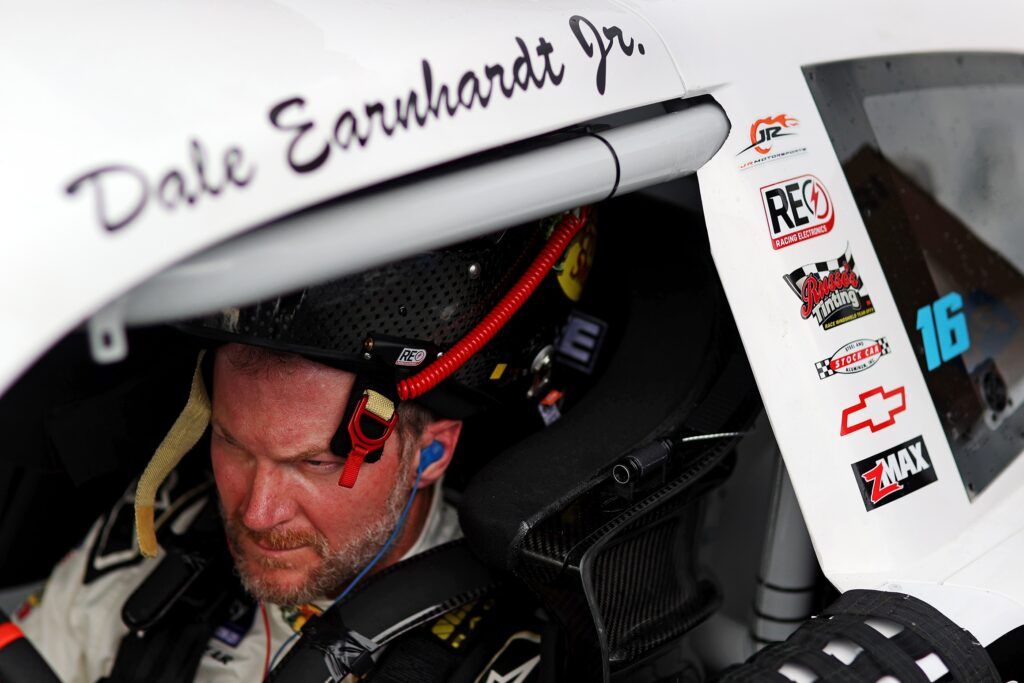
The weight of a legendary name can be both a blessing and a burden. For Dale Earnhardt Jr., carrying the torch of NASCAR’s most iconic family meant living with expectations that seemed impossible to meet. Now, years after his full-time racing career, the 50-year-old has revealed the one regret that still haunts him: not working hard enough when it mattered most.
In a brutally honest conversation on his “Dale Jr. Download” podcast, Earnhardt opened up about the missed opportunities that defined his early career.
Dale Earnhardt Jr. Opens Up About the Hard Truth He Can’t Shake Off
Earnhardt’s journey to NASCAR stardom began in the family business. After cutting his teeth racing late models and working as a mechanic in his father’s dealership, he entered NASCAR with nine Busch Series races for DEI (Dale Earnhardt Incorporated) between 1996 and 1997.
The transition to full-time racing in 1998 brought immediate success. Earnhardt captured back-to-back Busch Series titles in 1998 and 1999, edging out Matt Kenseth in a fierce championship battle. Everything seemed to align perfectly for the young driver carrying his father’s legacy.
However, tragedy struck in 2001 when Earnhardt lost his beloved father in a devastating crash. The loss of Dale Earnhardt Sr., NASCAR’s most dominant patriarch with seven Winston Cup Series titles, left a void that would shape the rest of Junior’s career.
Speaking candidly to Cup Series sensation Carson Hocevar, Earnhardt made a startling admission about his approach during those crucial early years. He said: “I look back on my career and definitely know that I should’ve worked harder, right? And I think everybody is going to do that. Everybody is going to look back and go, ‘Oh, I could’ve done more.’”
What Made the Hendrick Years Different From His Time at DEI?
The contrast between Earnhardt’s early career at DEI and his later years at Hendrick Motorsports couldn’t be more stark. At Hendrick, the work ethic was non-negotiable. The organization demanded excellence and pushed drivers to their limits.
“I definitely look back on my career mainly not in the Hendrick (Motorsports) years – you had to work, they made you work. They let me off the hook in the Bud years like the Eurys were mean, tough, awesome, badass,” Earnhardt explained during the podcast.
The “Bud years” referenced his time driving the iconic No. 8 Budweiser Chevrolet for DEI, where his uncle Tony Eury Sr. served as crew chief. Despite the family connection and the success they achieved together, Earnhardt now wishes things had been different.
Reflecting on those early days, he added, “They’re my family, I love them to death, but I honestly wish Tony (Eury) Sr. was even more harsh on me. Because, like on a Monday, Tuesday, Wednesday, he should’ve been on my ass to be over there, right?”
Without the demanding structure that would later define his Hendrick years, Earnhardt admits he drifted during the most crucial period of his development. The absence of a powerful mentor figure who could push him to greatness left him without the accountability he needed.
“I was like, I’m f**k off, I’m going to play video games, I’m going to do this, I’m going to do that and not train or not study. That wasn’t even a thing back then. We didn’t meet – competition meetings and s**t – but we should’ve been,” he confessed to Hocevar.
The two-time Daytona 500 winner’s career ultimately included 26 Cup Series victories and two Busch Series championships. While respectable by any measure, these numbers pale in comparison to his father’s seven Winston Cup titles and the expectations that came with the Earnhardt name.