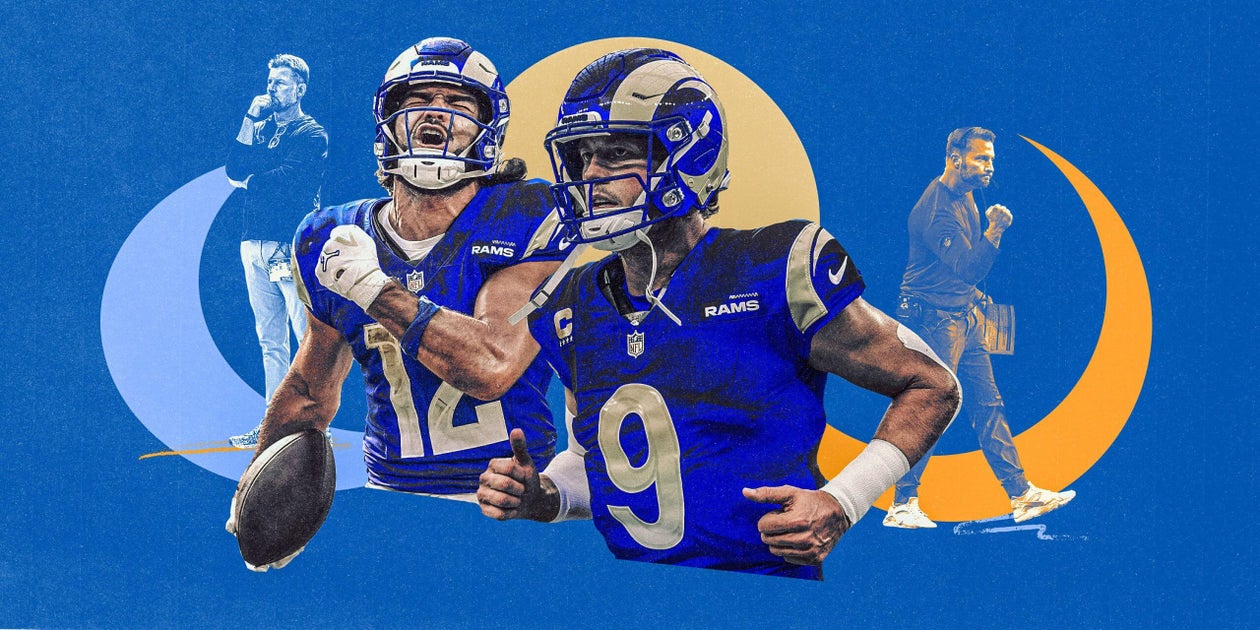
The Athletic has live coverage of Rams vs. Seahawks in the NFC Championship Game.
Depending on how the afternoon went, the Los Angeles Rams were either going to make a Super Bowl run, or they weren’t.
It was another hot, dry day in Woodland Hills, Calif., three weeks before the team’s 2025 season opener. Quarterback Matthew Stafford was going to try to throw in a practice for the first time since the spring.
Stafford, 37, had been sidelined for weeks with an aggravated disc, and neither he nor the team was sure if he’d be ready to start the season. He had tried everything: an epidural, hours of medical treatment and even sessions in a red-light therapy chair housed in a trailer the Rams parked at their facility. Time was running out. He was still in pain, but he had to see if he could throw. That late-August day, as Stafford and teammates took the field, general manager Les Snead quietly manned his typical spot on the sideline to watch.
Earlier in training camp, Snead had organized the scouting department’s annual summit. The week of programming for the scouts and senior staff features a review of the previous draft, cleanup of any process errors from that year of evaluation and a look ahead to the intensive coming months of college and pro scouting. There is always a guest speaker; this time it was Andrew Luck.
The former Indianapolis Colt, who in 2019 retired suddenly at 29, told the scouts what he believed it really takes to be an NFL quarterback.
You’ve got to be a little f———ed up. You have got to choose toughness. Snead wrote the words on one of the large whiteboards in his office.
As Stafford warmed up and then began to throw live, Luck’s comments flashed through Snead’s mind. “That practice, it was a laser beam show,” Snead told The Athletic, chuckling as he remembered the awe he felt watching Stafford. It was as if he was in a movie theater, and the villain had just arrived. “(Like) Freddy Krueger. … The ball was humming; I mean, he looked like he was 22.”
Snead brought Stafford into his office, and pointed to the board. “There’s no doubt that today you’re a little f———ed up,” he told the quarterback, “and you chose toughness.”
Stafford was back. And the three seasons the Rams had spent meticulously overhauling their roster and team-building philosophy since he last led them to a championship would not be in vain.
Now, the Rams are one win away from the Super Bowl. Stafford is the MVP favorite. And an organization that won Super Bowl LVI by trading draft picks for Stafford and other star players has gotten back to title contention using a completely different strategy.
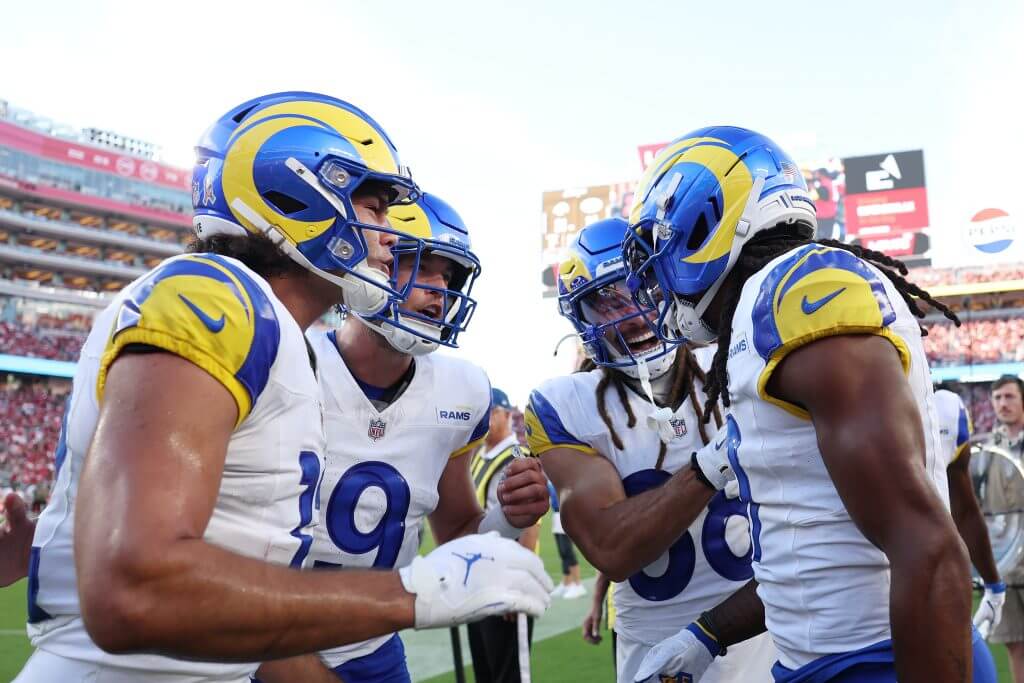
Matthew Stafford remains at the center of the Rams’ offense, but his supporting cast has changed. (Ezra Shaw / Getty Images)
From 2019 to 2021, a Rams leadership group that includes head coach Sean McVay, Snead, chief operating officer Tony Pastoors and president Kevin Demoff leaned fully into a picks-for-players team-building approach. McVay, hired at just 30 years old in 2017, had instantly transformed the mediocre (though defensively sound) Rams into an offensive powerhouse with quarterback Jared Goff and running back Todd Gurley. By the beginning of the 2019 season, McVay had already been to a Super Bowl and lost it.
The group believed it could leverage the earlier than expected success into a daring team-building strategy. If winning as much as they were meant drafting later in the first round — and Snead saw little difference between late first-round picks and early second-round picks — why not trade those picks for proven stars who could take an already competitive team a step further toward real contention? Other teams held tightly to their draft picks, and the Rams believed they’d be more likely to give up their best players than future capital.
The “F——— them picks” era began (the name is a fan creation; Snead often argues how important draft picks were to those Rams even if used in a different way). The Rams sent two first-round picks and a fourth-rounder to Jacksonville for elite cornerback Jalen Ramsey ahead of the 2019 trade deadline.
After the 2020 season, Goff and McVay’s relationship fractured as the quarterback struggled to navigate the pressure-coverage combinations permeating the league — ironically, as a reaction to McVay’s own prolific offense. The Rams made another shocking trade in late January, sending Goff and two more first-round picks plus a third-rounder to Detroit for Stafford. Ahead of the trade deadline that season, they sent the Broncos their 2022 second- and third-round picks for star pass rusher Von Miller.
Over those seasons, the wire the Rams walked got thinner. To supplement a lack of young blue-chip talent coming into the roster each year via the draft, they needed to nail their middle-round picks and trade back in the draft to acquire as many as possible. Snead and his scouts, and McVay and his assistants, honed their evaluation and coaching processes to try to maximize what they called a player’s “superpower.” A third-round pick didn’t need to be a star, or even a complete player. He just needed to do one or two things very well in complement of the stars, and he had to have the football IQ to keep up with them.
It worked. The Rams and their picks-for-players roster won Super Bowl LVI, and Snead stood on the parade stage a few weeks later yelling “F——— them picks” with the crowd while a hoarse and beaming McVay promised they’d “run it back” in 2022.
Instead, he — and with him, the team — imploded.
Injuries decimated a roster the Rams had mostly kept intact, including those suffered by Stafford and No. 1 receiver Cooper Kupp, the previous season’s Triple Crown winner and Super Bowl MVP. The Rams finished 5-12.
McVay, at an all-out sprint since his 2017 hire, wasn’t just burned out. He felt lost. He even considered stepping away from coaching — a break Snead, Demoff and Pastoors offered to him if it would help McVay the person.
“You’re in the middle of a storm. It’s real gray; things are cloudy,” McVay has told The Athletic of that time.
When he ultimately decided to return — surrounded by new mentors and determined to become more resilient — the leadership group met privately for several days to decide their next steps as a franchise.
They believed they had to pivot. Not only was their roster getting older, but it was also expensive. “Run it back” had broken the bank, and bad decisions made in the previous offseason — signing receiver Allen Robinson and linebacker Bobby Wagner — exacerbated the team’s roster and financial issues. The Rams also understood that Stafford, then 35, Kupp (30) and future Hall of Famer Aaron Donald (32) could still keep them in contention. Their time to maximize the three players was limited, though, because of their ages, and the Rams were also aware that Donald had been contemplating retirement.
Furthermore, many around the NFL had taken on the Rams’ strategy. In March of 2022, there were nine high-profile trades — four of which involved first-round picks, and four that also involved a quarterback. Even when the Rams were in the mix for trades ahead of the 2022 deadline (such as for running back Christian McCaffrey), they found the landscape they had created now too crowded to be competitive. They were outbid by rival San Francisco for McCaffrey — by an extra fourth-round pick that the Rams had previously traded away.
They realized the booming market they helped create had actually priced them out.
As 2023 began, Snead staked out Stafford, Kupp and Donald as the team’s “weight-bearing walls,” in his words, and the Rams began to offload the rest of the roster with especial focus on the defense. They took on a record $80 million in dead money, a decision so dramatic that Demoff had to release a letter to season ticket holders that explained the team’s process and expressed his genuine optimism that the team could compete — a “we aren’t tanking” manifesto, some in the organization now joke.
In April, still without a first-round pick, they drafted 14 rookies — including fifth-rounder Puka Nacua. The scouts went after players with three specific qualities: play speed (using GPS data from events such as the Senior Bowl or from players’ universities instead of a 40-yard dash time), how they projected their bodies would develop and football IQ/character.
By July, as the Rams prepared to open training camp, they had 44 players on their 90-man roster who were either new to the team or rookies. McVay had a half-dozen new assistant coaches, and they redesigned a run scheme that veered from predominantly wide- and middle-zone concepts, introducing significantly more physical gap and inside runs. He paired lead running back Kyren Williams, a specialist of those inside runs, with bigger guards — second-round draft pick Steve Avila and late-summer acquisition Kevin Dotson.
McVay, still building his own callouses from the previous year, wanted his team to feel resilient. He wanted toughness to be its identity. Nacua endeared himself to Stafford and other veteran teammates in part because he embodied this immediately. His record-setting breakout rookie season was punctuated with broken tackles and highlight-reel catches. The Rams, surprising everyone, went to the playoffs to take on Goff and the Detroit Lions in the wild-card round.
They lost. But McVay had rediscovered his love for coaching, buoyed by the joy and energy of the young roster.
“Man, did I learn a lot,” he said as the Rams’ improbable season ended. “And I really appreciate this group. They helped me find my way again.”
So Snead doubled down. Donald retired in March 2024. Snead told his scouting staff bluntly that it could not replace the all-time great interior defensive lineman, but it could rebuild the front by pairing multiple young players together who either already had chemistry, or the complementary physical and personality traits that could lead to it.
Armed with a first-round pick for the first time since 2016, the Rams drafted edge rusher Jared Verse at No. 19, then traded up in the second round to pair him with Florida State teammate Braden Fiske. Along with Kobie Turner and Byron Young, both 2023 third-round picks, the Rams’ defensive line quickly became one of the best pass-rushing units in the NFL (and it certainly was the cheapest).
That postseason, with many in the organization evacuated because of the devastating fires throughout Los Angeles, the Rams made it to the divisional round in Philadelphia. In the final seconds in the swirling snow, Stafford and the offense were just 13 yards away from a go-ahead touchdown and the NFC Championship Game.
But a sack and an incomplete pass later, they lost.
McVay stood in the visitors locker room after the game and looked at the faces of the players standing around him. He began to cry, the first time he ever had truly let tears spill in front of a team. It wasn’t about the loss itself, he later told The Athletic. It was seeing his players so hurt after their effort. The Rams had started 1-4 that season but stayed resilient even through the wildfires.
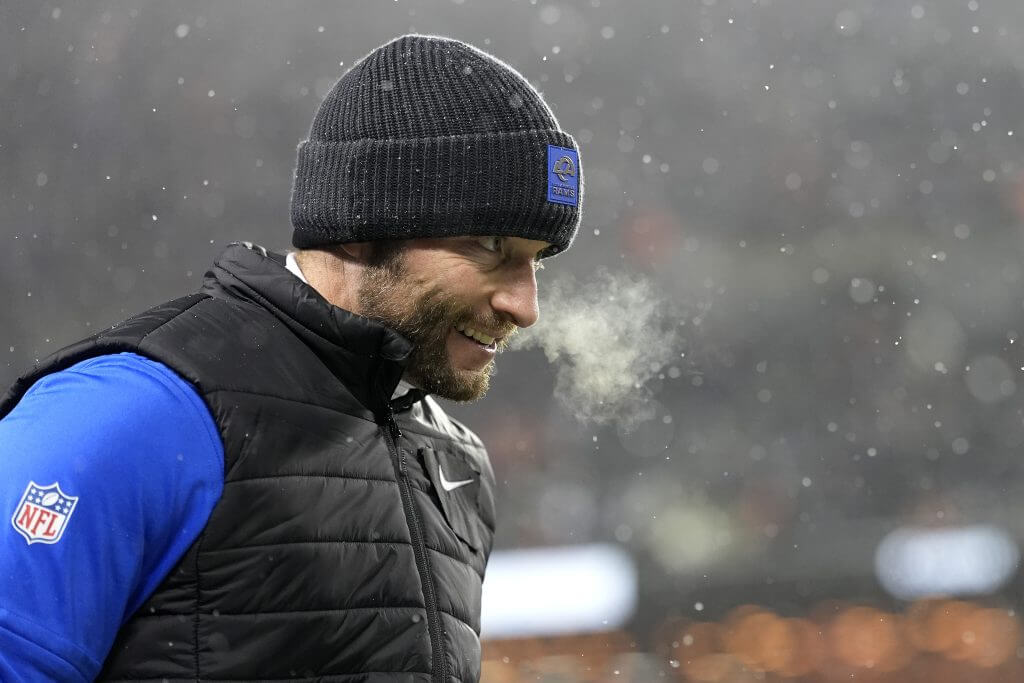
Sean McVay and the Rams earned a spot in the NFC Championship Game by beating the Bears in cold and snowy Chicago. (Patrick McDermott / Getty Images)
It was a sort of poetry that a year later the Rams were again on the road, this time in Chicago but again in the divisional round and in the snow. They had been altered a little for a third consecutive season; Kupp was released last March and signed with Seattle, whom L.A. faces for a third time this season in Sunday’s NFC Championship Game. Snead and McVay renewed the contract terms with Stafford in late February, staving off would-be suitors in the Giants, Raiders and Steelers, and tweaked the roster some by adding run-stopping defensive tackle Poona Ford and All-Pro receiver Davante Adams.
In Chicago, an ugly game swung toward the unbelievable with just seconds left in regulation when Bears quarterback Caleb Williams threw a touchdown pass on fourth-and-4 with a host of Rams players chasing him deep behind the line of scrimmage to tie the score and send the game into overtime.
McVay stood frozen for a few moments after Williams’ pass. Then, as NFL Films cameras later revealed, he gathered players to him. As he did a year prior, he looked at their faces. “We are winning this game,” he shouted hoarsely, his breath and that of the players who huddled around him streaming out in thick clouds.
They did. Safety Kam Curl intercepted Williams, and Stafford led a drive to set up a game-winning field goal. The Rams got one step closer to the Lombardi Trophy than they had the year before and will return to the NFC Championship Game for the first time since re-setting their organizational strategy.
Now, with few exceptions, they are a homegrown team. Three of their five offensive linemen and both running backs were drafted by the franchise (or were added as undrafted free agents). So were three of their four tight ends. All but one receiver; all but one defensive lineman. Two of three starting corners; two of three safeties. Every pass rusher. Their newly extended starting middle linebacker, Nate Landman, was initially a cheap free-agent signing, now an outlier on a defense full of drafted players. The team made 30 picks in three years. (And still, only one was in the first round. Snead is still Snead, after all.)
And of course there’s Stafford — whose acquisition was the signature move of the Rams’ last Super Bowl era. He is one win away from leading a totally different team to another championship.
It’s another version of the Rams. Another version of Snead and McVay and everyone who helped build and then rebuild it all. They chose to pivot the hard way — with sometimes painful decisions, educated by sometimes painful moments.
“We’ve been strengthened through our scars,” said McVay.
They chose toughness.